

India has raised strong concerns at the World Trade Organisation (WTO) over an interim arrangement being utilised to implement a proposed global e-commerce agreement. New Delhi has argued that a deal supported only by a group of countries cannot move forward without the entire membership’s approval.
In an official communication published on the WTO website on 9th July, India has raised several legal and procedural questions regarding the Agreement on Electronic Commerce (ECA).
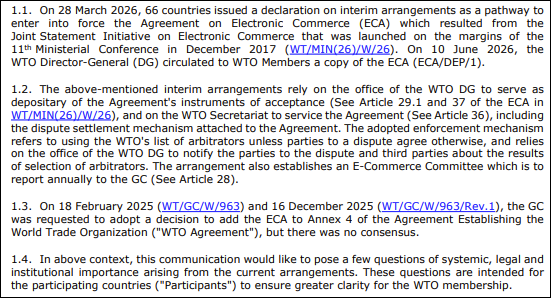
“Article X:9 of the WTO Agreement i.e. the Marrakesh Agreement requires consensus to add an Agreement to Annex 4. Consensus was not reached on two occasions. In the absence of consensus, we would like to understand the institutional basis on which the Interim Arrangements (IA) are operating,” the Indian government asked.
India questions legal basis for assigning the role of depository to the WTO Director-General for the e-commerce agreement
Furthermore, clarification has been sought on the legal basis within the Marrakesh Agreement under which the WTO Director-General has been assigned the depositary’s role for the Agreement on Electronic Commerce.
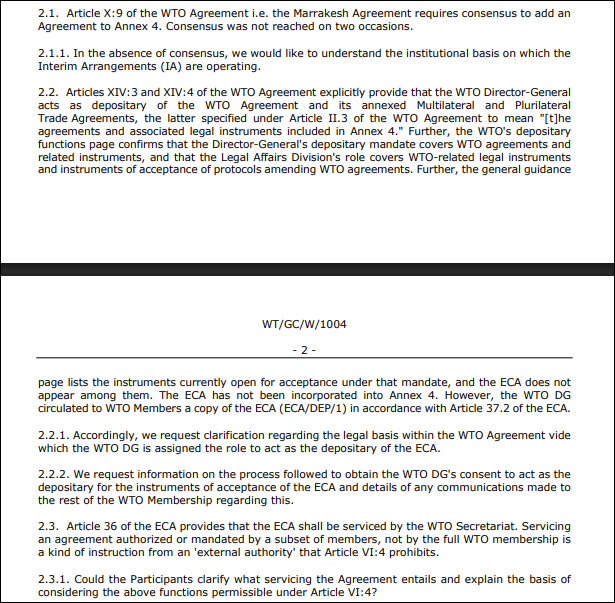
“Articles XIV:3 and XIV:4 of the WTO Agreement explicitly provide that the WTO Director-General acts as depositary of the WTO Agreement and its annexed Multilateral and Plurilateral Trade Agreements, the latter specified under Article II.3 of the WTO Agreement to mean “[t]he agreements and associated legal instruments included in Annex 4.” Further, the WTO’s depositary functions page confirms that the Director-General’s depositary mandate covers WTO agreements and related instruments, and that the Legal Affairs Division’s role covers WTO-related legal instruments and instruments of acceptance of protocols amending WTO agreements. Further, the general guidance page lists the instruments currently open for acceptance under that mandate, and the ECA does not appear among them. The ECA has not been incorporated into Annex 4. However, the WTO DG circulated to WTO Members a copy of the ECA (ECA/DEP/1) in accordance with Article 37.2 of the ECA,” India asked.
India seeks details on the process through which DG-WTO consent was obtained to act as the depository for the instruments of acceptance of the ECA
India has also sought information on the process via which the WTO Director-General’s consent was secured to act as the depositary for the instruments of acceptance of the agreement, in addition to the information on any communication made to the rest of the WTO membership regarding these arrangements.
“Accordingly, we request clarification regarding the legal basis within the WTO Agreement vide which the WTO DG is assigned the role to act as the depositary of the ECA. 2.2.2. We request information on the process followed to obtain the WTO DG’s consent to act as the depositary for the instruments of acceptance of the ECA and details of any communications made to the rest of the WTO Membership regarding this. 2.3. Article 36 of the ECA provides that the ECA shall be serviced by the WTO Secretariat. Servicing an agreement authorized or mandated by a subset of members, not by the full WTO membership is a kind of instruction from an ‘external authority’ that Article VI:4 prohibits. 2.3.1. Could the Participants clarify what servicing the Agreement entails and explain the basis of considering the above functions permissible under Article VI:4?” the document reads.
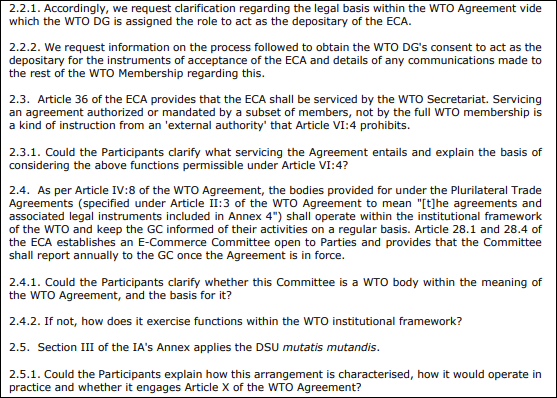
“As per Article IV:8 of the WTO Agreement, the bodies provided for under the Plurilateral Trade Agreements (specified under Article II:3 of the WTO Agreement to mean “[t]he agreements and associated legal instruments included in Annex 4”) shall operate within the institutional framework of the WTO and keep the GC informed of their activities on a regular basis. Article 28.1 and 28.4 of the ECA establishes an E-Commerce Committee open to Parties and provides that the Committee shall report annually to the GC once the Agreement is in force. 2.4.1. Could the Participants clarify whether this Committee is a WTO body within the meaning of the WTO Agreement, and the basis for it? 2.4.2. If not, how does it exercise functions within the WTO institutional framework? 2.5. Section III of the IA’s Annex applies the DSU mutatis mutandis. 2.5.1. Could the Participants explain how this arrangement is characterised, how it would operate in practice and whether it engages Article X of the WTO Agreement?” it adds.
In conclusion, the Indian government highlighted that given the significance of issues and their implications for the basic institutional mandate and the WTO framework, “we request that written responses to the questions be submitted and circulated as an official WTO document.”
India has also requested that its questions and responses thereto, “be placed on the agenda of the GC for substantive discussion at its next meeting.”
New Delhi emphasises a consensus-based system for negotiations on the WTO e-commerce agreement
India’s questions indicate the growing disagreements within the WTO regarding how the negotiations for new trade rules should proceed.
Several developed economies back smaller, issue-based agreements among willing members to expedite negotiations. India, however, has contended that such agreements should not undermine the WTO’s consensus-based system.
