

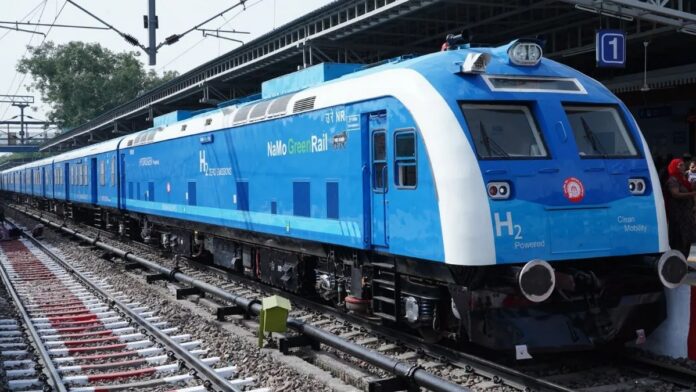
India’s first hydrogen fuel cell trainset is set to be flagged off tomorrow, marking a historic leap towards sustainable and emission-free rail travel on the Jind–Sonipat section in Haryana. Prime Minister Narendra Modi is scheduled to inaugurate the pioneering service on 17 July 2026 from Jind, ushering in a new chapter for Indian Railways.
The 10-coach trainset, developed entirely indigenously, will operate on the 89-kilometre route connecting Jind Junction, Gohana Junction and Sonipat, while serving intermediate stations and proposed halts such as Jind City, Pandu Pindara Junction, Lalit Khera Halt, Bhambhewa, Isapur Kheri Halt, Butane Halt, Khandrai Halt, Rabrah Halt, Lath Halt, Mohana, Barwasni Halt and Sonipat New. With an operational speed of 75 kmph and a design speed of 110 kmph, the train has already demonstrated its capability by achieving 120 kmph during final high-speed trials.
Hydrogen as fuel
Hydrogen Fuel Cell Train marks the return to onboard source of power, as steam and diesel locomotives carried coal and diesel. But instead of burning traditional fuels such as coal or diesel, hydrogen generates electricity inside the train using oxygen from the atmosphere, eliminating combustion and dependence on an external power supply.
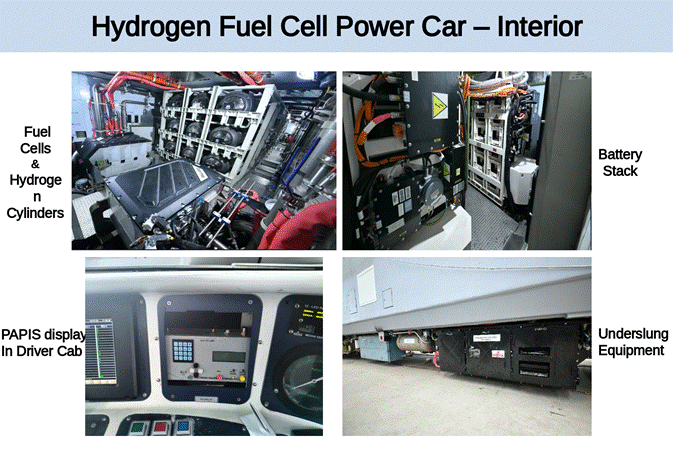
Unlike conventional electric trains that draw power from overhead wires or diesel locomotives that burn fuel, this hydrogen-powered trainset generates its own electricity onboard through Proton Exchange Membrane (PEM) fuel cells. Hydrogen stored in cylinders reacts with oxygen from the atmosphere inside the fuel cells, producing electricity that drives the traction motors. The only direct by-products are water vapour and heat, resulting in near-zero emissions at the point of use and no smoke or carbon emissions. In essence, the process converts hydrogen and oxygen into electricity and water vapour, allowing the train to move cleanly.
As electricity is generated onboard through clean hydrogen technology, the train represents the greenest form of rail propulsion, powering the future of sustainable mobility.
Hydrogen is a high-energy fuel, 120 MJ/Kg (megajoules per kilogram) in comparison to diesel, which is 43 MJ/Kg. It is low maintenance with a manageable carbon footprint. This makes hydrogen the cleanest propulsion technology currently available for rail transport
The trainset and support facilities
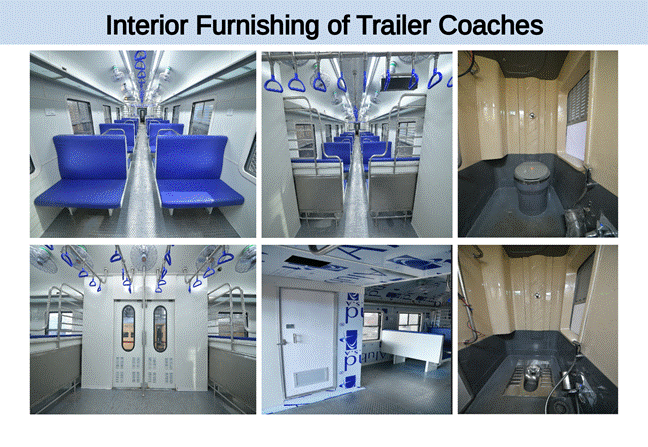
The train consists of two Hydrogen Driving Power Cars (DPCs), one at each end, and eight trailer coaches. Each DPC houses fuel cells, lithium iron phosphate batteries and hydrogen storage cylinders, and produces 1,200 kW (approximately 1,600 hp) of power. Together, the two power cars provide sufficient propulsion for the full trainset. With a passenger capacity of around 2,600, it stands out as a high-capacity configuration compared with most hydrogen trains currently operating globally, which typically comprise only two to four coaches and serve shorter regional routes.
Supporting this operation is India’s largest railway hydrogen refuelling facility, established at Jind in Haryana. Hydrogen is produced on site through electrolysis, splitting water into hydrogen and oxygen using electricity at a green hydrogen plant. The gas is then compressed to 500 bar for efficient storage and dispensed at 350 bar through two independent dispensers, enabling simultaneous refuelling of both power cars and minimising turnaround time. The facility can store nearly 3,000 kg of hydrogen at a time, adequate for regular operations, and its storage and supply system has received approval from the Petroleum and Explosives Safety Organisation (PESO).
Safety features
As hydrogen is highly inflammable and cannot be seen or smelled, great emphasis has been given on safety at every step of the operation. The entire safety design of this project is built around one goal, which is to detect even the smallest leak instantly and never let it turn into a danger.
Safety has been prioritised through a multi-layered “defence-in-depth” approach. Continuous detection systems monitor for hydrogen leaks, heat, flames and smoke on both the train and at the plant. Non-stop ventilation ensures any potential leak is quickly diluted, while automatic shut-off systems can isolate the hydrogen supply without human intervention. The loco pilot’s cabin features real-time system health displays and an emergency mode to move the train to safety.
The entire hydrogen ecosystem complies with international standards such as NFPA-2 and the ISO 19880 series, meets PESO statutory requirements, and underwent independent third-party safety assessment by TÜV SÜD of Germany. Before passenger service, the train completed rigorous testing including load-box trials, radio-frequency interference checks, oscillation trials and emergency braking distance evaluations.
The project embodies the spirit of Atmanirbhar Bharat. The Research Designs and Standards Organisation (RDSO) formulated the technical specifications and led design approval. Integration was carried out by Medha Servo Drives, while the Integral Coach Factory (ICF) contributed to the theme and exterior design. A complete hydrogen ecosystem, production, storage, compression and dispensing, has been created at Jind, complemented by maintenance preparedness at Shakurbasti in Delhi, trained personnel and 24×7 monitoring of the refuelling system.
Globally, hydrogen-powered passenger trains remain at a nascent stage, with commercial services pioneered by Germany and pilot projects underway in countries including France, Italy, China, Japan and the United States. India’s initiative is distinguished by its scale, indigenous development and the creation of a full supporting infrastructure. The Jind–Sonipat pilot will generate valuable operational data on safety, reliability and maintenance under regular conditions. Experience from this project is also expected to inform future applications, including the possible deployment of hydrogen technology on heritage routes such as the Kalka–Shimla line.
The launch aligns with the National Green Hydrogen Mission and Indian Railways’ broader journey towards net-zero carbon emissions. After achieving more than 99 per cent electrification of broad-gauge routes and sharply reducing diesel dependence, the introduction of hydrogen propulsion represents the next logical step in clean mobility. By validating technology, operating procedures and institutional capacity, the project lays the foundation for a structured national programme of hydrogen-powered rolling stock, reinforcing India’s position in sustainable rail transport.Pib
As the train prepares to enter service tomorrow, it symbolises not merely a technological milestone but a tangible commitment to greener, self-reliant and future-ready railways for the nation.
