

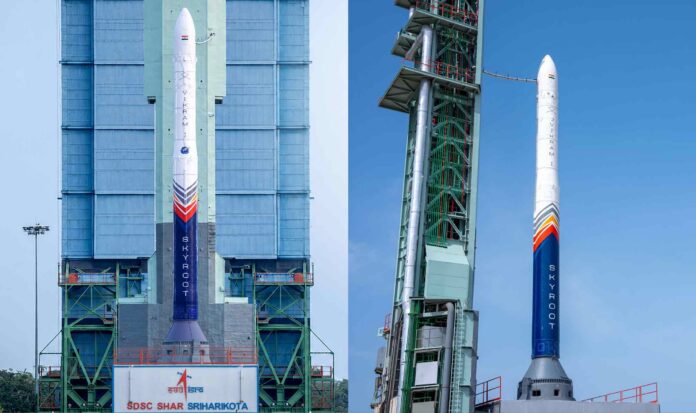
India is going to achieve a major milestone in space technology, as the country’s first private rocket launch has been scheduled for Saturday. Hyderabad-based Skyroot Aerospace has officially confirmed that its Vikram-1 rocket will lift off on July 18, 2026, at 11:30 am IST from the First Launch Pad at the Satish Dhawan Space Centre in Sriharikota.
The company announced the date and time on its official channels, marking a key milestone as preparations enter the final phase. This comes within the launch window of July 12 to August 4, and Skyroot has already received the necessary launch authorisation from IN-SPACe.
It’s official. 🚀
— Skyroot Aerospace (@SkyrootA) July 16, 2026
July 18. 11:30 AM IST.
Vikram-1. Test Flight-1. Mission Aagaman.
India’s first private orbital launch from the historic First Launch Pad at SDSC-SHAR, Sriharikota.
The countdown begins. 🇮🇳#Vikram1 #MissionAagaman #SkyrootAerospace #OpeningSpaceForAll pic.twitter.com/tGHCbQzsm8
The space vehicle has already been transported in parts from the company’s plant in Hyderabad to Sriharikota, where it was assembled and placed on the launch pad. This is the first time a privately designed, developed, and manufactured orbital rocket has been stacked on the launchpad in Sriharikota.
📸 Vikram-1 Stage 4 stacking completed. pic.twitter.com/1W9h6JqpI1
— Skyroot Aerospace (@SkyrootA) July 2, 2026
The mission, named Aagaman, is the first test flight of Vikram-1, India’s first privately developed orbital-class launch vehicle. The rocket stands approximately 20 to 24 metres tall and features a lightweight carbon-composite structure. It is designed to carry up to 350 kg of payload into low Earth orbit, with the target orbit for this flight being around 450 km at a 60-degree inclination. Vikram-1 uses three solid-fuelled lower stages and a liquid-fuelled upper stage known as the Orbit Adjustment Module, which is capable of restarting to enable precise deployment of multiple satellites into different orbits if required.
The primary objective of this test flight is to validate critical flight systems, including propulsion performance, stage separation, and guidance, navigation and control. While it carries customer payloads, the mission is focused on gathering extensive flight data to support future rapid and frequent launches. Success would make Skyroot the first private Indian company to achieve orbital launch capability.
Among the payloads on board are several technology demonstration and customer satellites, including Skyroot’s own SCOPE satellite, DCUBED’s technology demonstrator from Germany, Grahaa Space’s SOLARAS S3, and Cosmoserve Space’s Embrace robotic arm designed for orbital debris capture applications. Symbolic payloads include a lab-grown diamond lotus artwork called Cosmic Bloom, crafted in Bengaluru by Cosmos Diamonds, as well as a miniature 18-karat gold rocket model created by artist Ajay Kumar Mattewada to honour Indian space pioneers Vikram Sarabhai, C.V. Raman and A.P.J. Abdul Kalam.
Skyroot, founded in 2018 by former ISRO engineers Pawan Kumar Chandana and Naga Bharath Daka, had earlier demonstrated suborbital flight capability with its Vikram-S rocket in 2022. The upcoming launch represents the next major step towards establishing dedicated, on-demand launch services for small satellites from India. Public registrations have been opened by SDSC-SHAR for viewing the launch from the Sriharikota facility.
The confirmation has generated significant excitement across India’s growing private space sector, with many viewing it as a landmark moment that could pave the way for increased commercial activity and higher launch cadence in the coming years.
