

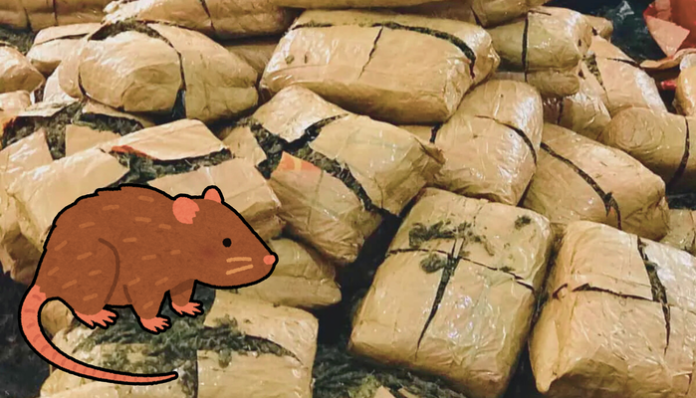
A Ranchi court recently acquitted an accused in a narcotics case, wherein the police had failed to produce 200 kg of seized ganja before the court, claiming that it was eaten by rats. On 19th December, Additional Judicial Commissioner-III-cum-Special Judge Anand Prakash acquitted the accused Indrajit Raj.
The judge held that the prosecution failed to prove the charges against the accused beyond a reasonable doubt. He raised suspicion over the seizure and handling of the narcotic substance.
The case dates back to 2022, when the Ormanjhi Police in Ranchi district stopped a vehicle on a tip-off that it was carrying narcotics. On January 17, 2022, the police intercepted a white Bolero on NH-20 based on information that it was transporting narcotics from Ranchi to Ramgarh.
The police said that when the vehicle was stopped, three people jumped out of it, trying to flee. One of them, Indrajeet Singh, was apprehended, and the remaining two, Vikas Chaurasia and Kundan Rai, escaped. The police claimed that they seized 200kg of ganja packed in about 170 packets, concealed in specially-created compartments. Kundan Rai was later arrested the same year during the trial of the case. Subsequently, an FIR was filed by the police under Sections 20(b)(ii)(c) and 22(c) of the Narcotic Drugs and Psychotropic Substances (NDPS).
However, during the trial of the case in 2024, when the police were asked to produce the seized ganja before the court, they said that the ganja, worth around ₹1 crore, was kept in the malkhana, where it was eaten by rats.
Referring to the claim of rats destroying the ganja, which was also mentioned in the station diary, the court remarked, “This casts a suspicion on the very seizure of the case and its handling by the police.” The court also found contradictions in the testimonies of seven prosecution witnesses, who were ball police personnel.
The court noted the contradictions regarding the key aspect such as the interception of the vehicle, the exact location of the drug seizure, who apprehended the accused, and the direction in which the other two accused had fled. “There are several contradictions in their statements… which casts a doubt whether the alleged accused was caught at the place as stated by the prosecution or from somewhere else,” the court stated in its order.
The court also took note of the fact that no independent public witness was examined, despite the interception and the seizure allegedly taking place on a busy national highway close to residential areas. In addition to that, the prosecution failed to satisfy the connection regarding the connection between the accused and the seized vehicle.
“No other paper of the vehicle has been brought before the court which could show that the vehicle was in any way associated with the accused,” the court pointed out. “The prosecution has failed to correlate the accused with the vehicle seized and to prove beyond doubt that the accused was apprehended in the manner and at the place as alleged,” the court added.
Moreover, during the cross-examination, the Investigating Officer (IO) had reportedly admitted that the seized vehicle did not have an engine or chassis number. This fact was neither recorded in the case diary nor reported to transport authorities. This, in the court’s opinion, weakened the prosecution’s case. The court also highlighted gaps in sampling, sealing and preservation of evidence with several witnesses.
As a result, the court said that the prosecution failed to prove its case beyond a reasonable doubt and ordered the acquittal of the accused.
