

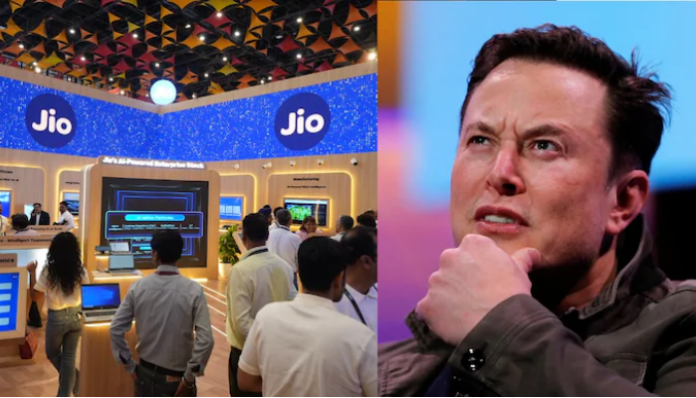
The biggest telecom company in India, Reliance Jio, is aiming for space after developing its fibre and mobile networks on the ground in a significant strategic move. On 8th October (Thursday), it revealed plans for a satellite communication network that might expand its offerings beyond traditional fibre cables and cell towers, which was introduced during the 10th India Mobile Congress (IMC) 2026 in New Delhi under the name “Sovereign Satellite Connectivity.”
Importantly, this could be another milestone for the centre’s ambitious “Make in India” program and a major step in the direction of technological sovereignty.
The event was inaugurated by Prime Minister Narendra Modi with the theme “Scale Without Boundaries.” Jio proposed a constellation of about 1,600 Low Earth Orbit (LEO) satellites and intends to set up 23 ground stations throughout India. The goal is to use satellites in addition to its current terrestrial network to cover such areas of the country where traditional telecom infrastructure is challenging to deploy.
The company stated that the hybrid satellite-to-ground system would be able to cover regions with more than 600,000 villages as well as 100% coverage across land and maritime areas. Jio anticipates that satellite access will be helpful in remote parts, on islands, and along borders.
Jio wants to integrate its satellite network with its current mobile and fibre infrastructure as opposed to treating it as an independent system. Businesses, rural areas, aviation, maritime activities, government, defence, and disaster relief will be able to employ this network. Jio’s vision also includes direct-to-device calling for rural areas.
Moreover, the tech giant’s objective is to maintain the whole value chain, including design, engineering, integration, testing, launch, deployment, and operations in India. The proposal was evaluated in July by India’s space regulatory agency, IN-SPACe after which it was determined to be technically feasible and similar to global satellite communication networks.
Additionally, Jio has requested authorisation from the government to submit applications to the International Telecommunication Union (ITU) and synchronise its orbits with those of other satellite service providers. A staged development timeline has been reported, with a test flight scheduled for September next year, the completion of 400-450 satellites by 2030, and the entire constellation by 2035.
Jio also conveyed that its drive for satellite connectivity “reflects” the event’s theme because it seeks to offer internet connectivity in areas where traditional telecom infrastructure cannot be implemented because of deployment or geographic limitations.
“We are trying to showcase the entire digital society vision that we have for Jio. I think what we are focusing on is our consumer value proposition. We really believe that we can innovate on the voice service and the data service using AI. We believe that would be very beneficial to all of the Indian consumers,” mentioned Akash Ambani, the Chairman of Reliance Jio Infocomm Limited and the Managing Director of Jio Platforms Limited.
“What we’re also showing is the progress that we’re making on satellite technologies and what we can prove to be an indigenous satellite stack based out of India,” he pointed out.
He also expressed that Jio is going to “contribute heavily” to PM Modi’s target of leading the world in 6G technology and having 10% of the patents from India. “In fact, in our pre-6G time, we’ve already filed for patents. We have almost at least from a standards perspective, and we will be able to get to a world-class level, which is only comparable to two or three other countries in the world,” Akash Ambani emphasised.
#WATCH | Delhi | At the 10th India Mobile Congress 2026, Akash Ambani, Chairman of Reliance Jio Infocomm Limited (RJIL), says, "We are trying to showcase the entire digital society vision that we have for Jio. I think what we are focusing on is our consumer value proposition. We really believe that we can innovate on the voice service on the data service using AI. We believe that would be very beneficial to all of the Indian consumers. What we’re also showing is the progress that we’re making on satellite technologies and what we can prove to be an indigenous satellite stack based out of India. Like the Prime Minister has said that we want to lead the world when it comes to 6G, and he set a target of 10 % of the 6G patents to be coming out of India; we’re going to contribute to that story heavily. In fact, in our pre-6G time, we’ve already filed for patents. We have almost — at least from a standards perspective—and we will be able to get to a world-class level, which is only comparable to two or three other countries in the world."
— ANI (@ANI) October 8, 2026
Notably, Jio’s new leap has taken place as American billionaire and SpaceX CEO Elon Musk complained about alleged “certain oligarchs” who are not allowing Starlink to enter the country’s market. “Starlink is licensed in over 165 countries and has spent five years complying with every single law and requirement of the government of India, so why still no license? Is Ambani the real boss of India,” he wrote in a further attempt to escalate the matter and pressurise the government.
He was also endorsed by predictable quarters, including Rahul Gandhi and the opposition ecosystem, who initially opposed Starlink but subsequently shifted their position in a blatant portrayal of not merely their hypocrisy, but how their animosity toward PM Modi has deteriorated into a precarious sentiment to undermine India.
