

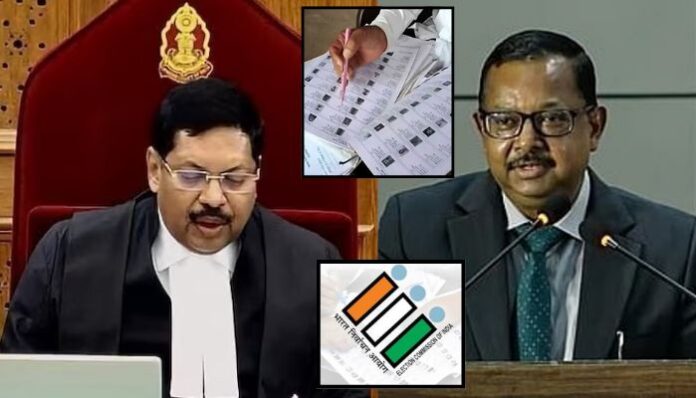
Former Chief Justice of India B R Gavai and two retired Delhi High Court judges have criticised Supreme Court Justice Ujjal Bhuyan for his recent remarks on the Special Intensive Revision (SIR) of electoral rolls. They said a sitting Supreme Court judge should be careful when commenting publicly on an issue that is already pending before the same court.
Justice Bhuyan spoke about the SIR issue during his valedictory address at the 19th Justice Bodh Raj Sawhney Memorial Moot Court Competition at NALSAR University of Law in Hyderabad on Sunday, 4th October. Without naming the SIR exercise directly, he said any process that results in millions of citizens losing their voting rights would be “intrinsically arbitrary” and a “negation” of the constitutional order.
The remarks came just a day before the Supreme Court heard petitions connected with the Election Commission and the SIR exercise. On Monday, 5th October, the court refused to pass an ex parte order seeking the suspension of Chief Election Commissioner Gyanesh Kumar and decided that the Election Commission and other respondents should first be heard.
Ex-CJI Gavai says judicial propriety does not permit such comments by Justice Ujjal Bhuyan
Former CJI B R Gavai, when asked about Justice Bhuyan’s remarks, said he did not want to comment on the merits of the SIR issue because it was pending before the Supreme Court. “Judicial propriety would not permit him to make any comment on the matter which is sub judice before the court,” Gavai said.
Gavai’s point was that a sitting judge of the apex court should not publicly express views on an issue that may come before the court for adjudication. His criticism was also echoed by retired Delhi High Court judges S N Dhingra and R S Sodhi.
Justice Dhingra was particularly critical of the remarks, saying they went beyond what was appropriate for a sitting judge. “He should have thought a thousand times before making such a statement,” Dhingra said.
He added that Justice Bhuyan did not have knowledge of the full facts of the issue and said such comments should not have been made at a public event while the matter was pending before the same court.
What Justice Ujjal Bhuyan said about SIR
Justice Bhuyan said the Constitution does not create two classes of citizens, one with voting rights and another without them. He argued that taking away the voting rights of a large number of citizens would strike at the heart of the constitutional system.
“If any process results in disenfranchising millions and millions of Indian citizens, making them second-class citizens in their own country in the sense of being citizens without voting rights, such a process is intrinsically arbitrary,” Bhuyan said.
He further said, “No amount of whataboutery can justify it. It strikes at the very heart of the Constitution, and I would go to the extent of saying that it is a negation of the constitutional order which we have adopted under the Constitution of India.”
Justice Bhuyan also said, “No authority can do it; no court can condone it. No one is above the Constitution.” His remarks were made in the context of the constitutional importance of voting rights and the ongoing debate over voter-roll revisions.
Another retired judge questions ‘disenfranchisement’ description
Justice R S Sodhi also questioned whether the SIR exercise could simply be described as disenfranchisement. He said the right to vote is governed by the statutory framework and that eligibility has to be determined according to the law. “Whether you have a vote or you don’t have a vote depends upon the statute. If you fall within the parameters of the statute, you have a vote. If you don’t fall within the parameters of the statute, you don’t have a vote,” Sodhi said.
He said that if a person’s name is wrongly included in an electoral roll or if the person does not meet the legal requirements, there are procedures under the law for deletion or for seeking inclusion again if the person is eligible.
Sodhi also questioned the description of people being removed from electoral rolls as becoming “second class” citizens. He said such an approach was too rigid for an issue that required a careful examination of the law and facts.
“I mean, this hardline thinking and these hardline statements, to my mind, are not a very mature way of looking at a thing, especially when you are supposed to be in a field which is supposed to be excellent in its rationalising,” he said.
SIR case remains before Supreme Court
The controversy comes as several petitions relating to the SIR exercise and the functioning of the Election Commission remain before the Supreme Court. The petitions include allegations concerning decisions taken by CEC Gyanesh Kumar and questions over the conduct of the electoral-roll revision.
On Monday, 5th October, the Supreme Court declined to immediately suspend Gyanesh Kumar without hearing the other side. Senior Advocate Vikas Singh had argued that an interim order was necessary and said, “The Court has to pass some interim orders, otherwise the country will burn.” The bench, however, chose to seek responses from the Election Commission and other respondents before considering the matter further.
The timing of Justice Bhuyan’s remarks has therefore drawn attention because they came immediately before the Supreme Court hearing. However, whether his comments have any bearing on the court’s eventual decision remains a matter for the judicial process.
Justice Bhuyan and the NALSAR controversy
Justice Bhuyan, who previously served as Chancellor of NALSAR, also spoke about the university’s students during the same event. NALSAR had recently been in the news after some students opposed a proposal to invite Chief Justice of India Surya Kant as the chief guest at the university’s convocation.
Speaking about the students, Bhuyan said, “You have shown to the country and the world what a university student, that too, a student of law, should be like. You are brilliant. You are bold, and you are brave.”
