

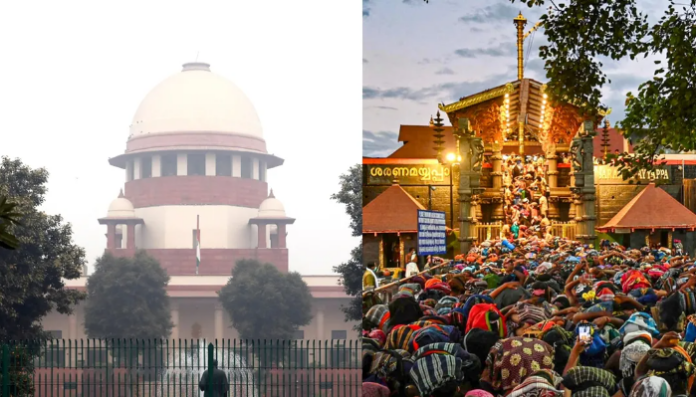
The centre has supported the ban on women of menstruating age entering the iconic Sabarimala temple in Kerala. On 7th April (Tuesday), it told the Supreme Court that the matter is outside the purview of judicial scrutiny and clearly falls within the ambit of religious faith and denominational autonomy. The Modi government was represented by Solicitor General Tushar Mehta before a nine-judge Constitution Bench headed by Chief Justice Surya Kant.
He stated that the legislature has the authority to rectify anything that is not scientific and asserted, “We have to respect every denomination’s practice, not everything is related to dignity or bodily freedom. If I go to a mazar or a gurudwara and if I have to cover my head, I can’t say my dignity, right or choice is taken away.” Justices B V Nagarathna, M M Sundresh, Ahsanuddin Amanullah, Aravind Kumar, Augustine George Masih, Prasanna B Varale, R Mahadevan and Joymalya Bagchi are part of the bench.
According to Mehta, if someone approaches the court under Article 32 of the Constitution and argues that human sacrifice is a fundamental aspect of faith, the latter does not have to consider whether it is religious or not. The prayer can be rejected because it directly violates public order, morality or health.
He mentioned, “It is submitted that the court should expressly decline a model of review that asks whether a practice is ‘rational,’ ‘modern,’ ‘scientifically defensible,’ ‘acceptable to judicial sensibilities,’ ‘unpopular views’ or based upon broad and subjective ‘doctrines’ of ‘transformative constitutionalism’ or ‘constitutional morality.’ Such an inquiry is not constitutional review; rather, it would be a substitution of judicial philosophy for religious self-understanding, depending upon the subjective view of the bench, which is not trained in interpreting religious texts.”
“The Constitution protects religious freedom precisely because the protected field contains convictions, rituals, disciplines, and forms of worship that may not satisfy secular standards of reason, utility or majoritarian taste,” Mehta further conveyed. He maintained that the Constitution does not establish “constitutional morality” explicitly.
“It is pertinent to note that ‘constitutional morality’ is not textually present in the Constitution. Rather, it is a judicially evolved, vague and indeterminate concept. Hence, the expansion of the term ‘morality’, which is explicitly referred to in the Constitution to mean and include ‘constitutional morality,’ amounts to not only judicial overreach but an amendment of the Constitution,” Mehta submitted. He pointed out that using the court’s authority to interpret any religion carries a critical risk.
“Apart from the fact that the court would not possess either expertise or scholarship on religious issues, holy books, scriptures, texts, et cetera, further in the context of India, which does not follow only one particular theistic religion but has a pluralistic society including Hindus, Muslims, Christians and other religions, each religion has its different sections or denominations, and each denomination and section has their own faith, belief and expression for worship. The founding fathers were fully conscious of this pluralism of the country and the internal pluralism amongst each religion,” he emphasised.
A five-judge Constitution Bench declared that the centuries-old Hindu religious practice was unlawful and unconstitutional, lifting the prohibition on women between the ages of 10 and 50 from attending the Sabarimala Ayyappa temple by a 4:1 majority ruling in September 2018.
On 14th November 2019, the matter of discrimination against women in various places of worship was referred to a larger bench by a five-judge bench led by then Chief Justice Ranjan Gogoi by a majority of 3:2. The Bench then presented general questions on religious freedom, stating that they could not be resolved in the absence of specific case data.
In addition to the Sabarimala case, the ruling raised concerns about Muslim women’s access to mosques and dargahs, as well as Parsi women married to non-Parsi men’s access to an Agiary’s sacred fireplace. On 16th February, the apex court pronounced that the final hearing in the case would take place from 7th to 22nd April.
