

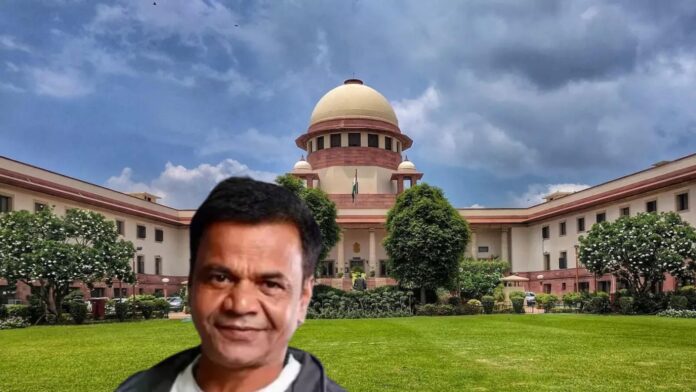
Actor Rajpal Yadav is turning to his ancestral property to settle a long-running financial dispute that began with a ₹5 crore loan linked to his 2012 film Ata Pata Laapata.
The Supreme Court on Wednesday took note of Yadav’s fresh proposal to arrange an immediate payment of ₹2 crore, after the actor’s earlier assurances to clear his dues repeatedly failed to materialise.
A Bench comprising Chief Justice of India Surya Kant and Justices Joymalya Bagchi and V Mohana recorded that Yadav had brought demand drafts worth ₹1.15 crore and that a prospective buyer of his ancestral property had agreed to arrange another ₹85 lakh.
The buyer, identified as Anant Prakash Yadav, was present in court and agreed to deposit the ₹85 lakh with the Supreme Court Registry by October 12.
The Bench said that once the payment was made, it would consider granting Yadav conditional relief and work out a schedule for payment of the remaining amount.
From a film loan to a courtroom battle
The dispute traces its origins to ₹5 crore received by Yadav and his wife from private entity Murli Projects in connection with the production of Ata Pata Laapata.
When the film could not be completed within the agreed timelines, the parties entered into multiple agreements in an attempt to restructure their arrangement.
Under the third agreement, Yadav handed over eight cheques as security. That agreement was subsequently replaced by a fourth arrangement, described as a consent agreement dated April 21, 2013.
Yadav’s case is that the new agreement required the eight security cheques to be returned and replaced with four fresh cheques of ₹10 crore each.
According to his plea, however, Murli Projects did not return the earlier cheques. Instead, seven of them were presented for payment and subsequently dishonoured.
The dishonour triggered criminal complaints against Yadav and his wife under Section 138 of the Negotiable Instruments Act.
Conviction, jail and repeated promises
The legal battle eventually resulted in Yadav being convicted by a sessions court in May 2024. He was sentenced to six months in prison.
The Delhi High Court later suspended the sentence after Yadav’s counsel assured the court that the dispute would be resolved. The matter was also referred for mediation.
But the proposed settlement repeatedly stalled.
The High Court noted that Yadav had made several commitments to deposit money but failed to follow through. Among the amounts he had undertaken to pay was ₹2.5 crore, for which he had sought permission to make payments in instalments.
In February 2026, the High Court directed the actor to surrender after finding that its earlier directions had not been complied with. Yadav’s request for more time was rejected, and he eventually surrendered on February 5.
He subsequently secured interim relief after depositing ₹1.5 crore with the complainant. However, further failure to meet his payment commitments eventually resulted in a three-month imprisonment order.
Yadav then moved the Supreme Court.
Actor challenges validity of cheques
Apart from seeking relief from the sentence, Yadav has challenged the very basis of the cheque-bounce complaints.
His plea argues that the 2013 consent agreement superseded the earlier arrangement and rendered the eight security cheques invalid. On that basis, he contends that proceedings founded on those cheques were not maintainable under Section 138 of the Negotiable Instruments Act.
The Supreme Court, however, has so far focused heavily on securing repayment to the complainant.
During the latest hearing, the Bench questioned how the outstanding liability would ultimately be cleared, given that the immediate proposal involved only ₹2 crore.
Yadav’s counsel responded that the ancestral property being offered for sale was worth more than ₹30 crore, indicating that the proposed buyer had sufficient financial capacity.
The complainant’s counsel also agreed to the proposal, saying that if ₹2 crore was paid immediately, Yadav could be given another three months to clear the balance.
Supreme Court warns of possible sentence enhancement
The hearing also saw the Bench express strong displeasure over Yadav’s conduct.
Justice Joymalya Bagchi questioned the actor’s repeated failure to honour earlier commitments and warned that the court could even consider enhancing his three-month sentence to two years.
The judge made it clear that the fresh accommodation being offered to Yadav should not be interpreted as an endorsement of either his conduct or the merits of his legal arguments.
“We are not satisfied with this. This conduct does not satisfy us,” Justice Bagchi remarked.
The Bench made the distinction explicit: any relief being considered was aimed at ensuring that the complainant ultimately recovered the money owed.
For Yadav, the proposed sale of his ancestral property could therefore become the key to avoiding further incarceration and finally bringing an approximately 16-year-old financial dispute closer to an end.
The Supreme Court will take up the matter again in two days, with the proposed ₹2 crore payment and a structured schedule to clear the remaining dues expected to be at the centre of the next hearing.
