

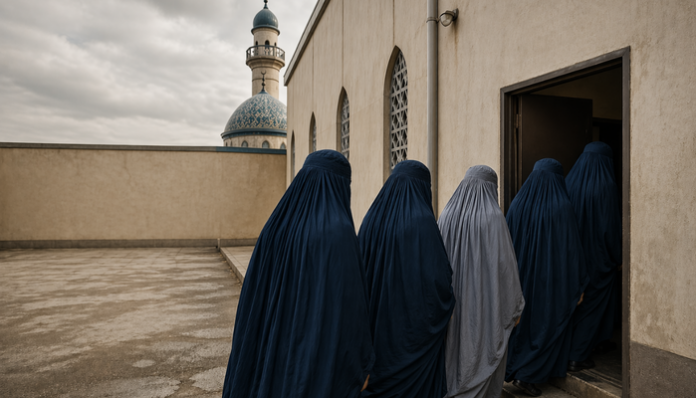
The All India Muslim Personal Law Board (AIMPLB) submitted before the Supreme Court on Thursday (23rd April) that women in Islam are permitted to enter a mosque but not through the front door. “There is no quarrel among the religious denominations in Muslims that women can enter into mosques. And that too for prayer… But there is a certain discipline that has to be followed,” Senior Advocate M R Shamshad, appearing for the AIMPLB, said responding to a question posed by Chief Justice of India Surya Kant during the Sabarimala reference hearing.
“As far as men’s position is concerned, it is obligatory for him to be part of the congregation. For that, you need a mosque. For women, it is preferable that she stays at home and she gets the same religious reward which the man gets in the mosque. But at the same time, if a woman wants to come, (according to the Hadith) ‘come to the mosque. Don’t stop her’,” Shamshad added.
“For factual clarity, are women allowed to enter the mosque?” the CJI had asked. Notably, CJI Surya Kant is presiding over a nine-judge bench hearing constitutional questions arising out of petitions seeking a review of the 2018 Supreme Court verdict on the entry of women in Sabarimala temple.
Justice Amanullah also asked Shamshad to let everyone know how women’s entry in the mosque has never been disputed in Islam. “You should elaborate for everybody’s consumption that right from the beginning, there is also no dispute(that women can enter) and that it started from the holy Prophet himself,” said, Justice Amanullah, who is part of the Bench comprising, CJI Surya Kant, Justices B V Nagarathna, M M Sundresh, Aravind Kumar, Augustine George Masih, Prasanna B Varale, R Mahadevan and Joymalya Bagchi.
He also asked Shamshad to cite reasons for not making it mandatory for Muslim women to offer prayer in mosques. “Give the reason also. The reason was if everybody goes from the house, who will look after the children… If she has the time, the capacity, she can also go, but then the crux comes. These are all managed by tradition right from the Prophet’s time itself,” Justice Amanullah added. Shamshad submitted that even though there is no bar on the entry of women in mosques, there is a consensus that it is not essential for women to be a part of the congregation performing namaz.
Petitions seeking Muslim women’s entry into mosques are also attached to the Sabarimala reference hearing. Responding to a plea filed by a Pune-based couple, Yasmeen Zuber Ahmad Peerzade and her husband Zuber, seeking permission for Muslim women to enter mosques and offer prayers, Shamshad said that Muslim women have no right to access to Musallah (main sanctuary). He added that pleas seeking a direction “to permit Islamic women to enter through the main door, have an Islamic right to visual and auditory access to Musallah (main sanctuary)” and “to pray in the Musallah without being separated by barrier” deserve to be rejected.
Shamshad said that the petitioners are trying to infer that there is a place within a mosque equivalent to the sanctum sanctorum of a temple, which, according to him, is invalid. “Sanctum sanctorum has no place in a mosque. If the religion believes that there is no sanctum sanctorum inside the mosque, then nobody can insist that ‘I have to stand at a particular place’ or ‘I have to be first to lead the namaz’,” Shamshad added.
The submissions were made on the eighth day of the Sabarimala reference hearing, which commenced on 16th April.
