

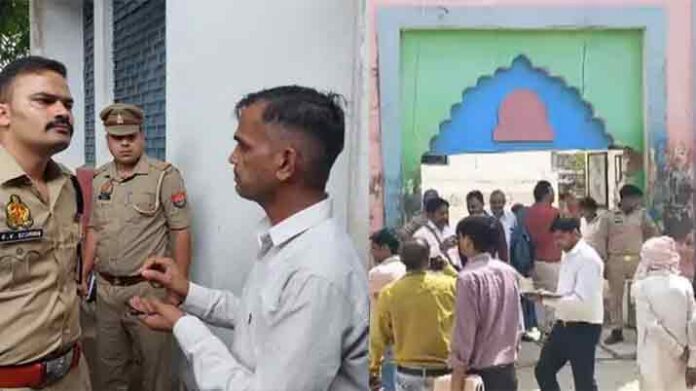
In Sambhal district in Uttar Pradesh, police have registered a case against five persons belonging to the Turk community after a family from the Dhunna community alleged that they were prevented from offering namaz at a local mosque. The Dhunna community is a lower-caste Muslim group officially recognised as an Other Backwards Class (OBC) in Uttar Pradesh, while the Turk community is recognised as a general category.
The complainant, Mohammad Wasim, a resident of Mandli Samaspur village under the Aichoda Kamboh police station limits, approached Sambhal Superintendent of Police Krishan Kumar Bishnoi on Friday and submitted a written complaint stating that his fundamental rights were being violated.
According to Wasim, members of the Turk community, including the mosque’s mutawalli Atiq Ahmed along with Shane Alam, Aamir, Bholu and Hafiz Maruf, stopped him and his family from offering Friday prayers at the 120-year-old mosque in the village. He further alleged that the harassment had intensified since 3 July 2026, with the family facing social boycott, death threats and pressure to leave the village.
Wasim claimed that the accused had introduced a new practice of offering six daily prayers instead of the traditional five that had been followed for over a century, and that anyone objecting to this change was barred from entering the mosque. Issues related to the azaan, contributions for the imam’s meals and collection of donations were also cited as points of contention.
#WATCH | Sambhal, UP: On a man alleging that people from the Turk community are preventing them from offering prayers at a mosque, SP Sambhal KK Bishnoi says, "A man named Mohammad Wasim belongs to the Dhunna community. He came to the district headquarters today and submitted an… pic.twitter.com/2cJB6oD54e
— ANI UP/Uttarakhand (@ANINewsUP) July 25, 2026
The dispute is not entirely new. A compromise had been reached between the two sides on 26 January 2024 in the presence of the then police station in-charge, under which both communities had agreed on certain arrangements regarding the azaan, donations and the imam’s food. That arrangement reportedly continued for nearly a year and a half before breaking down. Wasim, who belongs to the Deobandi school of thought, accused the other side of violating the earlier understanding and imposing Barelvi practices.
Police registered a first information report against the five named individuals on the directions of the Superintendent of Police. Speaking to the media, SP Krishan Kumar Bishnoi confirmed that Wasim had come to the district headquarters and complained that he was not allowed to offer Friday namaz. The officer described the matter as serious, noting that it involved violation of fundamental rights. He said the local station house officer had been instructed to register the case under appropriate sections and ensure that the complainant’s rights were protected. Further action, he added, would be decided after a proper investigation.
The incident has drawn additional attention because it came days after Chief Minister Yogi Adityanath’s public remark in Sambhal on 18 July. During a meeting in the district the Chief Minister had declared that “Turk ki turkai” would not be allowed to prevail in Sambhal and that the order of the Harihar temple would be followed.
The two communities at the centre of the dispute occupy distinct social positions within the local Muslim population. The Dhunna community, also known as Dhuna or Dhunia, is a Pasmanda or backward Muslim group traditionally associated with the occupation of cleaning and processing cotton. In several states they are listed among the Other Backward Classes, and in local parlance they are often described as Dalits.
Their numbers in Mandli Samaspur are small, only five or six families. The Turk community, on the other hand, traces its historical roots to Turkic migrants from Central Asia and is linked to the broader Mughal lineage. In the village they form the dominant majority, estimated at around 80 per cent of the population, and follow the Barelvi tradition. The present confrontation reflects long-standing differences as well as questions of social hierarchy and control over mosque management.
District officials have said that the situation is being monitored closely to prevent any further escalation and to restore the right of every individual to offer namaz without obstruction.
