

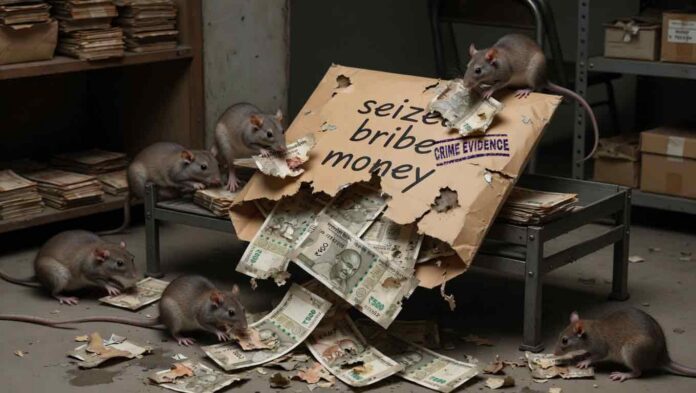
The Supreme Court on Friday, 24th April, granted bail to a Bihar government officer convicted under the Prevention of Corruption Act, but not without raising serious concerns over an unusual claim in the case, that the seized bribe money was eaten by rats. The court also stayed the conviction of the officer in the case.
A bench of Justices J. B. Pardiwala and K. V. Viswanathan expressed surprise at the explanation given regarding the missing cash.
“We are taken by surprise that the currency notes got destroyed by rodents. We wonder how many such currency notes recovered in this type of offences get destroyed as they are not kept at a safe place. It’s a huge revenue loss for the State. Besides, the explanation offered for the destruction of the currency notes also does not inspire any confidence,” the bench observed.
The court also said that the explanation given for the destruction of the notes does not inspire confidence.
A bribery case from Bihar stunned the Supreme Court after the defence claimed rats had destroyed the seized bribe money. The bench said, “We were surprised the recovered notes were destroyed by rats.”
— LawChakra (@LawChakra) April 25, 2026
Read More At: https://t.co/gsjvUnBdmM#supremecourtofindia #bribery #legalnews… pic.twitter.com/IryoZKKobU
The Supreme Court has now stayed the sentence for the time being and granted her bail. It said that the conditions for her release will be decided by the trial court.
The Supreme Court has expressed surprise that seized currency notes in a bribery case were eaten by rodents while in storage, asking how many such notes recovered in such cases are destroyed. #SupremeCourt #Rodents #Cash #Bribery https://t.co/INJnw6e1U8
— The Federal (@TheFederal_News) April 25, 2026
During the hearing, the apex court also took note of the Patna High Court’s observation that the envelope containing the seized bribe money had been destroyed by rats, even though the entry of the seized amount was recorded in the official records.
The High Court had earlier said that the destruction of the cash alone does not weaken the prosecution’s case if other evidence is strong enough to prove guilt. However, the Supreme Court indicated that this aspect will be examined in detail during the final hearing.
Case background and conviction
The case involves Aruna Kumari, an officer who was working as a Child Development Programme Officer at the time. She was accused of demanding a bribe of ₹10,000.
A trial court had earlier acquitted her, but the Patna High Court later overturned that decision and convicted her. The High Court sentenced her to rigorous imprisonment of four years and three years under different provisions of the Prevention of Corruption Act.
