

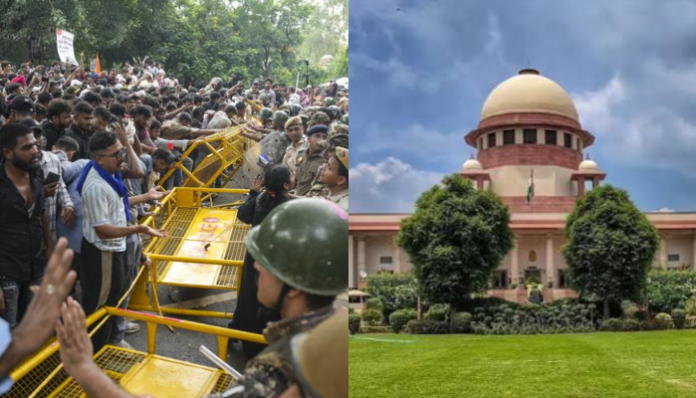
On 28th July (Tuesday), the Supreme Court ruled that demonstrators engaged in the protests organised by the Cockroach Janta Party (CJP) in Delhi’s Jantar Mantar and several other states cannot be subjected to coercive measures. It also ordered the prompt release of minors who were apprehended in different states. However, it declared that individuals with criminal records would not be covered by this protection.
The decision was pronounced by a bench consisting of Chief Justice of India (CJI) Surya Kant, Justices Joymalya Bagchi and V Mohana. A number of temporary orders, including for the release of the students who were held or arrested but had no criminal history.
“If we start looking at individual facts the most conservative language we can use is that there is, prima facie, a case of violence involved. That is why we are hearing these matters,” CJI Kant voiced. The apex court also referenced claims that AK-47s were apparently used against nonviolent demonstrators in Bihar.
It stated that the claims of injuries to students and police officers during the agitations required a thorough and impartial review. “The allegations made by the petitioners, at this stage, make out a case for an independent and impartial probe. Such a probe will invariably also probe the allegations of violence and attacks on police personnel and others,” the court observed.
However, the centre and Delhi NCT (National Capital Region) along with of Assam, Bihar, West Bengal, Uttar Pradesh, Madhya Pradesh, Maharashtra and Kerala were asked to submit their responses first as the bench intimated that it would appoint a Special Investigation Team led by a former Supreme Court Judge for the investigation.
“Whoever has committed excess, committed atrocities on innocent people, law will take care of them. For that, there needs to be a completely independent and fair investigation. Probe is meaningless if no responsibility is fixed,” CJI Kant declared. “For police victims also, the issue needs to be addressed. These attacks on police officials – were they committed by students or by somebody else,” he questioned.
No publication of information regarding protesters
The court mandated the preservation of all wireless communications, CCTV footage, body-worn camera tapes, drone recordings, PCR (Police Control Room) logs and other materials related to these protests. It conveyed that police-recorded digital and personal information of the participants would not be made public, remarking, “No personal data, details of protesters to be published.”
From 20th July onwards, the bench has been examining several petitions alleging police brutality against student protestors who campaigned against exam paper leaks and other systematic irregularities. Petitions submitted on behalf of media representatives and injured police officers were also heard by the court.
Accusations were made that pellet guns were utilised which reportedly resulted in the loss of vision for a boy. The pleas asserted that personnel stationed to maintain law and order were purportedly using rubber bullets, electric batons and lathis embedded with nails. Furthermore, it was insisted that cops were dressed as civilians were deployed during the agitations.
According to the CJI Kant, a number of applications and petitions have been filed that highlight incidents like the use of shock batons, a 19-year-old girl’s life-threatening injury, pellet gun wounds, an advocate’s assault, police violence in civil dress, molestation of young women, lathis with nails and more.
He expressed, “It was initially meant to be a peaceful protest by students. Such a protest is protected by the Constitution, no doubt. Now two things can happen. People who want to stop the protests can indulge in violence after entering it. There can be uninvited guests to protests. Second, there are petitions on behalf of injured police, the question is why there should not be an independent investigation?”
Nefarious elements infiltrated agitations
Solicitor General of India Tushar Mehta mentioned, “If students were attacked, it is a serious matter, and the government cannot take it lightly. The government also does not take such allegations lightly. Students undoubtedly have a right to protest peacefully. If anyone has violated the law, that person must be proceeded against and punished, subject to the satisfaction of this court.“
However, he outlined that about 250 police officers were also hurt. He added that anti-social elements might have infiltrated the gatherings. “As a state, we also cannot do anything that would demoralise the police force. Ultimately, there may be one version, another version, and then the truth. It is the truth that must emerge before this court,” he stated.
“There were hardened criminals, miscreants and uninvited guests who entered the protest sites and used violence against police personnel. We do not think students would attack the police,” he further argued. He mentioned that persons booked for rape and NDPS violations were present in the crowd.
The court’s recommendation for an impartial inquiry overseen by a retired judge chosen at its discretion was also accepted by the SG. “I would only request that an opportunity be given to place the government’s factual position on record before any such decision is taken,” he conveyed.
The court emphasised that it could be necessary to change the protest procedure established in previous verdicts and added that a mechanism must be implemented when such protests or circumstances transpire. “These agitations in democracy are bound to be,” it noted.
“It was a completely peaceful protest, and such a protest is absolutely permissible. There is absolutely no doubt about that. There were protocols framed earlier, but with the passage of time they require suitable modification. We need to address these issues,” the CJI highlighted.
“Right to peaceful, lawful protest absolutely guaranteed under Constitution. So long as it is peaceful agitation, merely because there is agitation, there can’t be (excess). If there is excess committed, it should be independently examined. It’s not only a case of Delhi. Uniformity in protocol required. Merely because agitation there, doesn’t mean lathi-charge. Discipline integral to democratic process,” CJI Kant announced on Monday.
Additionally, the court had stated that it could ask states and union territories why police officers are not given appropriate protective gear, such as helmets when managing major protests.
