

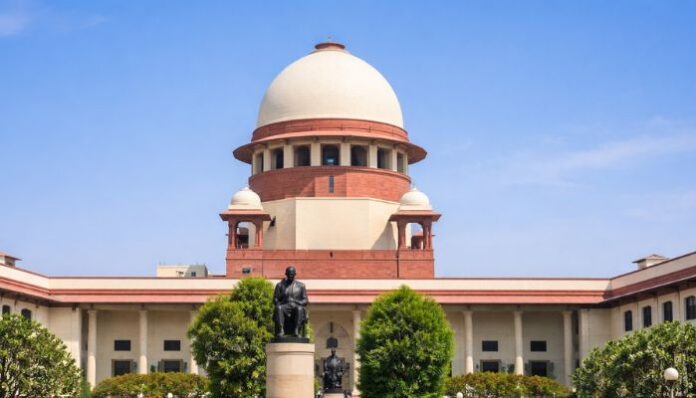
The Supreme Court on Wednesday, 8th April, made an important observation while hearing a batch of petitions related to religious practices and women’s entry into places of worship. The court said it does have the power to examine whether a particular religious practice can be called “superstitious,” even as the Centre argued that such matters should be left to the legislature.
#Sabarimala case: SC says it has right to hold what is superstitious practice in religion, Centre opposes#SupremeCourthttps://t.co/2fp3iME3nG
— IndiaTV English (@indiatv) April 8, 2026
The case is being heard by a nine-judge Constitution bench led by Chief Justice of India Surya Kant. The bench is looking into larger questions around religious freedom, discrimination against women at religious places like the Sabarimala temple in Kerala, and how courts should deal with such issues.
Centre questions Court’s role
At the start of the hearing, Solicitor General Tushar Mehta, appearing for the Centre, raised a key question: how can a court decide what superstition is?
“Even assuming that there is a superstitious practice,” he said, “it is not for the court to determine that it is superstition. Under Article 25(2)(b) of the Constitution, it is for the legislature to step in and enact a reform law.”
He further added that Parliament or state legislatures are better placed to identify and regulate such practices. “The legislature can say that a particular practice is superstition and requires reform. There are several such statutes and laws for the prevention of black magic and other such practices,” Mehta told the bench.
Mehta also argued that courts, being secular institutions, may not have the required expertise in religious matters. “Your Lordships are experts in the field of law, not religion,” he said, pointing out that what may be seen as a religious belief in one region could be considered superstition in another.
Court pushes back
However, the judges did not fully agree with this view. Justice Ahsanuddin Amanullah said the argument was too simple and that courts cannot completely step away from such questions.
“What will follow is for the legislature to deal with. But, in court, you cannot say that whatever the legislature decides is the last word. That cannot be,” he said, making it clear that the judiciary also has a role to play.
Justice Joymalya Bagchi also raised an important point by giving an example. He asked whether something like witchcraft, if claimed as a religious practice, should be accepted without question.
He said, “Let us say the court is approached under Article 32… saying that a religious practice of witchcraft exists, and the legislature is silent. Can the court not… give directions to prohibit such a practice, keeping in mind health, morality and public order?”
In response, Mehta clarified that the court can step in under judicial review, but only on grounds like health, morality, and public order, not simply because something is labelled as superstition.
What counts as ‘essential’ religious practice?
Justice B V Nagarathna added another layer to the discussion. She said that when courts examine whether a practice is essential to a religion, they must look at it from within that religion’s own philosophy.
“You cannot apply (the views of) some other religion and say this is not essential religious practice. The approach of the court is to apply the philosophy of that religion, subject to health, morality and public order,” she said.
Background: The Sabarimala case
This larger debate goes back to the Sabarimala temple issue. In September 2018, a five-judge Constitution bench, in a 4:1 verdict, allowed women of all age groups to enter the temple, striking down the earlier ban on women between 10 and 50 years.
The court had then ruled that the practice was unconstitutional and discriminatory.
However, in November 2019, another bench led by then Chief Justice Ranjan Gogoi referred the matter to a larger bench. It said that questions related to religious freedom and gender equality across different religions needed a broader examination.
