

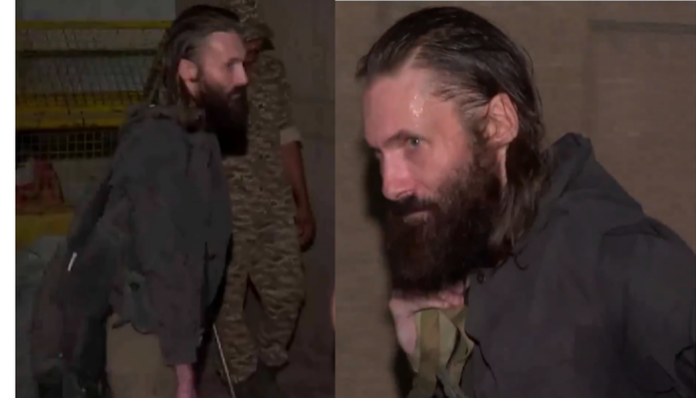
Three of the seven foreign nationals arrested in connection with the Myanmar training camp case were released from Tihar Jail on Thursday (September 24, 2026). US mercenary Matthew VanDyke and 2 Ukrainian nationals were seen leaving the jail in Delhi after a Delhi court allowed them bail to meet their families in the US and Ukraine.
#WATCH | Delhi: Myanmar Training Camp case | Two foreign nationals from Ukraine and the US were released from Tihar Jail.
— ANI (@ANI) September 24, 2026
The special NIA court at Rouse Avenue has granted permission to US National Matthew Aaron Vandyke and 6 Ukrainian nationals to travel to the USA and Ukraine… pic.twitter.com/D7BVx2faKC
The Ukrainian nationals were granted bail by the Delhi Rouse Avenue Courts on September 23, 2026, after US mercenary Matthew VanDyke was granted bail on September 18, 2026. Special Judge Prashant Sharma of Rouse Avenue Courts granted the foreign nationals default bail subject to certain conditions and allowed them one month’s time to meet their families. The Ukrainian nationals were earlier granted permission to travel to Ukraine to meet their families; the court allowed the US national to meet his family in the US earlier in the day.
The court ordered the Ukrainian nationals to be released on bail after furnishing a cash bond of ₹1 lakh each. VanDyke was initially allowed to be released after furnishing a bail bond of ₹1 lakh along with a surety bond of the same amount. However, the court later modified his bail conditions and allowed him to be released on bail after depositing a cash bond of ₹1 lakh.
All the foreign nationals were arrested by the National Investigation Agency (NIA) on March 13, 2026. Of the Ukrainian nationals, three, Petro Hurba, Taras Slyviak, and Ivan Sukmanovsky, were arrested at the Lucknow airport, and the other three, Marian Stefankiv, Maksim Honcharuk, and Viktor Kaminskyi, were arrested at the Delhi airport. US Matthew VanDyke was arrested at Kolkata airport.
The release of the foreign nationals comes two weeks after the NIA filed a chargesheet against them. The chargesheet did not involve charges under the UAPA, in relation to which they were initially investigated. In the chargesheet, the agency accused them of offences under the Immigration and Foreigners Act.
The court discharged all of them of offences under the Immigration and Foreigners Act after the matters were compounded before the Foreigners Regional Registration Office (FRRO) after the deposition of the penalty amount of ₹5.5 lakh each.
The Myanmar Training Camp case
The foreign nationals were accused by the NIA of travelling to the Indian state of Mizoram without the required permit and later crossing into Myanmar. The agency is also probing them for being involved in a drone-warfare training camp linked to ethnic armed groups in Myanmar.
According to the NIA, the foreigners were in contact with an ethnic armed group in Myanmar and were providing them training in weapons use and drone operations. The agency said that they brought drones from Europe for the training. Initially, the NIA probed them for suspected terror links, but terror charges were not invoked against them in the chargesheet.
Among the foreigners, US national Matthew VanDyke was involved in the Libyan civil war of 2011. He had joined the fight against Muammar Gaddafi’s regime and was held prisoner after being captured. He was released after the killing of Gaddafi and the fall of his regime.
Later, VanDyke was involved in the fight against the Islamic State in Iraq. He also trained Ukrainian civilians and military personnel during the Russia-Ukraine war in 2022. He founded an organisation called Sons of Liberty International, which provides security and military training.
The NIA’s investigation has focused on the route taken by the foreign nationals and the purpose of their visit to Myanmar. According to the agency, the group entered India on valid travel documents but travelled from Guwahati towards Mizoram without the mandatory permit required for foreigners. They crossed the India-Myanmar border and reached an area where they were scheduled to conduct training for Myanmar-based ethnic armed groups. The agency has stated that the training covered drone warfare, drone operations, assembly and jamming technology.
The agency has also been examining the movement of drones from Europe through India for use by the Myanmar-based groups. According to the NIA, some of these ethnic armed groups have links with insurgent organisations operating in India’s Northeast, which is why the agency initially examined the case under the UAPA.
The NIA has also told the court that it recovered potentially incriminating images, videos and voice samples from electronic devices seized during the investigation.
The case has therefore involved two distinct aspects: the illegal movement of the foreigners through India’s protected northeastern region and into Myanmar, and the broader allegations concerning their activities with ethnic armed groups across the border. While the NIA’s September chargesheet invoked provisions of the Immigration and Foreigners Act rather than UAPA provisions, the agency has maintained before the court that its investigation into the terror-related aspects is continuing and that a supplementary chargesheet could follow.
