

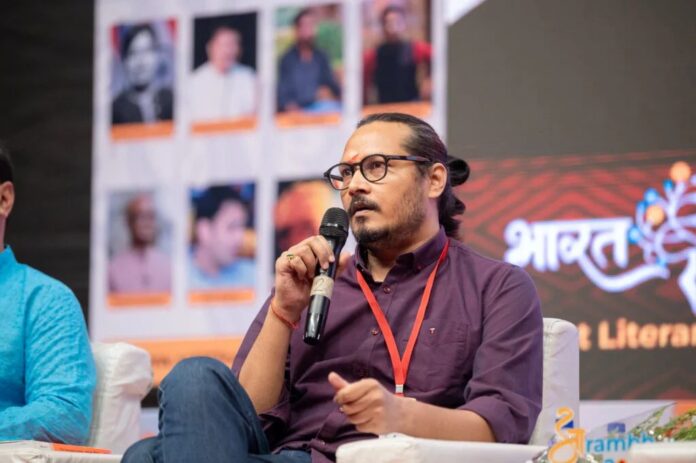
The Delhi High Court on Monday reserved its order on the anticipatory bail plea filed by YouTuber Ajeet Bharti in a case registered under the Scheduled Castes and the Scheduled Tribes (Prevention of Atrocities) Act, 1989, over remarks he allegedly made about Nagina MP Chandrashekhar Azad Ravan.
Justice Saurabh Banerjee, who heard the matter, questioned whether Bharti should have exercised greater caution while making the comments, particularly given the statutory protections provided under the SC/ST Act.
Appearing for Bharti, advocate Jai Anant Dehadrai highlighted his client’s work as a YouTube commentator and told the Court that creating political videos and podcasts was not merely a side activity for Bharti but his primary source of livelihood.
“I am a YouTube commentator, and my bread and butter is that I host these political conversations on YouTube. My primary source of income is the videos and podcasts we do,” Dehadrai submitted.
The Court observed that while Bharti was entitled to express his views, the manner in which he referred to caste and identified individuals could create legal consequences.
“You can’t come up to the level of expressing your opinion by naming. That is the only point that can come in problem with you,” the judge remarked during the hearing.
Justice Banerjee further stressed that individuals making public statements must remain conscious of laws that impose specific restrictions on speech.
The Bench also questioned Delhi Police on why Bharti had not been served a notice during the investigation.
“You don’t require custodial interrogation?” the Court asked.
Delhi Police’s counsel explained that the investigating officer had obtained Bharti’s address only two days earlier and therefore could not issue the notice before that.
Court objects to transcript submitted by defence
The hearing also saw a sharp exchange over a transcript of Bharti’s video that was sought to be placed on record.
Justice Banerjee objected to the language contained in the transcript and cautioned Bharti’s counsel against reproducing offensive expressions before the Court.
“You cannot hand over the words used by him to a court of law. I will issue contempt notice to you,” the judge said, while questioning whether the counsel considered the phraseology used in the video non-offensive.
The Court subsequently made clear that it would examine the legal implications of the alleged remarks rather than assess the statements that may have preceded or provoked them.
Defence: Remarks cannot be viewed without context
Appearing for Bharti, advocate Jai Anant Dehadrai argued that the allegedly objectionable portion comprised only a few lines and urged the Court to watch the preceding portion of the video to understand the context.
“One concern is that the impugned portion is a few lines but I am requesting that the Court hear the prior part as well,” Dehadrai submitted.
He maintained that Bharti was opposed to caste discrimination and argued that the ingredients of the SC/ST Act were not made out merely because an abusive statement had been made.
“What I am trying to show is that an abusive statement by itself does not amount to an offence under the SC/ST Act. There are Supreme Court judgments on this,” the counsel argued.
Dehadrai also submitted that Bharti had expressed a nuanced position on reservation and had not targeted Chandrashekhar Azad because of his caste.
According to the defence, Bharti’s remarks came after abusive comments were allegedly directed at his sister on social media.
“My sister was abused on social media feed, I responded to that. Some people may not like it, but my intention was not to malign,” Dehadrai said.
He further argued that Bharti had not even referred to Azad’s caste by name.
“I have not even named Mr Azad’s caste. The sine qua non is that,” he submitted.
Court says alleged provocation is a separate issue
The Bench, however, indicated that the statements allegedly made against Bharti or his family were not relevant to determining the present case.
“You have your angst, grievance, way of saying. That’s a separate issue,” the Court said.
The judge added that what Chandrashekhar Azad or anyone else had allegedly said was a separate matter and that the Court was concerned with the specific remarks attributed to Bharti and the context in which they were made.
The Bench also reiterated that, at the present stage, it was required to determine whether a prima facie case was disclosed.
“I have read your application. Today, a simpliciter notice is sufficient. For you to ask for a protection, I don’t think it can be granted,” Justice Banerjee observed.
Delhi Police opposes anticipatory bail
Delhi Police opposed Bharti’s plea, arguing that the statements made on social media contained material capable of attracting the SC/ST Act.
“All these words have been said on social media. Third thing is that he doesn’t belong to the same caste. These three things are there to attract the SC/ST Act,” the police counsel submitted.
The complainant’s counsel similarly argued that Bharti had knowingly targeted a particular caste and that the existence of a prima facie case would operate against the grant of anticipatory bail.
The counsel further alleged that Bharti was a “habitual offender”, pointing to an earlier instance in which he had made adverse comments concerning a former Chief Justice of India.
FIR registered in August
The case originates from an FIR registered at Delhi’s North Avenue Police Station on August 23. The FIR invokes provisions of the SC/ST Act, Section 67 of the Information Technology Act and Sections 196(1)(c) and 351(3) of the Bharatiya Nyaya Sanhita.
The complaint was filed by Balakram Bauddh, Delhi State President of the Azad Samaj Party (Kanshi Ram), over a video titled “SB79: Reservation Hatao Andolan Nautanki & More | Saptahik Bakaiti” published on Bharti’s social media account.
The complaint alleges that Bharti used caste-based and abusive language, made objectionable remarks against Chandrashekhar Azad and BR Ambedkar, used sexually degrading language concerning women and issued threats.
Bharti has denied the allegations and defended his remarks publicly, maintaining that he was responding to what he described as degrading comments directed at his family.
The anticipatory bail plea was filed after a trial court rejected Bharti’s application on September 7. The Delhi High Court has now reserved its order after hearing arguments from Bharti, Delhi Police and the complainant.
