

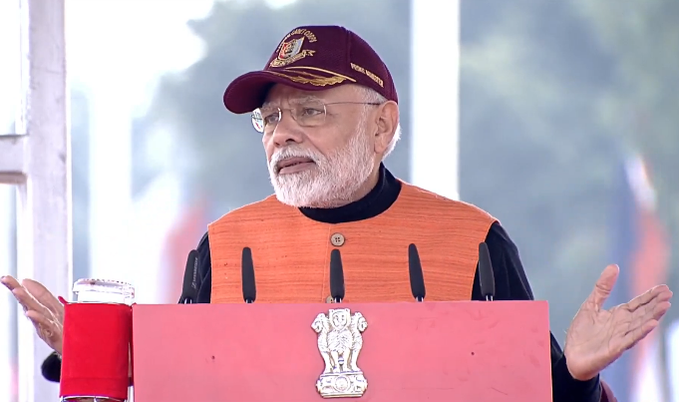
Prime Minister Narendra Modi, during his address at the NCC rally in Delhi, reminded the country that India swore an oath to protect the religious minorities of the Islamic State of Pakistan (which included Bangladesh) when the country was partitioned in 1947. He said that it is India’s responsibility to protect such people who have been persecuted for their religion in Pakistan, Bangladesh and Afghanistan.
Since Independence, leaders who had helped Partition had promised the minorities in Afghanistan, Pakistan, and Bangladesh that they can come back if they are persecuted. Gandhi Ji had the same wish as well: PM Modi #PMatNCC
— BJP (@BJP4India) January 28, 2020
Prime Minister Modi said that it was the wish of Mahatma Gandhi and the same sentiment was reflected in the Nehru-Liaquat Pact. He said that some time ago, an advertisement for the recruitment of cleaning workers was released by the Pakistani Army. He said that the ad mentioned specifically that only non-Muslims could apply for the job. In other words, only Dalits and people of minority religions could apply for the job of cleaning workers. PM Modi mentioned it as an illustration of the kind of discrimination non-Muslims face in these countries.
PM Modi also remarked that India could have used the ninety thousand captured Pakistani soldiers during the 1971 war to negotiate a settlement to take back Kartarpur Gurudwara from Pakistan. He bemoaned the fact the borders of India could have been changed but they weren’t. He said, “We could have set any terms we wanted, we could have squeezed anything away from them if we wanted. When the ninety thousand soldiers were in our captivity, we could have taken back Kartarour Sahib. The lines could have been changed but even this wasn’t done.” Narendra Modi said that his government had taken steps to have the Kartarpur Sahib Corridor opened after Sikhs pilgrims had to wait to visit the shrine for decades.
Narendra Modi also spoke of several other long-standing disputes that had come to an end during his tenure. He spoke of the abrogation of Article 370, the signing of the Bodo Accord, the Bru-Reang settlement, the enhanced coordination between the Armed Forces, the up-gradation of their arsenal and various other issues.
The PM, towards the beginning of his speech, said, “If any disease continues for a long time, it becomes a part of the body. In our social life, this has happened. Several diseases had weakened our country in a way that most of its energy was being utilized to fight these problems.” And towards the end, he said that he was trying to solve these problems so that our future generations don’t have to face the same. He said that he is ready to face every criticism and slander that is thrown his way but he is not willing to keep the country mired in all these disputes.
PM Modi also said that the Year 2022 is a great moment in Indian history and so is this decade. He said that India’s biggest strength is its youth and it is this youth that will play a critical role in the country’s fortunes this decade.


