

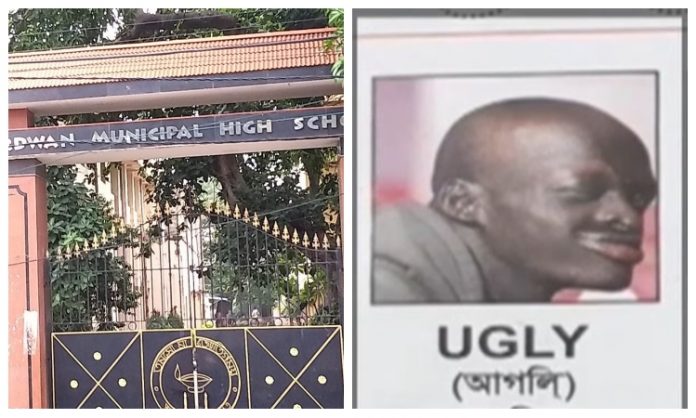
Following complaints lodged by parents with the state education department, the West Bengal education department has suspended two teachers of the government-aided school-Municipal Girls High School, located in Burdwan city of East Burdwan district of West Bengal. The school attracted the ire of parents after an illustration in one of its textbooks described dark-skinned people as “ugly”.
According to reports, in the alphabet section, the book shows the image of a black person as an illustration of the word ‘ugly’. The word was used as an example of words starting with U. As per a report in a local portal, the book is named ‘Child’s Study’ and is written by one Ruma Roy.
The incident had come to light after parents of children studying in that school outraged and lodged a complaint regarding the same with the state education department.
Sudip Majumdar, the complainant who is a college professor, said: “I was shocked when I saw the picture of a black boy’s face to give an example of ugliness. How can it be possible?’’ he asked.
West Bengal Education Minister passes the blame on to the school
According to Majumdar, the textbook in question was part of the course books referred by the education department. This allegation was refuted by the Education Minister, Partha Chatterjee, who passed the blame on to the school: “The textbook was introduced by the school itself. The two teachers have been suspended because we have zero tolerance for such acts which may have prejudices into students’ mind.’’ The minister said that the govt has not issued the book, and it is not printed in any govt press.
The suspended teachers also put the blame on each other. Shrabani Mullick, one of the suspended teachers said: “Though I am the administrative head of the primary section of the school, the issue should be looked after by the teacher-in-charge.”
Meanwhile, the suspended teacher-in-charge Barnali Ghosh said: “Though I am the teacher-in-charge, everything of the school is monitored by Shrabani. I have no clue why the book was selected for teaching.’’
Sishir Kumar Pal, the publisher of the book, admitted that it was a major mistake of their part: “I will inquire about how it happened. We will rectify the mistake and print the book again. We will give the rectified books to the schools at our cost,’’ he said.


