

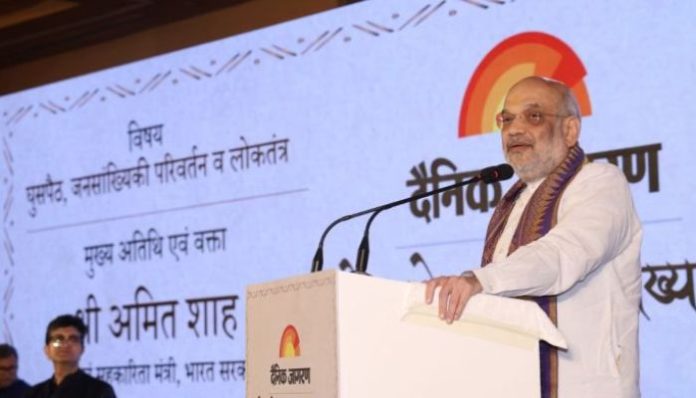
On Friday (10th October), Union Home and Cooperation Minister Amit Shah said that the growing Muslim population in India is not because of birth rates but due to infiltration from neighbouring countries like Pakistan and Bangladesh. Shah made these remarks while delivering the ‘Narendra Mohan Memorial Lecture’ on ‘Infiltration, Demographic Change, and Democracy’ organised by Dainik Jagran.
Shah said that demographic changes across several parts of India over the years are a matter of national concern and should not be viewed through a political lens. He also backed the ongoing Special Intensive Revision (SIR) of electoral rolls, saying that voting rights in India must be reserved only for Indian citizens.
“The Modi government follows the policy of detect, delete, and deport when it comes to infiltrators,” Shah said. “Infiltration is not a political issue; it is a national issue,” he added.
मोदी सरकार घुसपैठियों को Detect भी करेगी, मतदाता सूची से Delete भी करवाएगी और जहाँ से वे आए हैं, वहाँ उन्हें Deport भी करेगी। pic.twitter.com/zeUbV0ztXX
— Amit Shah (@AmitShah) October 10, 2025
‘Population rise due to infiltration, not fertility’
The Home Minister said that the rise in India’s Muslim population over the decades is mainly due to illegal infiltration. “All the Hindu population that decreased in Pakistan and Bangladesh, many of them took refuge in India. And the Muslim population that increased in India wasn’t due to fertility; it was because many Muslims infiltrated into the country,” Shah said.
1951 से 2011 तक की जनगणना में जो सभी धर्मों की जनसंख्या वृद्धि में असमानता दिखाई देती है, उसका प्रमुख कारण घुसपैठ है। pic.twitter.com/MMMyFjfWGS
— Amit Shah (@AmitShah) October 10, 2025
He also cited census data to support his claim. “In 1951, Hindus were 84% and Muslims 9.8% of the population. By 1971, Hindus were 82% and Muslims 11%. In 1991, Hindus were 81% and Muslims 12.21%. And by 2011, Hindus made up 79% while Muslims rose to 14.2%,” Shah said.
भारत में आजादी के बाद हुई जनगणनाओं में…
— Office of Amit Shah (@AmitShahOffice) October 10, 2025
1951 में हिंदू 84.1%, मुस्लिम 9.8%
1971 में हिंदू 82.72%, मुस्लिम 11%
1991 में हिंदू 81%, मुस्लिम 12.12%
2001 में हिंदू 80.5%, मुस्लिम 13.4%
2011 में हिंदू 79%, मुस्लिम 14.2%
और वहीं वृद्धि दर की बात करें तो:
2001-2011 में हिंदू जनसंख्या…
He added that the Hindu population has dropped by around 4.5%, while the Muslim population has grown by nearly 25% in the same period.
‘Congress failed minorities under Nehru-Liaquat Pact’
Amit Shah accused the Congress party of dividing the country on religious lines during Partition and then failing to protect minorities in Pakistan and Bangladesh. “Dividing this country in the name of religion was a huge mistake; by doing so, they cut off the arms of Bharat Mata and made the British conspiracy successful,” Shah said.
धर्म के आधार पर देश का विभाजन करना कांग्रेस की बहुत बड़ी गलती थी। pic.twitter.com/KbTLWoXpQk
— Amit Shah (@AmitShah) October 10, 2025
He also alleged that India’s first Prime Minister, Pandit Jawaharlal Nehru, broke his promise made to refugees under the Nehru-Liaquat Pact. “Pandit Nehru had promised citizenship to refugees but later went back on that promise,” he said.
“When Modi Ji’s government came to power with a full majority, we fulfilled that promise through the Citizenship Amendment Act (CAA),” he added.
‘Refugees and infiltrators are not the same’
Explaining the difference between refugees and infiltrators, Shah said, “A refugee comes to India to save their religion, but an infiltrator crosses the border illegally for economic or other reasons. They do not come here due to religious persecution.”
शरणार्थी वे हैं, जो धार्मिक प्रताड़ना के कारण भारत आए हैं, और घुसपैठिए वे हैं, जो आर्थिक या अन्य कारणों से अवैध तरीके से घुसे हैं। pic.twitter.com/lPbl3LeiUy
— Amit Shah (@AmitShah) October 10, 2025
Defending the Citizenship Amendment Act, Shah said the law was not designed to take away anyone’s citizenship but to provide citizenship to refugees who came to India after facing persecution in neighbouring countries. “CAA is not about taking away anyone’s citizenship. There is no provision in the Act to deprive Hindus, Muslims, Sikhs, Christians, or anyone of their citizenship. Its sole purpose is to give citizenship to refugees,” he explained.
‘SIR not political, but a national issue’: Shah
The Home Minister also defended the Special Intensive Revision (SIR) of electoral rolls being carried out in several states. He said that some political parties see infiltrators as vote banks instead of recognising them as a threat to the country’s security and democracy.
“Conducting SIR is the responsibility of the Election Commission. The Constitution entrusts the EC with ensuring free and fair elections, which is only possible when the voter list is correct,” Shah said. He warned that including infiltrators in the electoral rolls allows them to participate in the political decision-making process of the country, which weakens democracy.
Amit Shah warned that if infiltration is not stopped, the country will turn into a “Dharmashala”, and therefore, putting an end to it is essential for national security. He further questioned why infiltration does not happen in states like Gujarat or Rajasthan that also share international borders. “If someone enters illegally and the district administration fails to identify them, how will we stop infiltration?” Shah asked.
Shah concluded by saying that protecting India’s borders and ensuring that only citizens have the right to vote are essential to safeguard democracy. “When the basis of voting is not the nation’s interest, democracy can never succeed,” he said.
