

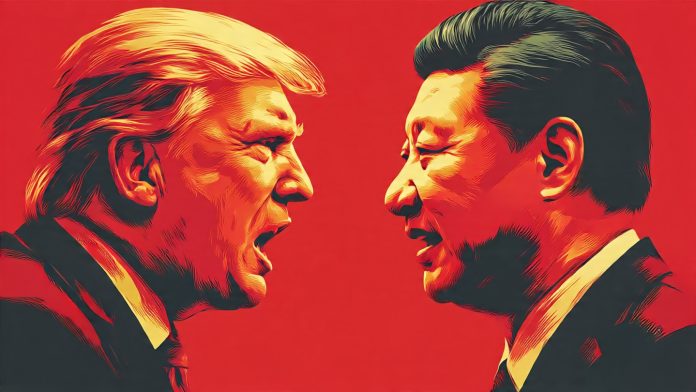
U.S. President Donald J. Trump announced sweeping retaliatory measures against China on Saturday, announcing an additional 100% tariff on all Chinese imports starting November 1, 2025. The move comes in direct response to Beijing’s aggressive export control plans for rare earth materials, which Trump described as an “unprecedented” and “moral disgrace” in international trade.
In a statement posted on Truth Social, Trump revealed that China had sent a “hostile letter” to the world, threatening large-scale export restrictions on “virtually every product they make.” These controls, he claimed, were a long-planned strategy affecting all nations and even extending to non-Chinese goods.
“Based on the fact that China has taken this unprecedented position,” Trump wrote, “starting November 1st, 2025 (or sooner, depending on any further actions or changes taken by China), the United States of America will impose a Tariff of 100% on China, over and above any Tariff that they are currently paying”.
Additionally, the Trump administration will impose export controls on all critical software to China. The president added, “It is impossible to believe that China would have taken such an action, but they have, and the rest is History.”
This follows an earlier post from the same day, where Trump accused China of unleashing “great Trade hostility” by imposing sweeping export controls on rare earth minerals and other critical production elements, vowing to respond with a “massive increase” in tariffs on Chinese imports. The outburst came just days after Beijing dramatically tightened restrictions on these vital resources, heightening fears of a renewed escalation in the U.S.-China trade conflict that has already rippled across the globe.
Trump portrayed the Chinese actions as a shocking betrayal after six months of warming ties, describing multi-page letters detailing controls on rare earths and other elements as a sinister bid to “hold the World captive” and “clog” markets.
Trump also said with these new developments, he has no intention to meet Chinese president Xi Jinping. The two leaders were expected to meet at the Asia-Pacific Economic Cooperation (APEC) summit in South Korea in two weeks. He wrote, “I have not spoken to President Xi because there was no reason to do so. This was a real surprise, not only to me, but to all the Leaders of the Free World. I was to meet President Xi in two weeks, at APEC, in South Korea, but now there seems to be no reason to do so.”
The U.S. president asserted that while China holds monopoly on rare earth minerals, the U.S. holds “much stronger and more far reaching” monopoly positions on key elements than China and warned that he would be “forced… to financially counter their move.” He claimed, “For every Element that they have been able to monopolize, we have two.”
China’s Rare Earth Export Control
China’s Ministry of Commerce announced the expanded controls on October 9, adding five new rare earth elements to its export restriction list and imposing extra scrutiny on shipments to semiconductor and defence users. The measures, effective immediately, also target refining technologies and require foreign producers using Chinese materials to obtain licenses, effectively barring companies affiliated with foreign militaries, including U.S. firms, from routine access.
This builds on April’s restrictions under Announcement 18, which curbed seven of the 17 rare earth types and related magnets in direct retaliation to U.S. tariffs, causing global shortages that forced U.S. manufacturers to shutter production lines. Beijing justified the curbs as safeguarding “national security,” it has been seen as leverage ahead of high-stakes U.S.-China talks, exacerbating Beijing’s near-monopoly (about 70% of global supply) on these metals, essential for everything from electric vehicle batteries to fighter jets and computer chips.
