

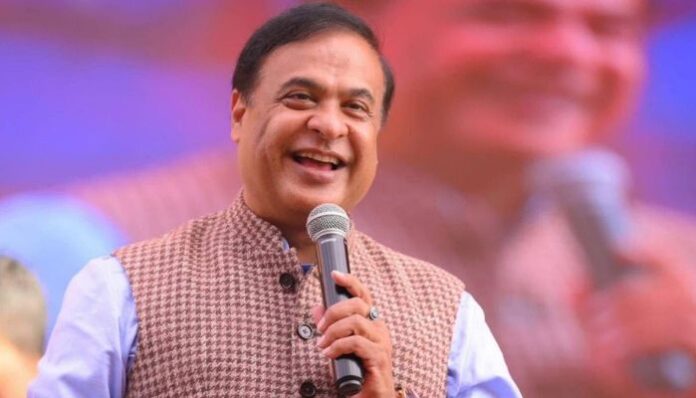
The Chief Minister of Assam, Himanta Biswa Sarma, has been able to do the unthinkable: Erase fault lines and friction between the Assamese Hindu and the Bengali Hindu community living in the State.
For decades, Assam kept boiling over ethnic tensions between the Assamese and the Bengali population. Issues like mass migration, religious persecution, demographic change, and economic opportunities have prevented both cohesion and harmony to a large extent.
Himanta Biswa Sarma took an objective approach to draw a much-needed distinction between Bengali Hindu refugees (who migrated to the Indian State to flee persecution) and Bengali Muslim infiltrators (who came to Assam for economic opportunities).
How can someone who came to Assam to protect his religious identity be compared to someone who first created an Islamic nation and then migrated to the Indian State for opportunism? Although such a comparison is untenable, it remained the mainstay of politics in Assam.
But years of political propaganda, aimed at dividing and ruling over the masses, have been decimated under the leadership of Himanta Biswa Sarma.
Through targeted messaging, awareness about the big difference between the two groups and their contribution to demographic change was made crystal clear.
The Assamese Hindu community, which was once made to believe by vested political groups that their Bengali Hindu counterpart is somehow their enemy, is now convinced that there is only one enemy: It is not the refugee but the illegal immigrant who came to the Northeastern State after 24th March 1971 (the cut-off date of the Assam Accord) to reap economic benefits and change its culture.
No single Bengali Hindi in detention camp in Assam: Himanta Biswa Sarma
The matter became crystal clear from a statement of Himanta Biswa Sarma, which he made on Friday (3rd July) at the Indian Express Idea Exchange.
On being asked about D voters in Assam (individuals who are unable to prove Indian nationality with cases pending before the Foreigners Tribunal), he pointed out, “Now, Bengali Hindus’ number has come down below 1 lakh. It was at some point of time it was almost 4.5 lakhs. Tribunals are working, and I think it will be resolved because now the number has become very insignificant.“
The Assam CM pointed out, “There is not a single Bengali Hindu in our detention camp. That is one good news because everything has been resolved. There was no Aadhar card, everyone has got it. Now from 4.5 lakhs, it has come down to below 1 lakh. So the problem is almost resolved. I think this issue will be resolved in 1-2 years because every issue goes to the tribunal and there are disputes in the tribunal. So we are resolving the dispute through a legal process.“
“The number was at some point of time around 12-14 lakhs of both communities (Hindus and Muslims). Today this number has come down to 3.54 lakhs and out of that Bengali Hindus will be below 1 lakh. So this is significantly coming down,” Sarma added.
असम में एक भी हिंदू बंगाली Detention Camp में नहीं है।@IndianExpress pic.twitter.com/GAVgsSJsL1
— Himanta Biswa Sarma (@himantabiswa) July 4, 2026
“But when NRC will be published, I doubt after publishing of NRC the number will jump initially again because many people names will not be there. So that point of time the Bengali Hindu people have to apply under CAA. So this issue is a little complex but we are resolving it,” he concluded.
A change in public perspective and role played by Himanta Biswa Sarma
When the Citizenship Amendment Act (CAA) was enacted in 2019, there were large-scale protests in Assam. There was an uproar over the possibility of Bengali Hindu refugees, who were undocumented, being granted Indian citizenship. Many political groups in the State also claimed it would nullify the purpose of the Assam Accord, which made every illegal immigrant who came after 16th March 1971 eligible for deportation.
CAA provided a gateway to fast-track citizenship of people belonging to one of the 6 religious groups (Hindus, Christians, Sikhs, Parsis, Jains and Buddhists) who came to India from Pakistan, Bangladesh and Afghanistan before 31st December 2014 due to religious persecution. Fast forward 7 years, and the cut-off date has been increased to 31st December 2024.
Himanta Biswa Sarma has been able to propagate the message that the Hindu Bengali who was forced to migrate to Assam from East Pakistan/ Bangladesh is different from the Muslim Bengali who came to the Indian State from the other side of the border for economic benefit. Although both are undocumented, one is a refugee while the other is an infiltrator.
As a result, the Assam Accord no longer applies to the Hindu Bengalis refuees, and they are protected under the Citizenship Amendment Act. Himanta Biswa Sarma also made it clear that the National Register of Citizens (NRC) will be implemented in the State and only the ‘infiltrators’ will be put in detention camps until they are deported to Bangladesh. No Bengali Hindu refugee will either be deported or put in detention centres.
Just like Israel is the fatherland of all Jews, India was/ is and will remain the motherland of all Hindus. But to convince the masses, a different magnitude of political will, messaging and policy-making was required in Assam. Himanta Biswa Sarma has been vocal in differentiating between infiltrators and refugees.
He made the paradigm shift in perspective possible, which was unimaginable 30 years ago. This explains why he received a grand welcome when he visited Silchar in August 2025. Lakhs of Bengalis flocked to catch a glimpse of Himanta Biswa Sarma. The overwhelming reception, warmth and adulation of the public that the Assamese-speaking Chief Minister received on that particular day remains unprecedented in the State’s history.
Ahead of the 2026 Vidhan Sabha election, he received a grand welcome in West Bengal. His speeches were attended by thousands of Bengali voters.
Himanta Biswa Sarma has been unabashed about his Hindu identity and has meticulously worked to unite the community across linguistic and ethnic lines in Assam. The historical differences between Assamese Hindus and Bengali Hindus have healed, and the State has moved in the direction of permanent reconciliation.
The vested groups, which thrived on exploiting fault lines, are watching the development from the sidelines. They have been left dismayed and powerless. All thanks to Himanta Biswa Sarma


