

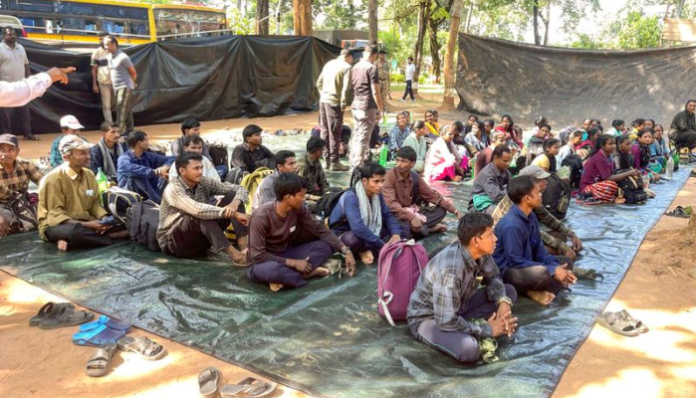
This week at least 258 Naxal cadres surrendered across Maharashtra and Chhattisgarh in just two days, marking a significant turning point in the decades-long battle against Left Wing Extremism (LWE). As many as 170 Maoists surrendered in Chhattisgarh today, while 27 had surrendered yesterday. On the other hand, 61 returned to the mainstream yesterday in Maharashtra.
Union Home Minister Amit Shah called it a landmark day in the battle against Naxalism. He said in a post on X, In total, 258 battle-hardened left-wing extremists have abjured violence in the last two days. I applaud their decision to renounce violence, reposing their trust in the Constitution of India. It attests to the fact that Naxalism is breathing its last due to the relentless efforts of the PM @NarendraModi led government to end the menace.”
A landmark day in our battle against Naxalism.
— Amit Shah (@AmitShah) October 16, 2025
Today, 170 Naxalites have surrendered in Chhattisgarh. Yesterday 27 had laid down their arms in the state. In Maharashtra, 61 returned to the mainstream, yesterday. In total, 258 battle-hardened left-wing extremists have abjured…
On 14th October, Mallojula Venugopal Rao (70) alias Bhupathi, a prominent Naxalite leader and strategist laid down arms in the Gadchiroli district, marking the start of the pivotal development.
He was a member of the Politburo and one of the three remaining senior leaders of the outlawed Communist Party of India (Maoist). He went by a number of different names, including Master, Vivek, Abhay, Venu, Sonu, Sonu Dada and Venugopal. He carried several bounties in states like Odisha, Maharashtra, Chhattisgarh, Telangana and Andhra Pradesh with amounts ranging from Rs 1 crore to Rs 10 crore.
Bhupathi who oversaw platoon operations along the state boundary, formally turned himself up with 60 cadres and a sizable cache of 54 weapons such as nine INSAS rifles and seven AK-47S. Ten members of the Divisional Committee, two members of the Zonal Committee and representatives of other dalams also surrendered alongside him.
Maoists surrender in Chhattisgarh
On 15th October, districts in Chhattisgarh targeted by the Naxal movement also announced major surrenders involving 78 Maoist cadres, after the events in Maharashtra. 50 cadres, including 32 women and important regional figures from the influential Dandakaranya Special Zonal Committee which is the highest state-level body of the group, such as Rajman Mandavi and Raju Salam, gave up arms before the Border Security Force (BSF) in Kanker district.
“A group of Maoist cadres led by Rajman Mandavi and Raju Salam, both members of the Dandakaranya Special Zonal Committee, reached the Kamtera camp of BSF’s 40th Battalion under the Koylaibeda police station limits in Kanker to surrender,” a police officer informed.
They also submitted 39 weapons, including seven AK-47 rifles, two Self-Loading Rifles, four INSAS rifles, an INSAS light machine gun (LMG), and a Sten gun. “The surrendered cadres include five divisional committee members, Prasad Tadami, Heeralal Komra, Jugnu Kowachi, Narsingh Netam and Nande (wife of Rajman Mandavi) as well as 21 area committee members and 21 party members,” he added.
Those who surrendered included significant Abujhmad also known as Maad Maoist leaders. More surrenders are anticipated in the days ahead, according to sources.
Larger than the state of Goa, this unsurveyed forested area spans over 4,000 square kilometres and is located in the Maharashtra state of Gadchiroli and the Chhattisgarh states of Narayanpur, Kanker, Bijapur and Dantewada. Maoists, including Bhupathi, have established the area as their stronghold since the 1980s.
The security forces who started the “Maad Bachao Abhiyan” (Save Maad Campaign) in 2024 to eradicate Naxalism from the area consider the most recent surrender to be a significant victory. More than 100 Maoists have been slain in and around Maad since last year.
Furthermore, 27 cadres followed suit in front of Central Reserve Police Force (CRPF) and police officers in Sukma, in a separate incident. A total of Rs 50 lakh reward was slapped on 16 of them, including notorious Oyam Lakhmu (People’s Liberation Guerrilla Army Battalion Number 1) who had a Rs 10 lakh bountry.
“Three others, Madvi Bhima (18), a member of a military platoon of PLGA Battalion No. 1, and Sunita alias Kawasi Somdi (24) and Sodi Mase (22), both members of Regional Military Company No. 2 carried bounties of Rs 8 lakh each. A cadre carrying a reward of Rs 3 lakh, two others with Rs 2 lakh bounty each, and nine others Rs 1 lakh each were also among those who surrendered,” the official mentioned.
A female cadre in Kondagaon named Geeta, also known as Kamli Salaam, a member of the area committee and the commander of the East Bastar Division’s tailor team did the same. She had a bounty of Rs 5 lakh.
A major leap towards Naxal free country
On 15th August, the Ministry of Home Affairs outlined that the number of districts most impacted by the Naxal movement has decreased from six to three. Bijapur, Sukma and Narayanpur are now the only districts in Chhattisgarh where Left Wing Extremism (LWE) is most prevalent.
The number of districts that are impacted by LWE has also fallen from 18 to just 11. Now, red terror only affects 11 districts marching forward to the Modi administration pledge to eliminate the threat entirely by 31st March 2026.
312 LWE cadres were eliminated, including the CPI (Maoist) General Secretary and eight other Polit Bureau/Central Committee members, this year surpassing all prior records in terms of operational victories. 1639 LWE cadres have turned themselves in and assimilated into society, while 836 have been arrested. One Polit Bureau member and one Central Committee member are also among the Naxalites who have gave up arms.
The National Action Plan and Policy, which call for a multifaceted strategy, have been rigorously implemented, resulting in unprecedented success in the fight against the Naxal threat. People-friendly, intelligence-based counterleft-wing extremism actions are part of the National Action Plan and Policy.
These actions were followed by the swift takeover of areas lacking security, the targeting of top leaders and ground forces, the thwarting of the perverse ideology, the rapid expansion of infrastructure and the saturation of welfare programs, a blockade of funds, improved coordination between the central government and the states and the expedited investigation and prosecution of cases related to Maoism.
Prime Minister Narendra Modi referred to Naxalism as India’s “biggest internal security challenge” in 2010, but it is now clearly eroding. The Naxals had envisioned a Red Corridor that would connect Tirupati, Andhra Pradesh and Pashupati, Nepal. However, only 18 districts, including six designated as “Most Affected Districts,” reported Naxal-related violence in March 2025 which is down from 126 districts across several states in 2013, due to the firm policies of the Modi government.
Operation Kagar
“Operation Kagar” is a part of the Modi government’s multi-pronged strategy combining aggressive military operations, enhanced coordination between Central and State forces, and development efforts to address the root causes of Naxalism.
Under this operation, around 1 lakh para-military troops, including the Central Reserve Police Force (CRPF), its elite CoBRA units, District Reserve Guards DRG), and state police have been deployed in the left-wing terrorism affected areas. These security personnel are equipped with modern technology like drones for information gathering, AI for intelligence gathering, and satellite imagery, among others.
Since its inception in January 2024, the operation gave an unprecedented intensity to the anti-Naxal efforts, especially in Chhattisgarh’s Bastar, with remarkable results in 2024 alone. In the year 2024 alone, 287 Maoist terrorists were neutralised, thousands were arrested, and around 837 surrendered.
Notably, security forces have gunned down over 150 Naxals in 2025 in Chhattisgarh alone. Similar operations in Jharkhand have also seen several deaths of the Left-wing extremists. On April 21, eight Naxals, including a top leader with a bounty of Rs 1 crore on his head, were killed in Jharkhand’s Lalpania.
“Operation Kagar” seeks to eradicate Naxalism in Chhattisgarh, Maharashtra (Gadchiroli), Odisha, Jharkhand, Madhya Pradesh and Telangana as well as installing new camps as part of the military offensive by security forces.
