

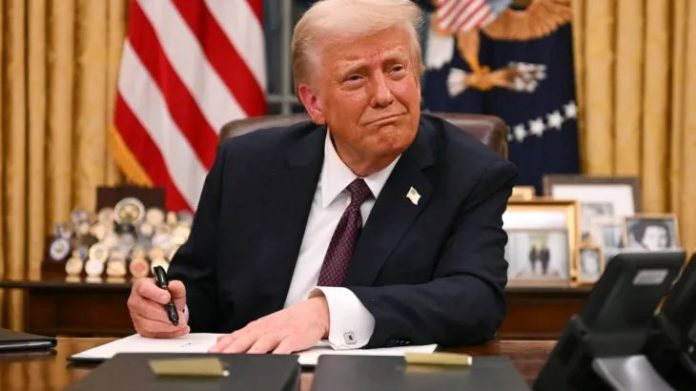
US President Donald Trump has claimed that several Middle Eastern nations have offered to deploy troops into Gaza to “straighten out Hamas,” asserting that he has so far declined those offers in the hope that Hamas will “do what is right.”
Posting on his Truth Social platform, Trump wrote that “numerous of our NOW GREAT ALLIES in the Middle East, and areas surrounding the Middle East, have explicitly and strongly, with great enthusiasm, informed me that they would welcome the opportunity, at my request, to go into GAZA with a heavy force and ‘straighten out Hamas’ if Hamas continues to act badly, in violation of their agreement with us.”
While Trump’s remarks suggest growing readiness among Arab and Muslim nations to intervene militarily in Gaza, media reports indicate a different reality. According to The New York Times, most countries remain hesitant to send forces into the conflict-ridden enclave, fearing direct confrontation with Hamas and the immense challenge of stabilizing the war-torn territory.
So far, Indonesia is the only nation that has publicly expressed willingness to contribute troops to a potential UN-led postwar stabilization mission. Reports claim that Turkey and Azerbaijan have privately shown interest but have yet to make formal commitments.
Despite this, Trump’s post struck an upbeat tone about the region’s geopolitical climate, saying, “The love and spirit for the Middle East has not been seen like this in a thousand years! It is a beautiful thing to behold!”
He added that he had advised both Israel and the unnamed allied nations to wait, declaring, “NOT YET! There is still hope that Hamas will do what is right.”
Ending his statement with characteristic flair, Trump warned that if Hamas fails to comply, “an end to Hamas will be FAST, FURIOUS, & BRUTAL!” He also thanked “the great and powerful country of Indonesia, and its wonderful leader,” for their support toward both the Middle East and the United States.
Trump’s comments come as discussions over the future governance of Gaza intensify amid mounting international pressure for a lasting resolution to the Israel-Hamas conflict. Whether his claims reflect actual diplomatic conversations or political posturing remains uncertain, but they have once again spotlighted his assertive, unorthodox approach to Middle East diplomacy.
