

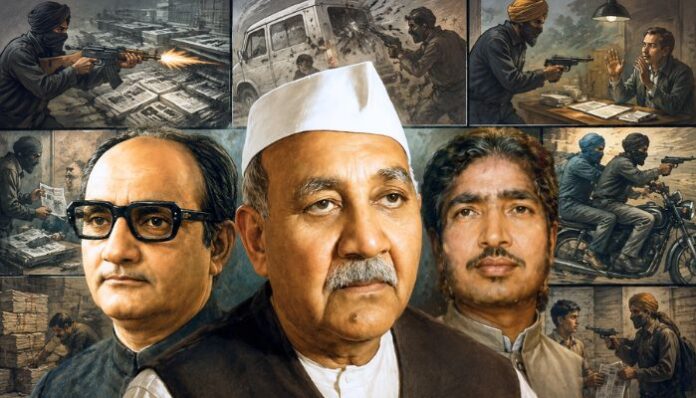
During the Punjab insurgency, Khalistani terrorists did not target only politicians, policemen or civilians. Journalists, editors, broadcasters, newspaper hawkers and delivery workers were also marked for death. The campaign began early in the insurgency and eventually developed into an effort to control not only what could be published or broadcast, but even the words journalists were permitted to use.
One of the earliest and most consequential attacks came on 9th September 1981, when Lala Jagat Narain, founder and chief editor of the Hind Samachar Group, was assassinated while travelling from Patiala towards Jalandhar. Jagat Narain had repeatedly criticised Jarnail Singh Bhindranwale, opposed communal separation and warned against growing violence. His newspapers reached readers in Hindi, Punjabi and Urdu, making his voice particularly influential. His killing was meant to demonstrate that publicly opposing Khalistani terrorism could carry fatal consequences.
The assassination failed to silence the Hind Samachar Group. Jagat Narain’s son Romesh Chandra continued the same editorial line, writing against terrorism and promoting Hindu-Sikh unity. On 12th May 1984, he too was shot dead in Jalandhar. The threat also crossed religious lines. Sumeet Singh, the Sikh editor of the Punjabi literary magazine Preet Lari, was murdered in February 1984 after advocating communal harmony. Communist activist and editor Baldev Singh Mann, another Sikh critic of Khalistan, was shot dead in 1986. Their killings showed that the decisive question for terrorists was not whether a journalist was Hindu or Sikh, but whether his words supported or obstructed the separatist cause.
District journalists were particularly vulnerable. Giani Jagjit Singh died after an armed attack in 1986, Punjab Kesari and Jag Bani correspondent Narendra Pal Singh was killed in 1987, Jag Bani chief sub-editor Bant Singh was assassinated in 1988, and PTI and Indian Express correspondent Parduman Singh was shot the same year. Hind Samachar news editor Inderjit Sood was also killed in 1988 after the death of Khalistan Commando Force chief Labh Singh, reportedly over the terminology used by Jag Bani while reporting his death. By the early 1990s, reporters including Nanak Chand Nagpal, Bhag Singh Khela, Balbir Singh Saggu and Amar Nath Verma had also been murdered.
The campaign soon extended beyond journalists themselves. After the Hind Samachar Group refused orders to stop publishing, terrorists attacked employees, newspaper vendors and the distribution network. Hawkers were killed while handling newspaper bundles, delivery workers were attacked and a newspaper van travelling towards Ferozepur was ambushed in July 1990, killing all five people inside. Around 40 vendors, agents and hawkers associated with the group were killed. Police eventually accompanied newspaper vendors on their routes as terrorists attempted to make the physical distribution of the publications impossible.
Khalistani organisations also tried to dictate editorial language. In November 1990, the Sohan Singh-led Panthic Committee issued a code instructing journalists to describe those campaigning for Khalistan as “militants” or “freedom fighters”, rather than terrorists. It went further by claiming that leaders of five associated terrorist organisations could pronounce death sentences on journalists and editors. The same battle over terminology reached All India Radio. Chandigarh station director Rajinder Kumar Talib was shot dead in December 1990 after Khalistani groups objected to the broadcaster’s language and terminology.
The most brutal example came in May 1992. Babbar Khalsa abducted ML Manchanda, station director of All India Radio in Patiala, and demanded that the electronic media adopt its prescribed code of conduct, including restrictions on Hindi and other non-Punjabi programming. When the government refused to comply, Manchanda was killed and beheaded. His torso was recovered in Punjab while his severed head was found in Ambala. Babbar Khalsa openly linked the murder to its effort to impose its media code.
From Lala Jagat Narain’s assassination in 1981 to ML Manchanda’s murder in 1992, the methods changed but the objective remained largely the same: force the media to submit. Editors were assassinated, correspondents were killed near their homes, broadcasters were targeted over terminology, hawkers were murdered for distributing newspapers and newsrooms received instructions backed by death threats. Yet newspapers continued publishing, vendors returned to their routes under police protection and journalists continued reporting from some of Punjab’s most dangerous districts.
Read the full article on Chapter One Magazine.


