

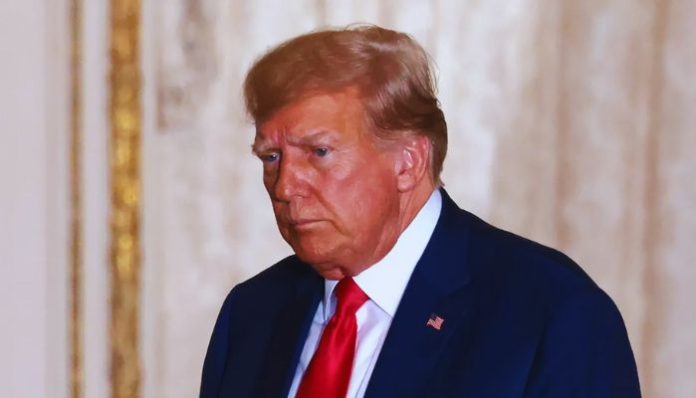
On 24th October the United States President Donald Trump declared that he was terminating “all trade negotiations” with his neighbour Canada due to recent television advertisements against the tariffs. He described it as “egregious behaviour” intended to sway US court rulings regarding his tariff policy.
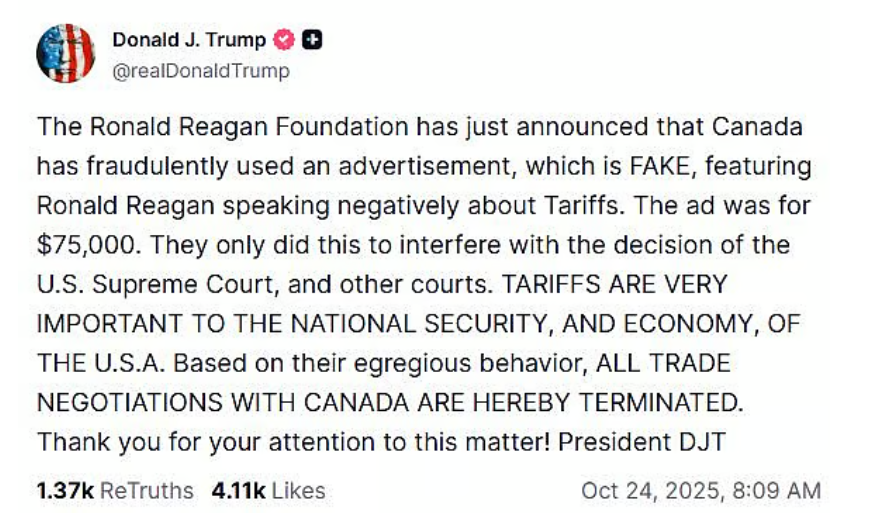
Trump posted on his social media site, Truth Social, to inform followers that the Ronald Reagan Foundation had revealed that Canada had unlawfully utilised a fake advertising that showed Ronald Reagan criticising tariffs. He claimed that the ad which costed $75,000 wanted to “interfere with the decision of the US Supreme Court, and other courts.”
“Tariffs are very important to the national security, and economy of the USA. Based on their egregious behaviour, all trade negotiations with Canada are hereby terminated,” the president concluded.
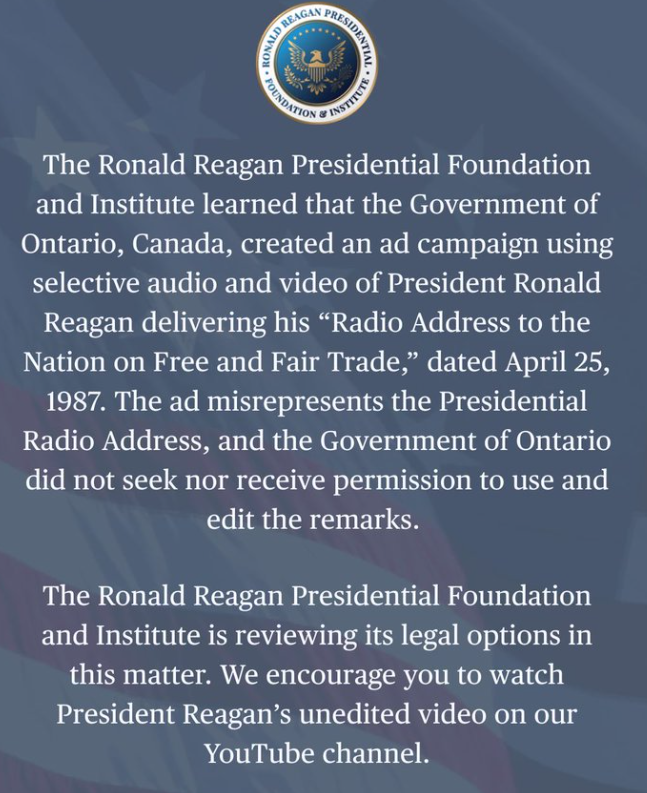
The Ronald Reagan Presidential Foundation and Institute accused that the Ontario government’s advertisement distorted a radio speech that the former president delivered in April 1987 without their approval to use and edit the same. As the foundation considers the legal options in the controversy, it urged people to watch unadulterated footage of the remarks on its YouTube channel.
Trump stated that he has seen the commercial on TV earlier this week and conveyed it demonstrated the effect of his tariffs. Ontario Premier Doug Ford also shared a link to the advertisement along with the caption, “It’s official: Ontario’s new advertising campaign in the U.S. has launched,” on X.
It’s official: Ontario’s new advertising campaign in the U.S. has launched.
— Doug Ford (@fordnation) October 16, 2025
Using every tool we have, we’ll never stop making the case against American tariffs on Canada. The way to prosperity is by working together.
Watch our new ad. pic.twitter.com/SgIVC1cqMJ
The development transpired after Canadian Prime Minister Mark Carney’s announcement that he aimed to double his nation’s exports to non-US nations due to the threat posed by Trump’s tariffs.
Earlier this month, Carmey met Trump in an attempt to defuse trade tensions as the two nations and Mexico prepare for a review of the US-Mexico-Canada Agreement, which Trump negotiated during his first term. Nearly $3.6 billion Canadian (US$2.7 billion) worth of products and services cross the border every day and almost three-quarters of Canadian exports are sent to the United States.
The Trump administration has taken action to levy high tariffs on a variety of Canadian exports. The Canadian government implemented retaliatory taxes on select American goods in April, but it also granted several automakers remission quotas or exemptions to import a set number of vehicles.
Canada’s auto industry which is largely located in Ontario has been particularly harmed by Trump’s tariffs. Carney mentioned that many of the country’s prior advantages which were founded on its close relations to the United States, have turned into vulnerabilities in response to the 25% tariff imposed by the United States.
“The jobs of workers in our industries most affected by US tariffs: autos, steel, lumber, are under threat. Our businesses are holding back investments, restrained by the pall of uncertainty that is hanging over all of us,” he informed.
Carney expressed that the decades-long process of the neighbouring economies growing closer has come to an end. “The US has fundamentally changed its approach to trade, raising its tariffs to levels last seen during the Great Depression. We have to take care of ourselves because we can’t rely on one foreign partner,” he further asserted.
Trump levied a 35% tax on Canadian imports, although he granted exceptions for products covered by the USMCA (United States-Mexico-Canada Agreement) a free trade pact he negotiated with the two nations during his first term. He also slapped sector-specific taxes on Canadian imports, such as 25% on cars and 50% on metals.
