

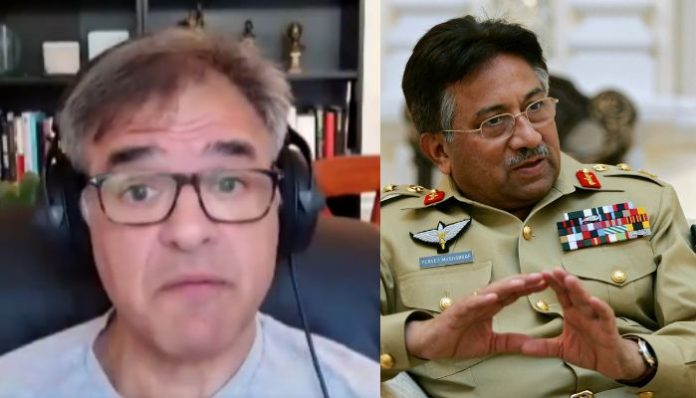
Former CIA officer John Kiriakou, who once headed counterterrorism operations in Pakistan, has made a series of explosive revelations about how the United States dealt with Pakistan and Saudi Arabia, and how power equations in South Asia are changing.
In an interview with ANI, Kiriakou spoke openly about how Washington “bought” Pakistan’s former president Pervez Musharraf with massive financial aid and even gained control over Pakistan’s nuclear arsenal for a period. He also accused the US of hypocrisy in its foreign policy, saying it often supports dictators when it suits its interests.
“When I was stationed in Pakistan in 2002, I was told unofficially that the Pentagon controlled the Pakistani nuclear arsenal, that Musharraf had turned control over to the United States because he was afraid of exactly what you just described (nuclear weapons falling into terrorist hands),” Kiriakou told ANI.
#WATCH | On the question of fear of nuclear weapons falling into terrorists' hands in Pakistan, ex-CIA Officer, John Kiriakou says, "When I was stationed in Pakistan in 2002, I was told unofficially that the Pentagon controlled the Pakistani nuclear arsenal, and that Parvez… pic.twitter.com/iaKPpixhMZ
— ANI (@ANI) October 24, 2025
Musharraf was sponsoring terror against India
Kiriakou added that during Musharraf’s presidency, the US essentially purchased Pakistan’s loyalty through millions of dollars in military and economic aid. “The United States loves working with dictators. You don’t have to deal with public opinion or a free press. We basically bought Musharraf,” Kiriakou said.
He said that under Musharraf’s rule, Washington enjoyed near-complete access to Pakistan’s military and intelligence systems. “We gave millions and millions of dollars, and Musharraf let us do whatever we wanted,” he said.
However, Kiriakou said Musharraf was playing a double game, publicly supporting the US in its counterterrorism efforts while quietly allowing Pakistan’s military to continue its anti-India agenda. “The Pakistani army didn’t care about Al-Qaeda. Their main concern was India. Musharraf pretended to be on our side against terrorism while actually sponsoring terror against India,” he added.
US had expected India to retaliate after the 2001 Parliament attack
Kiriakou said the US had expected India to retaliate after the 2001 Parliament attack and 2008 Mumbai terror attacks, but it did not. “At the CIA we called the Indian policy strategic patience. The Indian government would have been perfectly within its rights to respond by striking Pakistan and they didn’t. And I remember at the White House people were saying, wow, the Indians are really exhibiting a very mature foreign policy here. We expected the Indians to, to strike back and they didn’t. And that kept the world from what might have been a nuclear exchange. Right? But India’s gotten to the point where they can’t risk strategic patience being misunderstood as weakness. And so they had to respond,” he said.
Saudi Arabia blocked US action against A.Q. Khan
The former CIA officer also revealed that Saudi Arabia stopped the US from taking action against Abdul Qadeer Khan, the scientist known as the father of Pakistan’s nuclear weapons program. Kiriakou said that although the CIA had plans to “take out” Khan, Saudi Arabia directly intervened and asked Washington to back off.
“If we had taken the Israeli approach, we would have killed him. He was easy to find. But the Saudis told us, ‘Please leave him alone. We like A.Q. Khan. We’re working with him,’” Kiriakou said.
He called the decision a “big mistake,” claiming the White House ordered the CIA and the International Atomic Energy Agency (IAEA) not to touch Khan. “It had to be because the Saudis insisted,” he said. Kiriakou hinted that Riyadh may have had its own nuclear ambitions at the time, adding, “We always suspected that the Saudis wanted to develop a nuclear program. And looking at the current Saudi-Pakistan defence ties, they may be calling in their investment now.”
“The world is changing, Saudi, China, and India are rising”: Kiriakou
Kiriakou criticised Washington’s foreign policy, accusing it of double standards. “We like to claim that we stand for democracy and human rights, but that’s not true. The US does whatever benefits it at that moment,” he said.
He also described America’s relationship with Saudi Arabia as purely transactional. “Our entire policy with Saudi Arabia is simple, we buy their oil, and they buy our weapons,” Kiriakou said. Recalling an incident from his time in the region, he said a Saudi guard once told him, “You’re the hired help. We paid for you to come here and defend us.”
According to Kiriakou, the global power balance is shifting rapidly, with countries like Saudi Arabia, China, and India taking on more independent roles. “The US doesn’t need Saudi oil anymore, and the Saudis know it. They’re hedging their bets by improving ties with China and India. The world is changing, and we’re watching that transformation unfold,” he concluded.
