

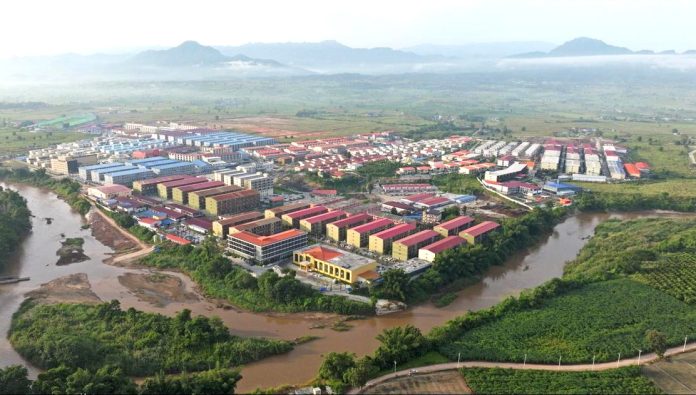
In a dramatic escalation of its campaign against cybercrime operations running from Myawaddy along the border with Thailand, Myanmar’s military junta detonated several buildings in the notorious KK Park scam compound late Friday, sending shockwaves and thick plumes of white smoke across the border into Thailand. The explosions, audible from the Thai town of Mae Sot, came after a week-long operation against the cybercrime centre run by Chinese gangs.
Burmese authorities have released over 2,000 individuals forced to work in the crime centres, seized satellite internet equipment, and triggered a chaotic escape of foreign workers toward safety. Indians form the largest group among them. Most of the trafficking victims from 27 countries were lured on the promise of lucrative jobs and then were forced into cybercrime.
The detonations, which began in the evening time on October 24, targeted structures used for online fraud operations within the sprawling KK Park complex in Myawaddy Township in Kayin State. No casualties were reported from the controlled blasts, which the military described as a measure to permanently dismantle the site’s criminal infrastructure.
Thai authorities were notified in advance about the operations, and they ramped up border patrols and humanitarian support, screening a total of 1,198 migrants, primarily from India, China, and Vietnam, who crossed the Moei River into Mae Sot. Among the workers who were allowed into Thailand are 399 Indians, 147 Chinese nationals, along with Vietnamese, Filipinos, Ethiopians, Pakistanis, Indonesians, Nepalese nationals and people from other countries. 31 Thai nationals were also part of them.
Ahead of the detonation of the buildings, junta’s allied Karen Border Guard Force (BGF) transported Chinese nationals out of KK Park by car on Tuesday. After that, compound gates were opened on Wednesday morning to allow the remaining workers to leave in large groups.
Most of the foreigners queued at the Thai border gate seeking entry, but only a limited number of people were allowed. Local groups have made arrangements for food for around 2000 people who fled KK Parka but were awaiting permission to enter Thailand.
KK Park, a 260-building enclave located on the Myanmar-Thailand border, has been the capital of Southeast Asia’s cybercrime epidemic. Originally developed between 2019 and 2021 as a border trade zone under a lease agreement between the Karen National Union (KNU) and Hong Kong-listed Huanya International, a firm tied to Chinese triad boss Wan Kuok-koi, alias “Broken Tooth”, the site ballooned into a fortress of fraud by 2020.
Researchers estimate it once housed up to 30,000 workers, many lured from across Asia and Africa with false job promises, only to be ensnared in forced labour schemes involving “pig butchering” romance scams, cryptocurrency fraud, and online gambling rackets that have siphoned billions from victims worldwide.
Myanmar troops have raided a Chinese-operated scam centers at KK Park near the Mae Sot border, detaining 2,198 staff, including employees and security guards, and seizing 30 Starlink satellite internet units. The operation, conducted on October 16, targeted a hub linked to… pic.twitter.com/h4NiDb8pNx
— Thai Enquirer (@ThaiEnquirer) October 20, 2025
The massive complex included casinos, hotels, restaurants, nightclubs, brothels, apart from online scam centres notorious for trafficking workers to run “romance scams” and fraudulent investment schemes.
The junta’s raid on the complex began on October 19 amid Myanmar’s grinding civil war. It came after rebel forces including the KNU seized swaths of territory, including parts of Myawaddy, a vital trade corridor to Thailand. A statement by the junta’s information ministry said that troops “cleared” the complex in the weeklong operation, and released over 2,000 people from captivity. The authorities also seized 30 unlicensed Starlink terminals, essential for the scammers’ high-speed internet needs.
Major General Zaw Min Tun, junta spokesperson, blamed Karen National Union “terrorists” for enabling the crimes and termed the operation a territorial reclamation ahead of planned December elections.
SpaceX disables over 2,500 Starlink devices
Coinciding with the action against cybercrime bases in Myanmar, SpaceX announced on Wednesday that it had disabled over 2,500 Starlink devices linked to Myanmar scam centers, including those in KK Park and nearby Shwe Kokko, after detecting violations in operational zones.
Lauren Dreyer, SpaceX’s vice president of business operations for Starlink, in a post on X, “On the rare occasion we identify a violation, we take appropriate action, including working with law enforcement agencies around the world.” She further added, “In Myanmar, for example, SpaceX proactively identified and disabled over 2,500 Starlink Kits in the vicinity of suspected ‘scam centers’.”
Dreyer also said, “SpaceX continually works to identify violations of our Acceptable Use Policy and applicable law because – as with nearly all consumer electronics and services – the same technology that can provide immense benefits has a risk of misuse.”
