

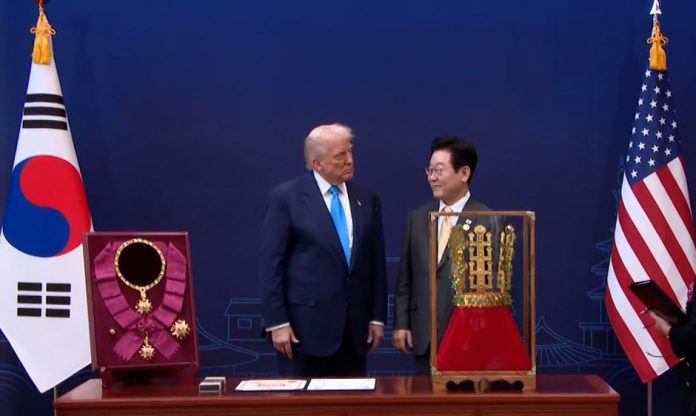
In July this year, U.S. signed a trade deal with South Korea as part of Donald Trump’s trade war against allies and foes. A key component of the deal was the condition that South Korea will invest 350 billion Dollars in the United States. However, both sides differed on the interpretation of this clause, leading the deal to halt for months.
The U.S administration claimed that South Korea will give $350 billion to the U.S. in cash, and this money will be invested in industries as per decisions of the Donald Trump. It was claimed that South Korea will only make the payment, and it will have no control over the investments. However, South Korea disagreed, saying that the investment will be made across sectors, and it will be impossible for one-time payment of $350 billion, as it will sink its economy.
Now, South Korea has released long-awaited details of the trade and investment deal with the United States, countering earlier claims made by U.S. President Donald Trump that Seoul would pay $350 billion “in cash” as part of the agreement. The explanation, issued this week by senior economic adviser Kim Yong-beom, reveals a much more structured and limited arrangement, one that spreads payments over years and includes non-cash components such as shipbuilding cooperation and investment commitments.
According to the disclosure reported by Reuters, the total value of the U.S.–South Korea package stands at about $350 billion, but only $200 billion of that will be delivered as direct investments in the United States.
Even that sum will not arrive as a lump transfer as hoped by Trump, Seoul will make phased instalments, capped at $20 billion per year, to prevent disruption to its foreign-exchange reserves and currency markets. Therefore, Seol will invest $200 billion in the U.S. over a period of 10 years, with $20 billion every year.
The remaining $150 billion will take the form of investment and industrial cooperation, including shipbuilding finance, technology partnerships, and export guarantees involving major Korean companies. U.S. has agreed to this scheme of investment, as per South Korean officials. This structured investment would reduce burdens on the South Korean foreign exchange market as well as increase chances of South Korean companies winning orders, Seoul said.
Kim Yong-beom added that the two sides agreed to split profits 50/50 from South Korean investments in the U.S. before the initial investments are recouped. Moreover, only investments will be made only in commercially viable projects, not in projects arbitrarily selected by President Trump. Kim further said South Korea will use operating income from the country’s foreign assets including interests accrued and dividends.
Under the new terms, U.S. tariffs on South Korean exports will drop to 15% from the earlier rate of 25%. U.S. is also allowing South Korea to build a nuclear submarine in the Philadelphia Shipyards, with will be the first nuclear submarine for the country.
Trump had earlier portrayed the deal as a historic financial victory for Washington, claiming that South Korea had agreed to pay $350 billion in cash, a statement that suggested the U.S. government could freely “invest” the sum as it wished. The new information from Seoul directly contradicts that narrative, indicating that there was never any plan for an immediate cash payment of such scale.
Earlier South Korean officials had said that an outright transfer of $350 billion would have been impossible without destabilizing South Korea’s economy and foreign exchange market. “We are not able to pay $350 billion in cash,” South Korea’s National Security Adviser Wi Sung-lac had said last month. The comments came after Trump said, “We have in Japan it’s $550 billion, South Korea’s $350 billion. That’s upfront.”
Given the structured payment schedule, Trump would receive no more than $60 billion before his presidential term is over, assuming the annual cap of $20 billion remains in place and the instalments continue smoothly through the end of his tenure. It can be maximin $80 billion if the first instalment is invested this year itself, which seems unlikely as a lot of things need to be finalised before implementing the deal. The majority of the cash component, along with most of the industrial investments, would therefore materialise only after his time in office.
The clarification also shows that the “deal” was less a traditional trade agreement and more an investment framework combining financial flows, industrial cooperation, and market access commitments. Korean officials underscored that the U.S. had eventually accepted this structure, rather than insisting on an upfront payment.
In short, South Korea’s newly released details make clear that the Trump administration’s portrayal of the agreement, as a $350 billion cash windfall for the United States, was misleading. Only about $200 billion will be directly invested in the U.S., gradually over several years, while the rest consists of cooperative investments designed to benefit both sides’ industries rather than serve as a direct payment to Washington.
