

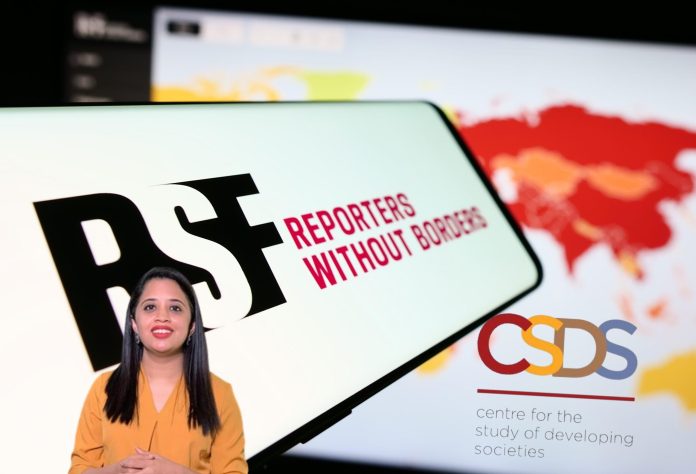
Reporters Without Borders (RSF) has released its 2025 list of “Press Freedom Predators,” targeting a mix of global leaders, tech giants and institutions, from Elon Musk, Netanyahu and Vladimir Putin to the Chinese Communist Party, IDF, Alphabet and Meta.
From India, RSF has named Adani Group and OpIndia as “enemies of journalists,” accusing them of harassment and disinformation. RSF claims OpIndia ramped up “attacks” on government-critical journalists in 2025, citing its exposé on CSDS and its reports on Dhanya Rajendran.
RSF, which acts a front to manipulate public opinion with his prejudiced indices, alleges OpIndia pushed “Soros ecosystem” narratives and triggered “coordinated harassment”, yet offers no factual rebuttal to any of the articles it complains about.
Here are the two reports based on which RSF declared OpIndia a global threat:
Report 1: Research paper on CSDS, scrutinising its history, ideological orientation, funding ecosystem, and collaborations with foreign entities
This research paper presents a comprehensive investigation into the Centre for the Study of Developing Societies (CSDS), uncovering how the institution has evolved into a central node in a global network of foreign-funded NGOs, think tanks, media platforms, and “democracy promotion” outfits. Far from being an independent academic body, CSDS emerges as an ideological project rooted in Western-backed activism since its inception in 1963, when it received early support from the Asia Foundation, a known CIA front.
Over the decades, CSDS has consistently advanced a narrative architecture that delegitimises India’s majority population, pathologises Hindu civilisational identity, and frames the Indian state, especially under Prime Minister Narendra Modi, as authoritarian and oppressive. The paper argues that this intellectual scaffolding is not accidental but mirrors the strategic priorities of foreign governments and regime-change actors who seek to influence, pressure, and reshape India’s internal political and social landscape.
OpIndia’s research paper demonstrates that CSDS’s vast web of foreign funders, ranging from German political foundations and Canadian crown corporations to U.S.-based philanthropic powerhouses like Open Society, Ford, and Omidyar, creates a system of financial leverage that shapes its research agenda and ideological output.
Through collaborative projects, media linkages, and overlapping personnel with Western “investigative” networks such as GIJN, OCCRP, RSF, and Bellingcat, CSDS functions as both a producer and amplifier of narratives that fragment Hindu society, manufacture minority victimhood, and justify external intervention in India’s domestic affairs.
This coordinated ecosystem feeds a self-reinforcing loop: foreign-funded research generates alarmist claims about India, these claims are elevated by international media and indices, and the resulting global pressure emboldens agitation networks at home.
The paper concluded CSDS represents a textbook case of how academic institutions can be weaponised into instruments of narrative warfare, necessitating strict scrutiny, transparency, and regulatory oversight to safeguard India’s sovereignty and democratic security.
Report 2: Dhanya Rajendran nominated by RSF after Dharmasthala hitjob
Dhanya Rajendran’s nomination for RSF’s “Impact Prize of the Year 2025”, the report argued, is not a recognition of journalistic merit but a political reward issued just weeks after The News Minute was exposed for amplifying the fabricated Dharmasthala “mass grave” hoax.
It recounts how TNM turned an unverified claim into a national scandal, feeding long-standing biases against Hindu institutions, only for the story to collapse when the SIT found zero evidence and the whistleblower admitted he was coached and paid.
Yet instead of accountability, Rajendran was elevated by Reporters Without Borders, an organisation funded by Western governments, billionaire foundations, and regime-change outfits like NED and Open Society.
The article frames this as a calculated act of ideological endorsement, not an honour for press freedom. It further argues that RSF, Soros-linked media networks, and their Indian partners operate a coordinated ecosystem that selectively targets Hindu institutions while downplaying Islamist or Church-linked crimes.
Through awards, rankings, and global amplification, this network rewards journalists who push narratives of a “majoritarian,” “authoritarian” India and punishes those who challenge them. Examples such as the Ajmer Dargah scandal, ISIS grooming networks, and the Pegasus hoax illustrate this pattern of selective morality and narrative manufacturing.
Rajendran’s nomination, the article claims, is part of a larger strategy of narrative laundering using Western validations to legitimise biased journalism, undermine India’s image, and reinforce a propaganda cycle in which truth becomes the casualty and ideological loyalty becomes the criterion for global acclaim.
