

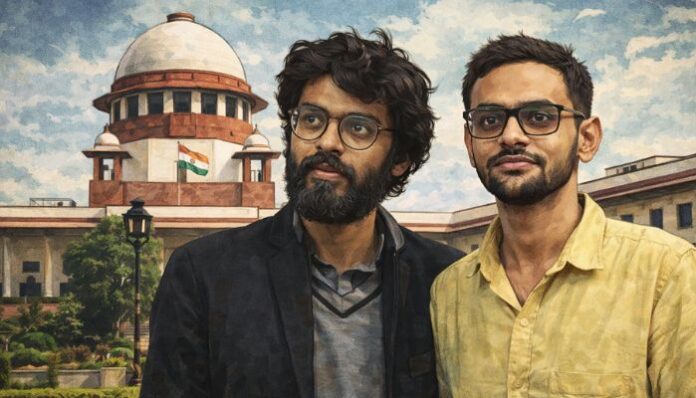
On 5th January, the Supreme Court of India refused to grant bail to Umar Khalid and Sharjeel Imam in the 2020 Delhi riots larger conspiracy case. The apex court held that both accused stand on a qualitatively different footing from other co accused booked under the Unlawful Activities Prevention Act (UAPA). At the same time, the court granted bail to five other accused while citing prolonged incarceration and delay in trial. The judgment was pronounced by a Bench of Justice Aravind Kumar and Justice NV Anjaria.
Court draws distinction between accused
The court observed that bail pleas must be examined individually and noted that all seven accused could not be treated as being on the same level of culpability. The court ruled that the prosecution material discloses a prima facie case against Khalid and Imam. Thus, the statutory threshold under Section 43D(5) of the UAPA was attracted.
Judgement: the court has consciously avoided a collective or unified approach.
— Bar and Bench (@barandbench) January 5, 2026
This court is satisfied that the prosecution material disclosed a prima facie allegation against the appellants Umar Khalid and Sharjeel Imam. The statutory threshold stands attracted qua these…
The Bench further held that the stage of proceedings did not justify granting bail to them. However, the court allowed both Khalid and Imam the liberty to renew their bail pleas after the examination of protected witnesses or after one year from the present order.
Bail for five accused, strict conditions imposed
The court allowed bail to five accused, namely Gulfisha Fatima, Meeran Haider, Shifa ur Rehman, Shadab Ahmed and Mohd Saleem Khan. The court imposed 12 restrictions on them in the bail order. The apex court emphasised the constitutional right to personal liberty and stated that even in cases under special statutes like the UAPA, prolonged pre trial incarceration cannot be ignored.
The court noted that while the UAPA sets a higher threshold for bail, it does not mandate automatic denial. Delay in trial serves as a trigger for heightened judicial scrutiny, especially when undertrial custody has extended for years.
Article 21 and limits of UAPA
The court reiterated that under Article 21 of the Constitution of India, the State is required to justify continued detention before conviction. The court further clarified that although the UAPA departs from general bail principles, it does not oust the jurisdiction of the court to grant bail where judicial intervention is warranted based on the circumstances.
The court also observed that UAPA offences often relate to wider conspiracies rather than isolated acts, a factor that informs the statutory scheme governing bail.
Background of the case
The larger conspiracy case arises from the anti-Hindu Delhi Riots of 2020, in which 53 people died and hundreds were injured. An FIR was registered by the Special Cell of the Delhi Police alleging that a larger conspiracy was hatched to engineer multiple riots.
Umar Khalid was arrested in September 2020 and has been in custody since then. Sharjeel Imam was booked in several FIRs across states on sedition and UAPA charges. He secured bail in other cases but remained in jail in the larger conspiracy matter.
