

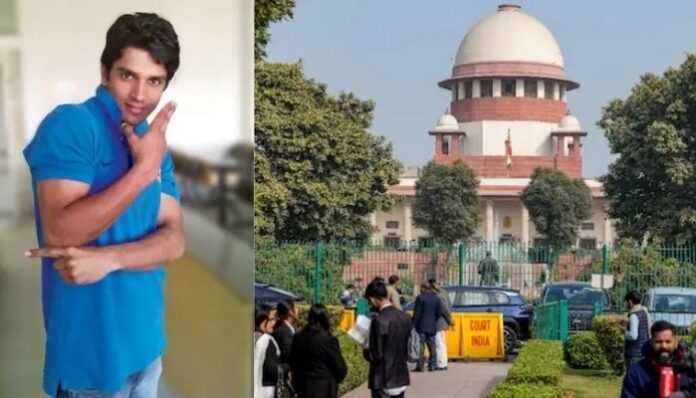
The Supreme Court on Thursday (15th January) reserved its judgment on a petition seeking permission to withdraw life-sustaining treatment for Harish Rana, a man who has been in a permanent vegetative state for more than 13 years following a severe brain injury. The case has once again brought attention to the complex ethical, legal and emotional questions surrounding end-of-life decisions in India.
A Bench of Justices J.B. Pardiwala and K.V. Viswanathan heard detailed arguments from both sides before concluding the hearing and reserving its decision.
Teenager’s fall left him permanently vegetative
Appearing for the petitioner, Advocate Rashmi Nandakumar told the court that Harish Rana was in his late teens when his life changed forever. She said Rana fell from the fourth floor of an apartment building in Chandigarh, suffering a traumatic brain injury that caused irreversible damage.
Since the accident, Rana has remained in a permanent vegetative state and is entirely dependent on clinically assisted nutrition and hydration to survive. Nandakumar described his condition as “incurable” and said medical experts have assessed him as having “100% mental retardation” with no chance of recovery.
She informed the Bench that medical boards have clearly stated that Rana suffers from non-progressive and irreversible brain damage caused by severe traumatic injury with diffuse axonal damage.
According to the medical opinion placed before the court, he meets all the criteria required to be classified as being in a permanent vegetative state and has remained in this condition continuously for the last 13 years.
Withdrawal of nutrition amounts to passive euthanasia: Petitioner
Nandakumar argued that the continued administration of clinically assisted nutrition and hydration amounts to mechanical life support. She said such treatment falls squarely within the definition of life-sustaining treatment.
Explaining the legal position, she told the court that passive euthanasia involves either withholding or withdrawing medical treatment that only serves to artificially prolong life. This includes removing a patient from life-support systems when there is no hope of recovery and the patient has permanently lost cognitive function.
She urged the court to consider the prolonged suffering of the patient and the emotional and financial toll on the family.
Centre says court guidelines are rarely implemented
The Union government was represented by Additional Solicitor General Aishwarya Bhati, who told the Bench that the Centre was assisting the court as directed. Bhati said the government had conducted extensive research on the issue of passive euthanasia and found that the Supreme Court’s landmark judgment in Common Cause vs Union of India had seen little effective implementation across the country.
That judgment had laid down guidelines allowing passive euthanasia under strict safeguards, but Bhati said these guidelines have not translated into real-world practice in most cases.
Medical condition shows a complete loss of awareness
Referring to the medical records, the ASG told the court that Harish Rana is in a state of complete inertness. She said his eyes do not follow movement, he does not react to objects brought close to his face, and there is no response to fear or sensory stimuli.
According to Bhati, these clinical signs show a deep and irreversible loss of neurological, cognitive and sensory functions. She submitted that there has been no meaningful improvement in Rana’s condition over the years, despite continuous medical care.
Judges call issue deeply sensitive
After hearing both sides, the Bench noted that detailed written submissions and relevant case laws had been placed on record by the petitioner as well as the Union government. The judges recorded that the arguments were complete and reserved the judgment.
After hearing both sides, the Bench noted that detailed written submissions and relevant case laws had been placed on record by the petitioner as well as the Union government. The judges recorded that the arguments were complete and reserved.
Justice Pardiwala, while thanking both lawyers for their assistance, made a thoughtful observation on the nature of the case. “These are very delicate issues,” he said, adding that judges, too, are mortals and often struggle with the question of who they are to decide matters concerning another person’s life and death.
On 18th December last year, the Bench had said it wanted to personally meet the parents of the patient, who is now 31 years old and has remained in a comatose or vegetative state for over 12 years.
The court had examined a report submitted by a secondary medical board from AIIMS, New Delhi, detailing Rana’s condition and treatment history. Calling the report “sad,” the Bench had remarked, “We cannot keep this boy in this stage.”
Earlier, the Supreme Court had directed AIIMS to form a secondary medical board to assess whether life-sustaining treatment could be withdrawn. The court acted after medical experts concluded that Rana’s chances of recovery were “negligible.”
With judgment now reserved, the case awaits a decision that could have far-reaching implications for passive euthanasia and end-of-life care in India.
