

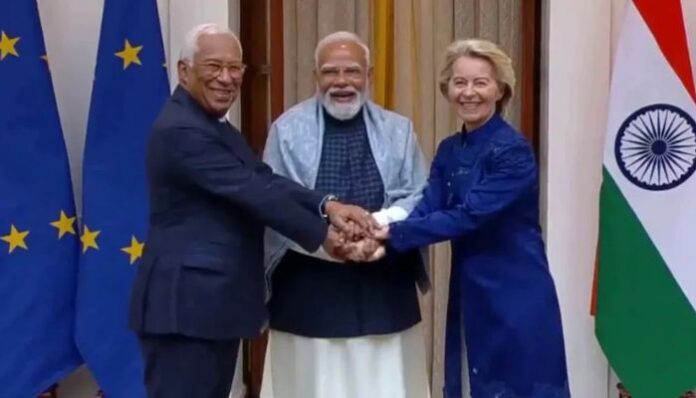
India and the European Union have finally wrapped up negotiations on a long-pending free trade agreement, a deal that Commerce and Industry Minister Piyush Goyal described as one of the most wide-ranging trade pacts India has ever signed. This deal has been described as the “mother of all deals” for the subcontinent. Speaking on Tuesday, 27th January, at a joint press conference with the Commerce and External Affairs Ministry, Goyal explained that the pact offers duty cuts on nearly all goods and services traded between them.
This deal is super comprehensive; it covers about 99% of what India sends to the EU and 97% of what Europe sends here. It’s one of the biggest trade pacts either side has ever signed, ending nearly 20 years of on-again, off-again negotiations. Goyal pointed out that it’s India’s 8th such agreement under Prime Minister Narendra Modi, all with advanced economies. Together, these deals link India to trade with 37 developed nations, showing a smart shift in how India does business abroad.
Breakthrough after two decades of talks
Goyal said this breakthrough came after 20 long years, with the real push starting in 2024. Both sides smartly set aside tricky political and economic issues to get a fair deal done. “We left the sensitive stuff aside and landed a balanced, win-win FTA for industries on both sides,” he explained. The EU is a huge market, sucking in $6.5 trillion in goods and $3 trillion in services each year, one of the biggest shopping spots out there.
India is opening up some areas like auto parts, wines, and spirits for better access. But they’ve protected weak spots by keeping them out or giving long timelines to adjust. “We’ve made sure sensitive items are excluded or get plenty of time to adapt,” Goyal added.
He even said India will soon match Bangladesh on duties. Remember how everyone asked why Bangladesh ships $30 billion in textiles to the EU duty-free as a least-developed country, while India’s $7 billion faces up to 12% tariffs? This levels the playing field in that massive $250 billion EU textile market.
India can now ramp up textile exports to compete with Bangladesh in Europe
— Shashank Mattoo (@MattooShashank) January 27, 2026
"India can boost textile exports to Europe from $7 billion to $30-40 billion quickly. We were always asked how Bangladesh exports so much to Europe. They had zero duties and captured a $30 billion share" pic.twitter.com/HK6HtrJvTX
Jobs boom from $7 Billion textile exports
Goyal highlighted how this goes way beyond just cutting tariffs. “This goes far beyond a regular FTA; India and the EU are teaming up in tons of areas for a better future for a third of the world’s people,” he noted. It’s a huge milestone for India’s trade game and edge in global markets. “I congratulate 1.4 billion Indians today,” he cheered.
The real kicker is jobs, especially in textiles, India’s second-biggest employer after farming, with 40 million jobs already. Better access could supercharge those $7 billion yearly exports and add 6-7 million more jobs. “This will create loads of jobs in India and the EU through tariff breaks and supply chain links,” Goyal said.
India already plays a dominant role in global home textile supply, particularly in bed linen, towels, curtains, and soft furnishings. With tariff barriers removed, European importers are likely to increase sourcing volumes significantly.
For retailers, the deal improves pricing stability and product availability. For Indian producers, it offers long-term access to one of the world’s most valuable consumer markets. For European manufacturers, it raises the importance of specialization, branding, and premium positioning.
Commerce Secretary Rajesh Agrawal said the agreement will be formally signed after legal checks are completed, following which it will move to ratification in India and the EU.
Historic ‘VonDerful’ pact at 16th summit
At the 16th India-EU Summit, they sealed this history-making deal, relaunched in 2022. It puts India and the EU in an elite club of trusted partners for fair trade, steady access, and deep ties. Services get a big boost, Indian companies now have a reliable entry into 144 EU areas like IT, finance, education, and tourism. There’s a solid setup for business travel, company transfers, pros on contract, and even family perks, plus steps toward social security and student swaps.
