

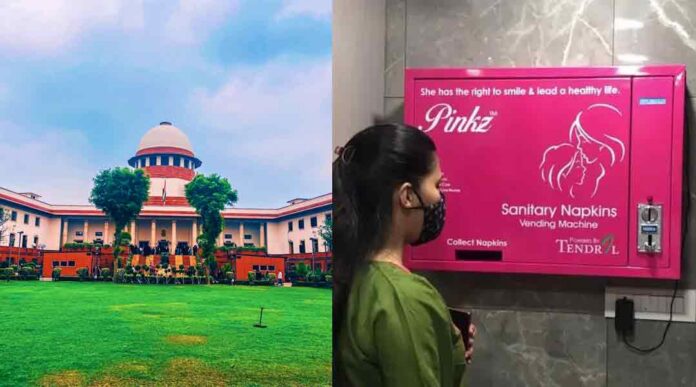
In a landmark ruling, the Supreme Court on Friday (30th January) recognised the right to menstrual hygiene and access to menstrual hygiene products as a part of the right to life under Article 21 of the Constitution. A bench of Justices JB Pardiwala and R Mahadevan issued a set of guidelines while hearing a case relating to the countrywide implementation of the Centre’s policy ‘Menstrual Hygiene Policy for School-going Girls’ in government and government-aided schools.
“The right to life under Article 21 of the Constitution includes the right to menstrual health. Access to safe, effective, and affordable menstrual hygiene management measures helps a girl child attain the highest standard of sexual and reproductive health. The right to a healthy reproductive life embraces the right to access education and information about sexual health. The right to equality is expressed through the right to participate on equal terms. At the same time, equality of opportunity necessitates that everyone has a fair chance to acquire the skills necessary to access benefits,” the Court held.
Inaccessibility to menstrual hygiene measures undermines the dignity of a girl
In this case, the top court was concerned with the question of whether the unavailability of gender-segregated toilets and non-access to menstrual absorbents is a violation of the right to education. In answer to this question, the court held that the inaccessibility of menstrual hygiene management measures would amount to undermining the dignity of a girl child.
“The inaccessibility of menstrual hygiene management measures undermines the dignity of a girl child, as dignity finds expression in conditions that enable individuals to live without humiliation, exclusion, or avoidable suffering. Privacy is inextricably linked with dignity. As a corollary, the right to privacy entails a duty on the State not only to refrain from violating privacy, but also an accompanying obligation to take necessary measures to protect the privacy of an individual,” the court asserted.
Right to equality expressed through the right to participate on equal terms
The Court further said that the unavailability of gender-segregated toilets and the lack of access to menstrual hygiene management amount to a violation of the right to participation and equality of opportunity. “The right to equality is expressed through the right to participate on equal terms, and at the same time, the equality of opportunity necessitates that everybody has a fair chance to acquire the skills necessary to access benefits. Inaccessibility of menstrual hygiene management measures strips away the right to participate on equal terms in schools. The domino effect of the absence of education is the inability to participate in all walks of life in future later,” the court stated.
The Court said that the lack of access to menstrual hygiene management measures would have an impact on girls’ access to education, which enables them to access other connected human rights. “The right to education is termed a multiplier right as it enables the exercise of other human rights. The right to education forms a part of the broader framework of the right to life and human dignity, which cannot be realised without access to education. The substantive approach to equality demands that the treatment be accorded with due regard to institutional, systematic and contextual barriers that impede the translation of rights in reality,” the court explained.
“The State as a benefactor is under an obligation to remedy such structural disadvantages. The fundamental right to education under Article 21A and the RTE Act comprises free, compulsory and quality education. Free education includes all kinds of charges or expenses which would prevent a child from pursuing and completing elementary education,” the Supreme Court said, adding that all the schools, whether run privately or by the government, must comply with the Act.
Supreme Court’s guidelines for schools
Directing the pan-Indian implementation of the policy, the Apex Court issued a set of directions to be implemented in schools across the country:
- All States/UT must ensure that every school, whether government-run or privately managed, in both urban and rural areas, is provided with functional gender segregated toilets with usable water connectivity.
- All existing or newly constructed toilets in schools shall be designed, constructed and maintained to ensure privacy and accessibility, including by catering to the needs of children with disabilities.
- All school toilets must be equipped with functional washing facilities and soap and water available at all times.
- All states/UTs must ensure that every school, whether government-run or privately managed, in both urban and rural areas, provides oxyzo-biodegradable sanitary napkins manufactured in compliance with the ASDM-694 standards free of cost. Such sanitary napkins must be made readily accessible to girl students, preferably within toilet premises through sanitary napkin vending machines or, where not visible, at a designated place.
- All States/UTs must ensure that every school, whether government-run or privately managed, in both urban and rural areas establish menstrual hygiene management corners. It must be equipped with spare innerwear, uniforms, disposable pads and other necessary materials to address menstrual urgency.
Justice Pardiwala said that the pronouncement is not just for stakeholders of the legal system. He said, “It is also meant for classrooms where girls hesitate to ask for help. It is for teachers who want to help but are restrained due to a lack of resources. And it is for parents who may not realise the impact of their silence and for society to establish its progress as a measure in how we protect the most vulnerable.”
