

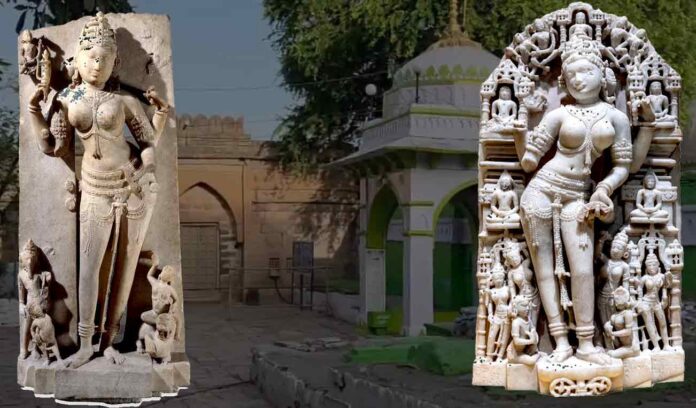
The recent Madhya Pradesh High Court verdict that upheld the Hindu religious nature of the long-disputed Bhojshala complex in Dhar, Madhya Pradesh, also threw light on a lesser-known aspect of the temple’s history. The verdict drew national attention to the ancient Goddess Saraswati Pratima (consecrated statue) belonging to the temple, which was smuggled out of the country during the British era.
Petitioners from the Hindu side had requested the High Court to issue directions for the repatriation of the Goddess Saraswati Pratima, which is currently kept at the British Museum in London, United Kingdom. As per the submissions made by the petitioners, an inscription at the base of Goddess Saraswati Pratima states that Vararuci, an official in the Paramara kingdom, had made two pratimas: one of Vagdevi and another of Amba (both representing Goddess Saraswati). Both the Pratimas are now placed in the British Museum in London.
“That an inscription on the base of a Pratima notes that Vararuci, an official in Paramara kingdom, had made two pratimas, together with the pratima of 3 Jinas (tirthankaras): one of Vagdevi and another of Amba. Both forms Vagdevi and Amba represent the divinity of Saraswati. The two Pratima of Saraswati, are both over 1000 years antiquity and are now held in the British Museum. British Museum should return the Pratima for puja (worship) in Saraswati Mandiram (temple), Dhar, Central India,” a submission stated.
After hearing the submissions of the petitioners and examining the historical evidence, a Division Bench of Vijay Kumar Shukla and Alok Awasthi noted that the Pratimas were removed by British officials and are now preserved in the British Museum in the United Kingdom. “Based on the various documentaries, evidences available in all the cases, it is established as fact that British officials, recognizing their significance, removed and preserved two idols found near the disputed Bhojshala complex in Dhar, which is now housed in a museum in London,” the High Court observed.
The High Court asked the central government to consider the representations of the petitioners and repatriate the Pratima from the London Museum and re-establish it within the temple complex. “So far the relief claimed by the petitioners to bring back the Pratima of goddess Saraswati from London Museum, UK and re-establish same within the Bhojshala complex, the petitioners in WP No.10497/2022 and WP No.10484/2022 have already made number of representations to the Government of India, the Government of India may consider their representations to bring back the Pratima of goddess Saraswati from London Museum and re-establish the same within the complex,” the Court said.
The pratimas, which originally stood inside the shrine complex during the reign of King Bhoj in the 11th century, have been on display in the museum since 1903. According to the petitioners and the ASI (Archaeological Survey of India) records, Major General William Kincaid, a British political agent, excavated the Bhojshala complex site in 1875. During the excavation, he found the statue of Vagdevi (Saraswati), which had been buried there by Muslim rulers. In 1903, Lord Curzon took away the idol of Vagdevi found within the temple complex, and the same has since been kept in the museum in the United Kingdom.
The verdict states that the second idol in London has been labelled as “Jain Vidyadevi”, and it is universally accepted that Saraswati is the goddess of Vidya (knowledge). The idol has a book in a hand, making it clear that it is Saraswati.
The Vagdevi Idol
The Vagdevi (Saraswati) idol is a remarkable 11th-century marble sculpture created during the reign of Raja Bhoja of the Paramara dynasty in Dhar, Madhya Pradesh. Carved from coarse white marble, the standing figure measures approximately 1,285 mm (about 4 feet 2.5 inches) in height, 586 mm in width, and 265 mm in depth, weighing around 250 kg.
Depicted in high relief against a plain slab background with an offset inscribed base, the goddess originally possessed four arms, though two are now broken. In the surviving hands, she holds an elephant goad (aṅkuśa) and what appears to be the lower part of a noose or the stalk of a plant.
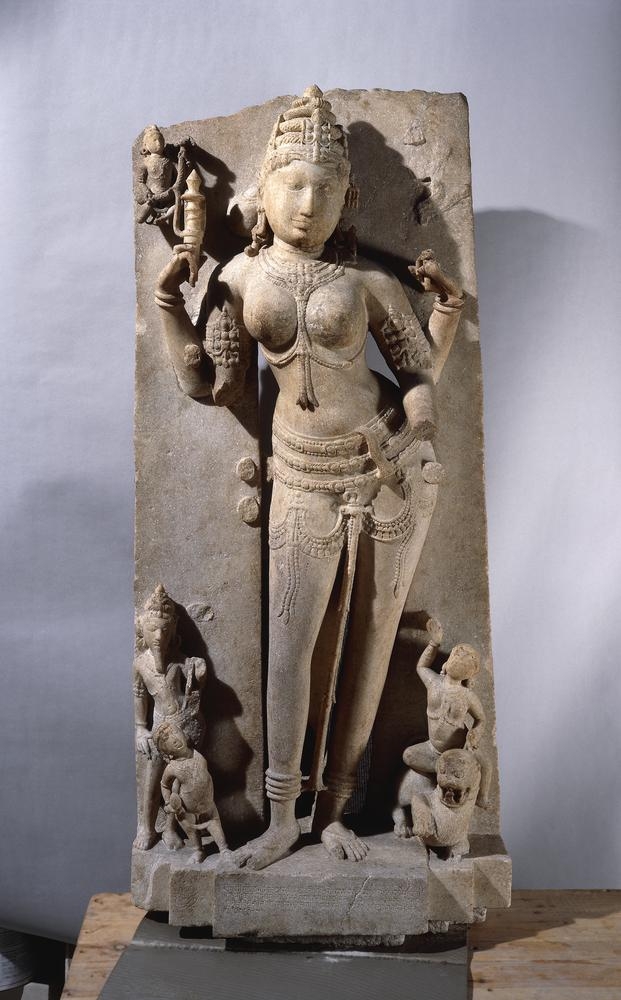
She wears a distinctive tiered beehive-style (karaṇḍa) crown, with her long hair gathered into a small bun on one side, and the sculpture features fine detailing of jewellery and drapery typical of medieval Indian artistry. A small incised figure of a kneeling female donor is visible on one stepped face of the base, accompanied by Sanskrit inscriptions in Devanagari script.
Discovered in 1875 by British officer Major General William Kincaid, the idol was later transported to England and acquired by the British Museum around 1880, where it is registered as museum number 1909,1224.1 and currently displayed in Gallery 33. The museum has listed it as “Jaina yakṣiṇī Ambikā”.
The Amba Idol
The second idol mentioned in the verdict is another significant 11th-century marble sculpture linked to the Paramara dynasty and the scholarly heritage of King Bhoja’s temple complex in Dhar, Madhya Pradesh. It is currently displayed at the British Museum, registered as British Museum number 1880.349 and displayed at section 1 of Gallery 33.
Carved from white marble, this standing figure measures approximately 66.1 cm (about 26 inches) in height. It depicts a four-armed Jain Vidyādevī (goddess of knowledge), revered in Indian tradition as a form associated with Saraswati or Vagdevi. The goddess holds a rosary (akṣamālā) in her upraised left hand and a small book (pustaka) in her lower left hand, while her right hands are now broken.
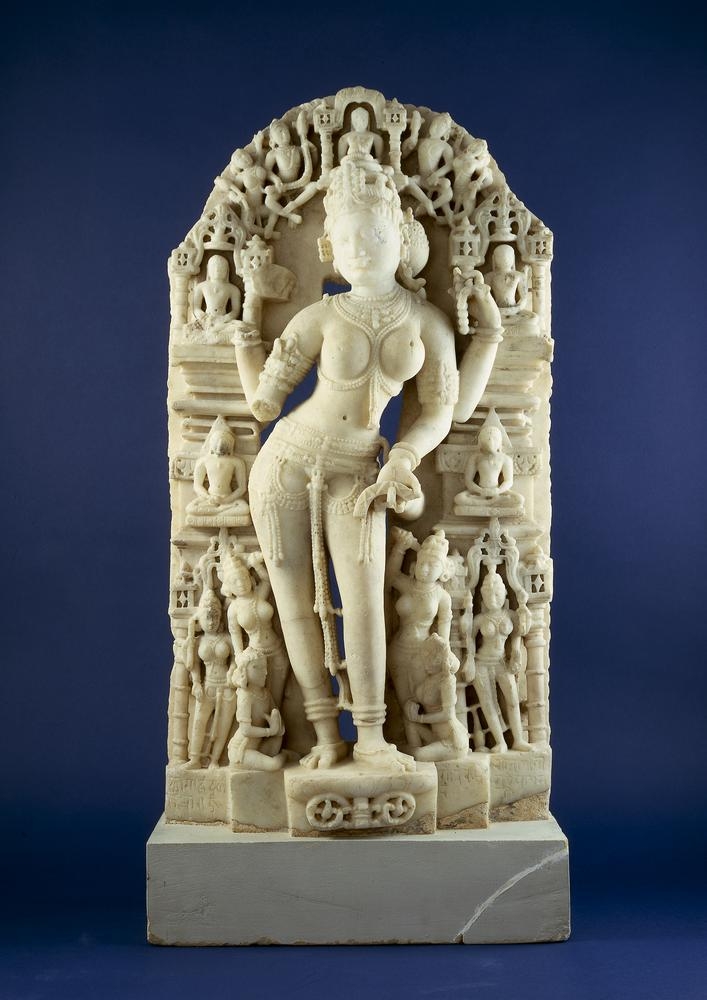
She wears a distinctive beehive-shaped crown (karaṇḍa) with her hair arranged in a large bun, complemented by an elaborate pearled necklace with loops passing under the breasts, a girdle with a long pendant reaching the ankles, and festoons draped over the thighs. The figure is framed by an elaborately moulded niche featuring seated Jinas above, flying celestials, donor figures, and female attendants holding flywhisks at the base, along with subsidiary goddesses in small niches displaying the boon-granting gesture (varadamudrā) and lotus tendrils.
The idol has a two-line inscription in Devnagari on the pedestal. The British Museum states that the idol was probably found in southern Rajasthan.
Bhojshala
The Bhojshala complex was established as a major seat of Sanskrit learning in Dhar during the reign of Raja Bhoj of the Parmara dynasty. Scholars studied grammar, philosophy and literature at the institution. The Saraswati Pratima was installed inside the Bhojshala complex as the presiding deity.
The Bhojshala complex endured repeated destruction and vandalism at the hands of Islamic invaders. Large portions of the complex were destroyed during Alauddin Khilji’s invasion in 1305. This was followed by another bout of destruction in 1401 by the Islamist invader Dilawar Khan, who demolished the temple and transformed part of it into a dargah.
Later in 1514, Mehmud Shah Khilji further converted parts of land outside the Bhojshala into a dargah, establishing the Kamal Maula Makbara. It was constructed 204 years after death of Maulana Kamaluddin, who died at Karnawati (present day Ahmedabad) in 1310. Centuries later, the British carried out an excavation at the Bhojshala complex in 1875, during which several historical pieces of evidence, including the Saraswati pratima, were unearthed.
Pertinently, the Indian government has recently secured the return of several artefacts associated with the Indian cultural heritage. Earlier this week, the Dutch government returned 11th-century Anaimangalam copper plates, also known as the Leiden Plates, to India. In January this year, the Smithsonian’s National Museum of Asian Art in Washington, D.C., returned three stolen Indian bronze statues to the Indian government.


