

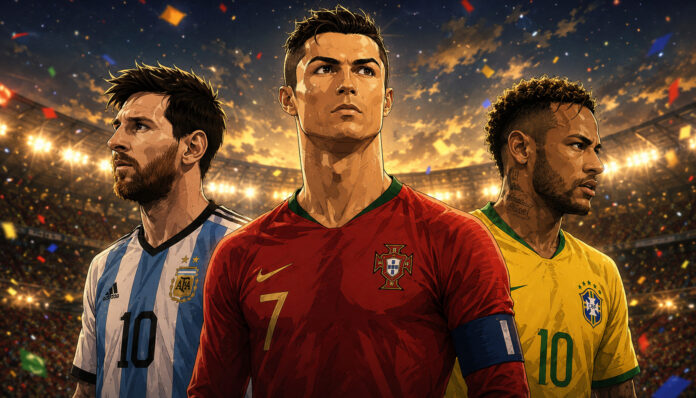
Fans gathered around television screens in cafés along the Tagus riverfront on Tuesday evening in Lisbon, and as Roberto Martínez read out the name that inevitably concludes every Portugal squad announcement, the crowd went silent for a moment. Families in Rosario, a city that has learned to map its emotions onto one man’s football calendar, leaned forward in their living rooms as Argentina’s preliminary 55 man roster was reviewed for the umpteenth time that week. Additionally, supporters erupted in Rio de Janeiro at the Museu do Amanhã, a museum of the future of all places, when Carlo Ancelotti verified that the name they had dreaded might never appear again ultimately did. One final World Cup, three cities, and three men.
The 2026 FIFA World Cup, which will take place in the United States, Canada, and Mexico, is surrounded by something that even the most seasoned fans find hard to describe. It’s neither quite celebration nor nearly despair. It is the strange pain of seeing something come to an end when it is still, in some way, phenomenal.
Cristiano Ronaldo: The architects final blueprint
After being added to Portugal’s squad for the tournament, Cristiano Ronaldo is expected to make a record breaking sixth World Cup appearance, making history as the first man to do so. The number merits a little period of silence. He made his World Cup debut in 2006, when George W. Bush was president, José Mourinho was managing Chelsea, and the majority of the players who will face Portugal this summer were in primary school.
What is often ignored in the frenzy around Ronaldo’s personal achievements is what he has done for Portugal as an institution, rather than just a football team. They have qualified for six World Cups, several European Championships, and won both the UEFA Nations League and the Euro 2016 championship under his shadow, or perhaps more appropriately, his shield. ‘He has the same demands as the other players, a competitiveness to be in the national team and For me, he’s an exemplary captain,’ Martinez stressed, highlighting the fact that Ronaldo’s influence goes well beyond his fame.
That is the subtle, significant story that uninformed viewers completely overlook. Ronaldo did more for Portugal than just score goals; he completely revitalised the country’s football culture. He transformed qualification from a wish to a must. He convinced a generation of Portuguese children that their country belonged at football’s highest table, not as lucky visitors, but as worthy occupants. In November, he told CNN that this would definitely be his final World Cup. At 41, that pronouncement carries weight, even if the man appears to be physically hostile to endings.
Lionel Messi: The cerebral coda
In his third season with Inter Miami, Lionel Messi created MLS history by becoming the fastest player in the league to earn 100 regular-season goal contributions in just 64 games. He reached the milestone just one month before the 2026 World Cup. At 38, what matters most about Messi is the quality of his presence in critical moments, not the quantity of his productivity.
Messi has been included to Argentina’s preliminary squad for the tournament, but the 38 year old has yet to confirm his availability as the country looks to defend its 2022 championship. It speaks to a different kind of Messi, one who is, for the first time, dribbling with his own body rather than with defenders, as seen by the fact that his participation was even little unclear until lately. However, Scaloni has consistently said that the remaining 25 berths are still up for grabs, with only Lionel Messi having a definite spot.
Historically, defending a World Cup has been a brutal endeavour. Since Brazil in 1958 and 1962, no country has done so again. Messi bears the psychological burden of arriving as champions, with all the expectations that come with it, the tactical familiarity that opponents will have thoroughly studied, and the reduced element of surprise. Argentina, on the other hand, has a captain who has mastered the art of running into the correct fraction of space, so he no longer needs to rush past everyone. His game has grown into something almost architectural, in that he sets himself inside the geometry of a passage of play rather than driving it, making the entire structure around him more unified.
Neymar: The gamble for redemption
Neymar, 34, is Brazil’s all time leading goal scorer with 79 goals and will be at his fourth World Cup. Since tearing his left ACL in October 2023, the Santos striker has had difficulty regaining his best form. That injury, which occurred while playing for Brazil versus Uruguay in a CONMEBOL qualification, appeared to be the end of his international career at the time. It did not.
Neymar has been named to Brazil’s World Cup roster, a decision that many local observers and former players thought was unlikely just days ago. At his Rio de Janeiro press conference, Ancelotti, who has chosen to speak in terms of experience and environment rather than pure fitness measures, stated, ‘He has improved his fitness.’ In this World Cup, he will play a significant role.The coach went on to say that for certain positions in his team, he wanted guys with more experience. ‘He has experience in this kind of competition, the love of our group, he can create a better environment in this group.’
For almost three years, Neymar has not represented Brazil. The public’s impression of his absence has been filled with a complex mix of pity and annoyance, sympathy for the injury and annoyance at the idea that his club football in Saudi Arabia had placed more emphasis on display than content. The World Cup provides him with the tidy narrative he has always sought: architect rather than showman. Morocco, Haiti, and Scotland are Brazil’s group opponents. If handled properly, this bracket offers the Seleção easy progress, but Neymar’s ability to unlock compact defensive positions in close tournament games could be crucial from the moment Ancelotti makes sure he is prepared.
What the naked eye misses
The larger tale, as always, is being revealed on the edges.
Observe Ronaldo in Portugal’s recent qualifying campaigns, not when he scores, but when he does not. You’ll see that he’s increasingly drifting to the front post or peeling to the far side of the penalty area, not with any apparent intention of finishing, but to draw a centre-back a metre out of position, creating exactly the corridor through which Bruno Fernandes or Bernardo Silva can enter. It is the motion of a man who has so thoroughly digested the penalty box’s geometry that he is essentially recreating it for his teammates. Even when Ronaldo’s name isn’t on the football scoreboard, his fingerprints are frequently seen in the layout of the final goal.
The details are even microscopic when Messi is involved. Observe him throughout big games, but pay attention to the three or four seconds prior to his clear flashes of genius. A small head tilt to peek over his shoulder. The barely noticeable shoulder-drop that indicates a direction change he hasn’t made yet. Without using words, he may signal a teammate that the pass is going to his left foot instead of his right by making a tiny alteration to his body shape. Television cameras rarely focus on these gestures since they occur before anything dramatic happens. They are, nevertheless, the source code for everything that comes after.
Neymar’s influence on the training field and in the Brazil locker room depends more on colleagues’ testimonies than on camera footage. Former teammates have often described a player who continually converses with younger attackers, modifying their spacing, pushing them into the broader positions that create the openings he subsequently takes advantage of, and encourages them not to swarm in tight spaces. After years of criticism for ball retention that bordered on arrogance, Neymar’s arrival in North America appears to have carefully reconditioned his senses. The most intriguing open question in Brazil’s tournament is whether that recalibration can withstand the heat of a knockout match.
The last curtain
One of these three men is shown lifting a trophy in a stadium in North America as the sun sets on their period in a depiction of the 2026 World Cup that football fans will watch on screens in 2046. Another, equally plausible scenario is when all three exit the competition before their countries would like, but it still becomes theirs because of the qualities they contributed to it rather than the trophies they won.
The only player to score in five World Cups is Ronaldo. Messi is unique in that he is the only player to have won every significant trophy football has to offer, both at the club and international levels. Neymar enters bruised, cherished, and unsettled, still hunting the one title that will settle the dispute over where he belongs in the pantheon.
The feeling that you are witnessing not just players but the last living remnants of a time when three contemporaries who were born within seven years of one another redefined the boundaries of what football could look like is what unites them in this last chapter, something that only devoted fans will genuinely experience. Whether it’s a final night under stadium floodlights or a group stage farewell, when the whistle blows at the end of their final games in North America this summer, the sport won’t instantly find three substitutes to fill the void they leave behind. But not quite yet, there’s still one dance left.


