

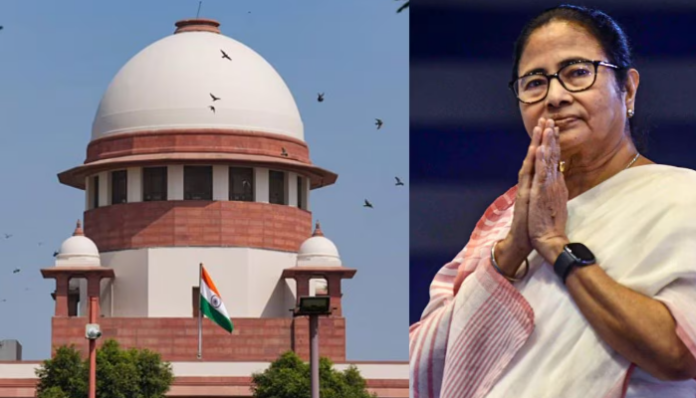
On 9th February (Monday) the Supreme Court ruled that there can be no obstacles to the Special Intensive Revision (SIR) of electoral rolls, in a stern message to all governments, especially West Bengal. A bench of Justice Joymalya Bagchi, Justice Vipul M Pancholi and led by Chief Justice Surya Kant pushed back the drive’s deadline in West Bengal by one week from 14th February.
“Whatever orders or clarification are required, we will issue. But we will not allow any impediment to the SIR process. Let us be very clear about it. This must be understood by all states,” Kant stated as the court considered multiple petitions about the West Bengal SIR, including a plea by Chief Minister Mamata Banerjee, which contested the way voters were grouped into the “logical discrepancy” list, among other issues.
Mamata filed a complaint against the SIR campaign in West Bengal, claiming that the process was flawed and raising concerns about the use of thousands of micro-observers in the state. The strong statement transpired when the apex court heard the Election Commission of India’s (ECI) response to the submission. The state government has been accused by the EC of not completely cooperating with its requests.
Kant observed that 8,500 officers have now been sent out as part of the exercise and seemed to be referring to the government’s timing of compliance when he added, “If done earlier, it would probably get approved.” The bench also asked, “Why the delay in sending names of more than 8,000 Group B officers to be used in place of micro-observers?”
The timing of the state’s communication was also decisively questioned by Kant, who addressed Mamata and asked, “Why are you sending names at 12 am on 7th February by mail when we gave directions on 4th February?”
The poll body expressed grave concerns over the selection of Electoral Registration Officers (EROs), stressing that, as EROs carry out quasi-judicial duties, they should have sufficient adjudicatory experience. ECI highlighted that just 64 officers with such experience were provided, despite the fact that it demanded almost 300 Group B officers. Pay parity was the foundation for the remaining appointments.
The Election Commission informed the court that it had sent the West Bengal government five letters outlining the officials it needed, but the latter withheld information about the officers it was seeking. The EC insisted that the lack of response compelled it to take action, and it was within its constitutional rights to send out micro-observers to protect the integrity of the revision process.
The court told the state to supply the Election Commission with Group B officials for SIR responsibilities, enabling them to take the position of micro-observers assigned by the electoral body. It made clear that while micro-observers might merely offer assistance, only Electoral Registration Officers have the authority to issue final rulings on claims and objections.
The court also sought a personal affidavit from the state’s director general of police addressing the ECI’s worries about violence and threats against SIR officials.
The Bengal government had asked the Supreme Court to prevent the SIR process by stopping official directives sent out through WhatsApp. It called for the removal of micro observers and the replacement of them with 8,505 Group B officers. The government also wanted all instructions to be publicly issued and posted on the ECI website.
Mamata personally appeared before the top court and alleged that the Election Commission was “targeting” Bengal and the SIR was intended to “bulldoze” the Bengali people. The process, she contended, was solely for elimination and not for inclusion.
On the other hand, ECI’s affidavit charged that her government is making conscious and systematic efforts to thwart, impede and frustrate the SIR exercise through “proper planning and concerted action.” It read, “Every trick in the armoury is being employed to ensure that the SIR process is either stopped or frustrated by fair or foul means.”
The affidavit added that the activities showed the cooperation of important state actors, such as the state government, some elected members of the ruling party and its officials. According to the submission, the Bengal government’s persistent attempts to block the SIR process and to continue these impediments are blatantly against the Supreme Court’s orders.
