

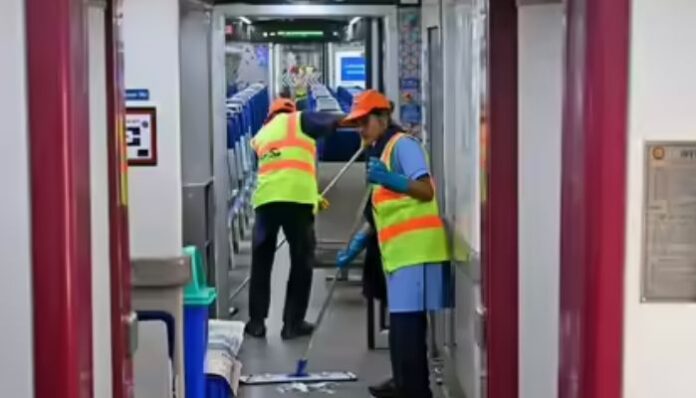
In a big shift from the existing system of cleaning trains mainly at major stations, the Indian Railways has decided to move to a continuous cleaning model inside running trains. Railway Minister Ashwini Vaishnaw announced that from 2026, cleaning of toilets, wash basins, garbage bins and coach interiors will be done throughout the journey from the train’s starting point to its final destination.
#Report | 52 reforms in 52 weeks: Union Minister @AshwiniVaishnaw lists big interventions to boost Railway's performance in 2026.@RailMinIndia pic.twitter.com/al8QjZmSiJ
— DD News (@DDNewslive) February 14, 2026
The reform is part of a larger programme titled “52 Reforms in 52 Weeks”, under which one major change will be rolled out every week in 2026.
Continuous cleaning inside moving trains
Till now, regular cleaning inside moving trains largely focused on reserved coaches, and deep cleaning has been done at selected “clean train stations.” General or unreserved coaches were cleaned mostly after complaints. Moreover, all the cleaning activities are done at stations by cleaning staff based at that station. Such cleaning staff don’t board trains.
Under the new plan, all coaches, including general compartments, will be covered under a fixed cleaning schedule. Railway officials said toilets in such coaches are expected to be cleaned every 1-2 hours. Garbage collection, wash basin cleaning, cabin upkeep and water availability will be checked continuously during the trip. This means that now cleaning staff will be present on moving trains to address issues like dirty toilets and basins.
Moreover, minor issues like lights not working, small electrical faults or water problems will also be fixed on the spot by trained onboard teams.
Technology and AI monitoring
To ensure that the new system works properly, Railways will use high-resolution cameras and Artificial Intelligence. Images of toilets and coaches will be captured and sent to control rooms. If the system finds that cleaning standards are not met, alerts will be generated, and service providers may face penalties.
Professional agencies will be hired through a Quality-cum-Cost Based Selection (QCBS) process instead of routine low-cost contracts. These agencies will work under clear Service Level Agreements, which will define cleaning frequency, especially during peak hours.
Linen distribution, collection and washing, which earlier involved different contractors, will now be given to a single agency for better coordination.
Phased rollout over three years
The new onboard cleaning system will begin within six months on about 80 long-distance trains with heavy passenger traffic, roughly 4 to 5 trains in each railway zone. Over the next three years, it will be expanded to cover the entire Indian Railways fleet.
The minister said this is not just a short-term drive but a long-term change in how passenger services are managed.
Part of a bigger reform plan
The cleaning overhaul is one of the first two reforms cleared by the Railway Board. The second focuses on boosting freight movement through Gati Shakti Cargo Terminals (GCTs).
Railways expects the cargo reforms to generate around ₹30,000 crore in additional revenue over the next three years. Cargo terminals will be upgraded into “cargo plus processing” hubs, and contract periods will be extended from 35 years to 50 years to attract more investment.
With Indian Railways recently becoming the world’s second-largest cargo carrier, the ministry says these reforms aim to modernise both passenger comfort and freight operations in a structured, time-bound manner.
