

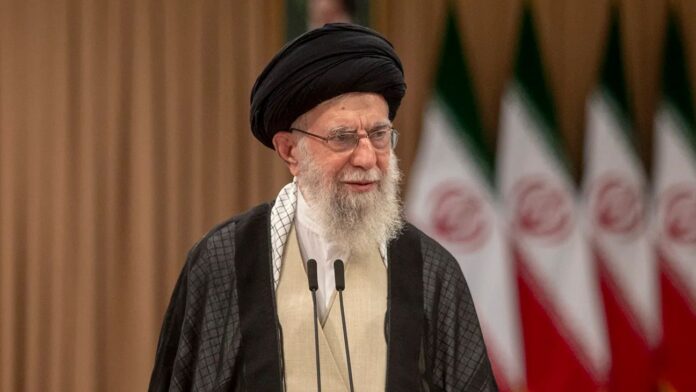
India has formally conveyed its condolences to Iran following the death of Iran’s Supreme Leader Ayatollah Ali Khamenei, who was killed in airstrikes on Tehran reportedly carried out by the United States and Israel on Sunday. The diplomatic gesture comes at a delicate moment in West Asian geopolitics, as tensions between Iran and Western powers continue to intensify.
On Thursday, India’s Foreign Secretary Vikram Misri visited the Iranian Embassy in New Delhi and signed the condolence book opened in honour of Khamenei. The outreach marks New Delhi’s first official expression of sympathy after the Iranian leader’s death, which occurred hours after coordinated airstrikes targeted key locations in Tehran.
The move follows a phone conversation between External Affairs Minister S. Jaishankar and his Iranian counterpart Seyed Abbas Araghchi. Jaishankar said on X that the two leaders held a telephonic discussion earlier in the day, though details of the conversation were not publicly disclosed.
A calibrated diplomatic response
India’s message of condolence is being interpreted as a subtle recalibration of its position after days of cautious silence. Since the strikes in Tehran, New Delhi had refrained from issuing any direct condemnation of the attacks that led to Khamenei’s death, even as opposition leaders urged the government to speak out.
PM Modi later addressed the unfolding crisis in the Middle East, reiterating India’s longstanding position that conflicts should be resolved through diplomacy rather than military escalation.
“India has always called for dialogue and diplomacy to find a solution to such disputes,” Modi said, underscoring the government’s preference for de-escalation amid a rapidly deteriorating regional security environment.
India’s restrained tone broadly mirrors the response of most major global powers. Apart from Russia and China, which publicly offered condolences, many governments have avoided direct statements regarding Khamenei’s killing.
Strait of Hormuz tensions add strategic pressure
The diplomatic outreach from New Delhi also comes as Iran announced a major move affecting global shipping routes. Iran’s Islamic Revolutionary Guard Corps declared that the strategic Strait of Hormuz would remain open to international shipping but closed to vessels belonging to the United States, Israel, the European Union and their allies.
Iranian authorities warned that ships associated with those countries could be targeted if they entered the waterway. The Strait of Hormuz is one of the world’s most important energy transit corridors, through which a significant portion of global oil exports pass.
The announcement has heightened international concern, particularly for countries dependent on Gulf energy supplies and maritime trade.
Opposition criticism over India’s stance
India’s handling of the situation has triggered sharp criticism from the opposition. Senior Congress leader Sonia Gandhiaccused the government of abandoning India’s traditional foreign policy balance in West Asia.
She argued that the absence of a clear statement defending sovereignty or international law raised questions about the direction of India’s diplomacy.
“India has long invoked the ideal of Vasudhaiva Kutumbakam, the world is one family. That civilisational ethos is not a slogan for ceremonial diplomacy; it implies a commitment to justice, restraint and dialogue,” Gandhi said earlier this week.
Balancing historic ties and new partnerships
India’s position reflects the complex balancing act it faces in West Asia. For years, Iran was a key energy supplier to India, at one point accounting for roughly 13 per cent of India’s crude oil imports. However, imports dropped sharply after the United States reimposed sanctions on Tehran following its withdrawal from the Joint Comprehensive Plan of Action in 2018.
At the same time, India has significantly strengthened its strategic partnership with Israel, spanning defence cooperation, technology, agriculture and security ties. Prime Minister Modi’s landmark 2017 visit to Israel, the first by an Indian prime minister, symbolised the deepening relationship.
As the geopolitical situation in West Asia continues to evolve, New Delhi appears to be walking a careful diplomatic line: maintaining its historic engagement with Tehran while preserving its growing strategic ties with Israel and the United States.
