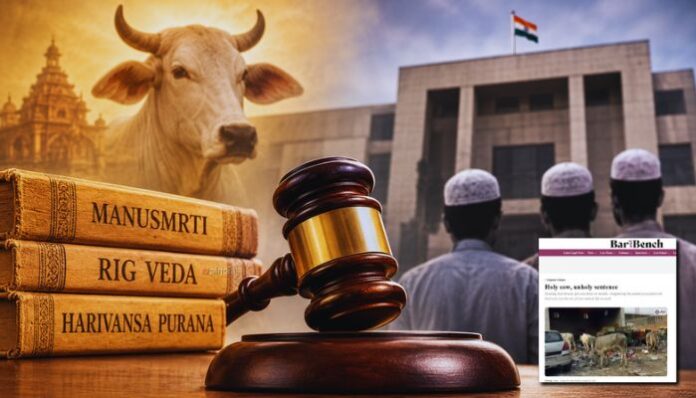
Hindu religiosity, particularly in legal contexts, has long been portrayed as an antithesis of constitutional secularism and religious tolerance. When courts cite Sharia while deciding criminal cases, such references are met by self-appointed defenders of secularism either with silence or anfractuous justifications. However, when courts refer to Hindu scriptures while sentencing Muslim men involved in cow slaughter and beef sale, it is painted as a departure from statutory discretion and a pivot toward enforcement of a theological code.
On 30th October 2026, legal reporting portal Bar and Bench published an article headlined, “Holy cow, unholy sentence”.
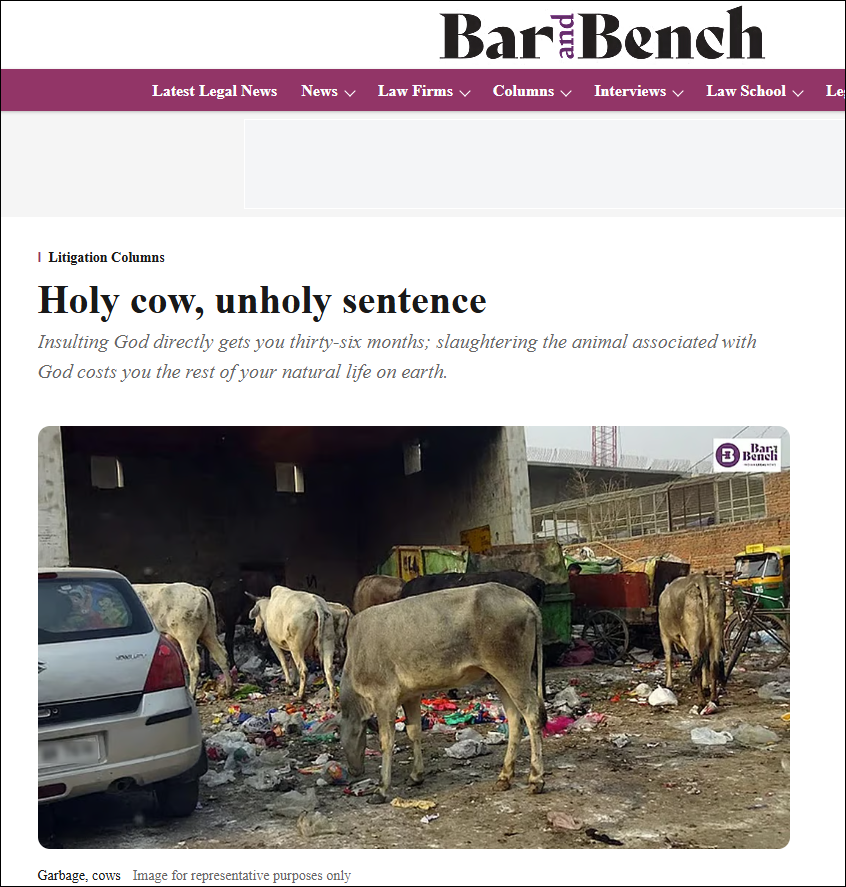
The article, authored by Ritwik Choudhary, lamented the fact that an additional sessions court at Kalol in Gandhinagar district of Gujarat recently cited Manusmriti, Rig Ved, and Harivamsa Purana, while awarding life imprisonment sentences to three Muslim convicts, Wasim, Mohammad Rafiq and Ashfaq, in a 2024 cow slaughter case “based on the recovery of 277 kilograms of beef, seized during a raid on a village house in Jamla.”
“Drawing directly from the Rigveda, the Manusmriti and the Harivamsa Purana, the court noted that the cow houses 33 crore deities; that the sun and moon dwell within its eyes; that Brahma, Vishnu and Mahesh inhabit its horns; and that the four legs of the bovine represent the four Vedas. Then came the judicial diagnosis: if those who slaughter cows are not handed life sentences, “Gau Mata will become extinct from the earth.”,” the Bar and Bench article reads.
Besides the shallowness of the arguments put forth by the Bar and Bench author, the article’s claim that India has “over 300 million head of cattle” is inaccurate.
The 2019 census puts the total bovine population, which includes buffalo, Mithun, and yak, at 302.79 million; however, the cattle population is recorded at 192.49 million.
The Gujarat Animal Preservation Act grant absolute protection to cows from slaughter given their religious significance and economic utility; there are provisions for conditional slaughter of buffaloes.
Instead of questioning why the three Muslim men indulged in the slaughter and sale of cow meat despite laws in place against such acts, the Bar and Bench Article suggested that if three men slaughter a few cows, they will not go extinct.
It further suggested that it is not deliberate slaughter but “ingestion of municipal single-use plastic, starvation in decrepit, State-funded gaushalas and road accidents” that pose a risk to cattle. While these issues are real, it is juvenile to expect the court to address these issues during the hearing of a case involving slaughter of cows and sale of cow meat. This is a part of the liberal playbook, which presents other factors about an issue bigger than the one at hand, to deviate from the root cause and to gaslight Hindus.
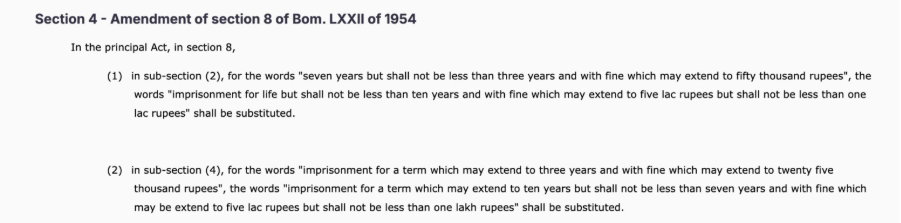
The article highlighted the amended Section 8(2) of the Gujarat Animal Preservation (Amendment) Act, 2017 Section 8(2) which states that imprisonment for cow slaughter “shall not be less than ten years but which may extend to imprisonment for life.”
Subtly questioning the Kalol Sessions Court judge Brijeshkumari Rameshwarsinh Rajput’s intellect and integrity, the Bar and Bench article suggested that the judge did not appropriately assess aggravating and mitigating circumstances, criminal antecedents, age, socioeconomic background, and the role played by the accused while deciding their punishment.
The Bar and Bench article claimed that the Gujarat court disregarded the defence’s plea that the accused Muslim men were young (one was nineteen), that they were the sole breadwinners of impoverished families and that they had no prior convictions, based on “a collection of Sanskrit verses and an imaginary ecological apocalypse.”
Throughout the article, the author conveniently downplays the crime the three men have been convicted for. Long paragraphs on the judge’s reference to Hindu scriptures, but only a “recovery of 277 kg beef” mention about why they have been awarded life imprisonment?
Author Ritwik Choudhary conveniently ignored the distinction between the statutory minimum and the statutory maximum.
Even though the author identifies that Section 8(2) of the Gujarat Animal Preservation Act provides for imprisonment ranging from ten years to life, he suggests that imposing life imprisonment, particularly by disregarding the defence’s pleading that the convicts are sole breadwinners and poor, is an inherently disproportionate exercise of judicial discretion.
The range of punishment, be it minimum or maximum, does not become automatically appropriate because the prosecution has established guilt. In the Kalol case, the court did mention that “cow would go extinct” if cow slaughterers are not punished, this apprehension alone did not drive the court to award sentence to the accused to life in prison.
When a law prohibits cow slaughter, the public of the state understands such a law exists, and what consequences will follow if they violate the law, and yet they slaughter cows, attempt to carry out an illegal organised cow meat trade; is it alarming that the court awarded maximum punishment? No! Statutory maximum is not decorative, nor does it exist to demonstrate mere on-paper strictness of the law.
Recovery of 277 kg of beef alone drove a Gujarat Sessions Court judge to sentence three men to life imprisonment?
Contrary to the framing by the Bar and Bench, the basis of the conviction of Wasim Qureshi, Mohammad Rafiq Qureshi and Ashfaq Behlime was not only the recovery of 277 kg of beef.
In fact, this ‘recovery’ framing is vague and downplays the seriousness of the acts the convicts were accused of. Bar and Bench‘s framing of the Kalol case suggests that three men were found possessing cow meat whose origin and legal status are disputed.
In reality, the court’s observations were devoid of any ambiguity about the role of the accused persons. The Bar and Bench article skips mentioning an important detail that two persons were acquitted by the same scripture-citing judge. The acquittal of two accused persons is in contrast with the Bar and Bench’s suggestion that the Gujarat court enforced theological code or demonstrated ideological biases.
It is, thus, pertinent to know what the police found and what the court said.
On 22nd August 2024, the Kalol police in Gandhinagar raided a house in Dhankani Vas, located in Jamla village, and apprehended individuals allegedly involved in cow slaughter. The police recovered 277 kilograms of meat from the premises. Laboratory testing subsequently confirmed that the meat was cow meat.
The police also seized weapons allegedly used for cattle slaughter, vehicles and other items worth a total of ₹3.61 lakh.
Subsequently, a case was registered against five accused at the Kalol Taluka police station under Sections 325 and 54 of the Bharatiya Nyaya Sanhita, the Gujarat Police Act, the Gujarat Animal Preservation Act and provisions of the central government’s Prevention of Cruelty to Animals Act. The accused were arrested. A separate case was later registered against a sixth accused. The accused were released on bail at different times between September and December 2024.
According to the police chargesheet, Lalabhai Senma, a resident of Jamla, and his son, Vitthal Senma, allegedly purchased weak cows and buffaloes that had stopped producing milk from surrounding areas at low prices. They would then call the other accused, who allegedly slaughtered the animals and sold the meat.
Lalabhai Senma, Wasim Qureshi, Mohammad Rafiq Qureshi and Ashfaq Behlime were apprehended at the scene, while the remaining two accused, Ghulam Moin Qureshi and Vitthal Senma, were arrested subsequently.
Later, Ghulam Moin Qureshi and Vitthal Senma were acquitted due to insufficient evidence.
In its judgment, the court quoted a shloka from Mahabharat’s Anushasan Parv, stating that the cow is regarded as the mother of the world and is beneficial to human life and society.
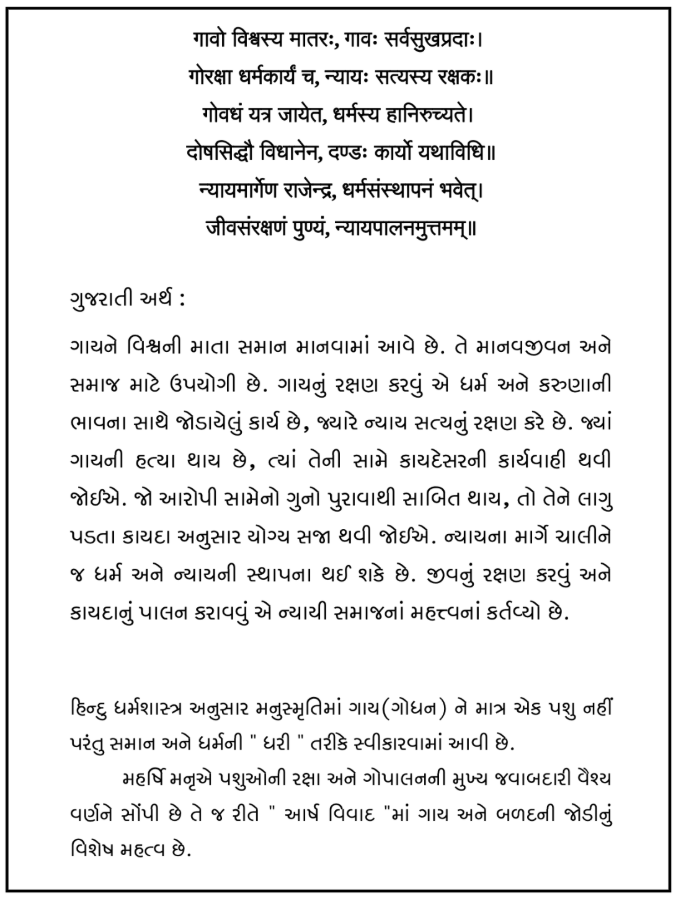
The court cited the Manusmriti, stating, “According to Hindu religious scriptures, the cow is not merely an animal but is regarded as a pillar of dharma. According to the Vedas and religious texts, when drops of divine nectar fell upon the Earth from Brahma’s mouth during his penance, Kamadhenu emerged from these divine drops. She is regarded as the mother of all cattle on Earth.”
The court also cited the Rigveda, stating that the cow is described as ‘Aghanya’, meaning one that must never be killed or slaughtered.
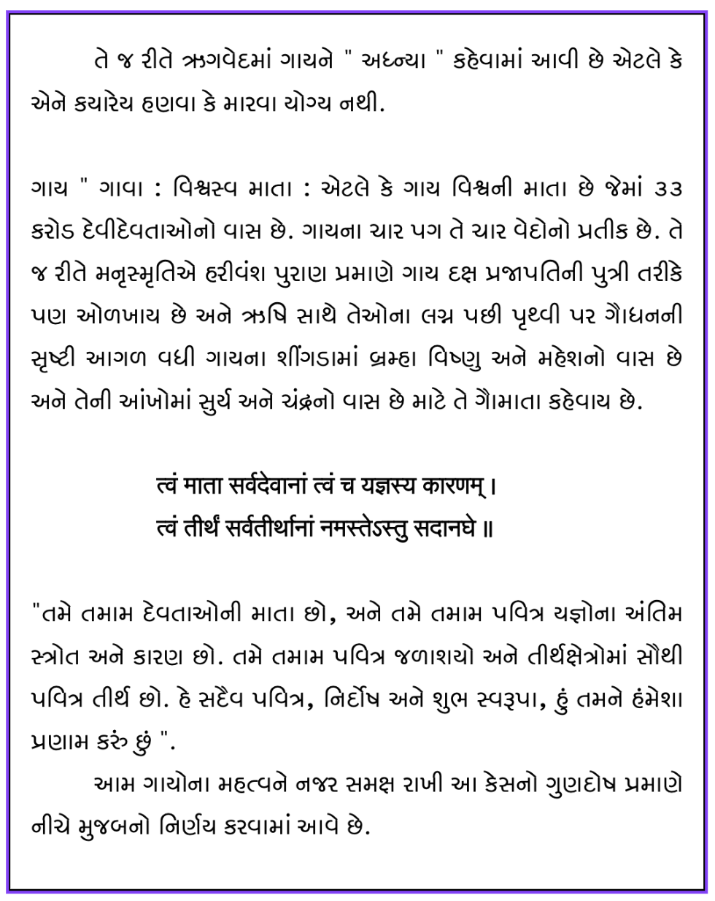
While pronouncing the sentence, the court stated: “Despite being aware of the consequences, the accused mercilessly slaughtered a cow regarded as a mother and attempted to sell approximately 277 kilograms of beef obtained from it. If those who cruelly slaughter cows are not punished as prescribed by law, Gau Mata will gradually become extinct from the Earth. Therefore, it is necessary to award the accused the maximum punishment permitted under the law.”
Scriptural reference is contextual, not legal reasoning
While the Bar and Bench article downplayed the aggravating factor, the court noted that the accused persons were aware of the fact that cow slaughter was illegal in Gujarat and also that cows hold religious significance for Hindus, and yet they slaughtered cows, obtained beef and sold it.
Contrary to the Bar and Bench article’s insinuation that “discretion collapsed entirely”, courts in Gujarat do differentiate punishments based on the seriousness of the offence.
Even if we go by just ‘recovery of XYZ kg of beef ‘framing, an Ahmedabad court awarded eight years for about 12 kg of cow meat in July 2026. In the Kalol cow slaughter case, the accused slaughtered cows, planned to sell their meat, and 277 kg worth Rs 55,000 was seized. Clearly, commercial, organised trade designs were the primary reason for the judge choosing the upper end of the imprisonment range under the relevant law.
The Kalol Sessions Court’s references to Hindu scriptures only highlight the religious significance of cows; the court did not utilise them for legal reasoning behind the life sentence for the accused. If courts begin to rely on Hindu scriptures like the Vedas and Manusmriti for operative reasoning while deciding punishment for cow slaughter, the convicts will have to be executed.
Bar and Bench’s ‘penal exchange rate’ contention is both illogical and misleading
In pursuit of painting the Gujarat court and Judge B. R. Rajput as enforcing religious code instead of legal reasoning, author Ritwik Choudhary compared the life sentence for cow slaughter with punishments for stalking, sexual harassment, outraging the modesty of a woman, negligent driving and cruelty to a wife. The Bar and Bench article implied that somehow the law, the courts, and the judges are considering the killing of a cow more serious than violations of a woman’s dignity and human life.
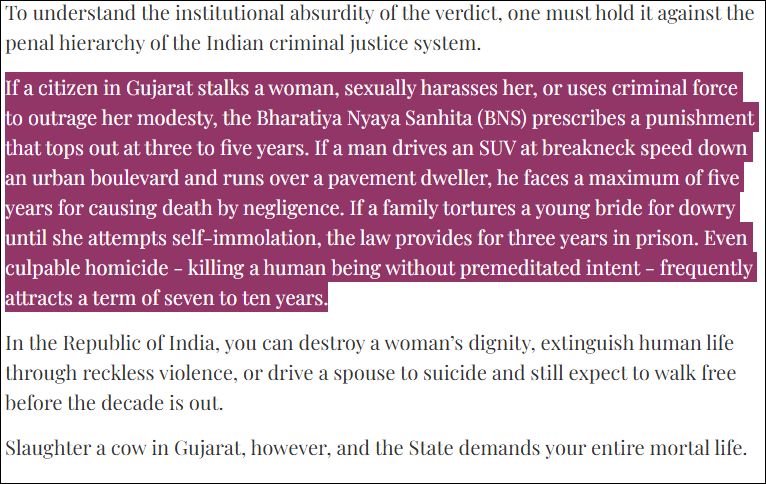
“In the Republic of India, you can destroy a woman’s dignity, extinguish human life through reckless violence, or drive a spouse to suicide and still expect to walk free before the decade is out. Slaughter a cow in Gujarat, however, and the State demands your entire mortal life,” the article reads.
While this argument is rhetorically appealing, it is legally unsound.
Various offences have different statutory elements, circumstances, and legislative objectives.
The Bhartiya Nyaya Sanhita does not mandate a single universal punishment for all offences relating to women. Different offences, be it assault, sexual harassment, voyeurism, rape, aggravated rape, or gang rape, etc., have different punishments prescribed.
Comparing the maximum punishment for one form of crimes against women with the maximum punishment for a separate statutory offence does not automatically establish a hierarchy of human and animal worth. Does making punishment for outraging the modesty of women require strengthening the relevant law, or does it require reduction of punishment under a cow slaughter law?
The Bar and Bench article further highlights an SUV driver running over a pavement dweller and argues that the offender faces a maximum of five years in prison. The article, however, skips mentioning the fact that even in such cases there is a distinction between negligence (covered in BNS Section 106(1)) and a deliberate act (BNS Section 106(2).
Taking the punishment for one category of negligent conduct and using it to establish the argument that the law values cattle more than human life is irrational.
Furthermore, the article draws a comparison between cow slaughter law and dowry-related cruelty. Relying on Section 85 of the BNS, the article claims that a family can torment a young bride until she attemptsself-immolation and still suffer only three years in prison. The article, however, ends up conflating the legally distinct cruelty, attempted suicide, abetment to suicide and dowry death offences.
The article misleadingly suggests that the three-year maximum punishment for one offence is the statutory maximum for all the dowry-related offences against women.
It further claims that beating a stray dog to death, mutilating a horse or poisoning a cat may attract only a fine of Rs 50 for a first offence under Section 11 of the Prevention of Cruelty to Animals Act, 1960; cow slaughter in Gujarat can lead to life imprisonment.
This comparison between the Prevention of Cruelty to Animals Act and the Gujarat Animal Preservation Act is carefully crafted to make the life imprisonment provision of Gujarat’s cow slaughter law appear irrational and inhuman.
However, laws don’t price human lives against animals. Statutes are meant to set penalties based on the harm to a protected interest and the extent of deterrence the legislature wants.
Under BNS Section 178, counterfeiting Indian currency carries a life-term ceiling; does that mean the law considers banknotes more valuable than human beings?
The Bar and Bench article also referred to the State of Gujarat v. Mirzapur Moti Kureshi Kassab Jamat case.
Notably, in the 2005 State of Gujarat v. Mirzapur Moti Kureshi Kassab Jamat case, a seven-judge Supreme Court bench ruled that the Bombay Animal Preservation (Gujarat Amendment) Act, 1994, which imposed a complete ban on the slaughter of cows and bulls, was constitutionally valid, noting its economic usefulness.
There is an interesting contradiction in Choudhary’s article. On one hand, it argues that the Supreme Court justified the cow slaughter ban based on agrarian and ecological grounds, not religious significance or sacredness. On the other hand, it benchmarks the same judgment against BNS Section 299, which concerns the offence of outraging religious sentiments.
If the Act is an economics-driven measure, isn’t Section 299 a wrong comparator? If it is indeed a sentiment-driven law, then doesn’tif defeat Choudhary’s Mirzapur argument?
Also, Section 299 has a high mens rea threshold, and it safeguards all religions equally; it is not some Talibanic blasphemy law against “insulting God”. Cow slaughter is prosecuted under varying state agricultural or animal-related statutes, not essentially as religious insult.
Equating American or British animal cruelty laws with cow slaughter law is wrong
The Bar and Bench piece also equates the Gujarat Animal Preservation Act with the UK’s five-year jail sentence ceiling and America’s seven-year ceiling under the PACT Act. However, these are cruelty-to-animals statutes penalising suffering inflicted on an animal.
The Gujarat Act, on the contrary, is a preservation and prohibition statute which essentially bans a category of killing even when it may be painless and the animal, cow specifically, is owned. The comparison doesn’t hold.
Courts citing Manusmriti represent the theological zeal of judges; citing the Quran doesn’t?
The Bar and Bench article argues that citing Manusmriti while deciding criminal cases dissolves the constitutional wall separating Church and State.
“When a criminal court begins citing the Manusmriti to calibrate the deprivation of fundamental liberty under Article 21, the constitutional wall separating Church and State does not just crack; it dissolves. The Supreme Court established long ago in SR Bommai that secularism is the basic structure of the Constitution. A citizen cannot have their prison term dictated by a magistrate’s theological veneration of an animal, regardless of how deeply held those religious beliefs may be in private life,” the article reads.
There is no constitutional obligation on Central or state governments to follow the American model of separation of powers. India has its own moral and legal understanding of secularism.
In fact, the SR Bommai case actually endorses the accommodative model of principled engagement with all faiths. It does not hold that any single ritual performed by a government or constitutional official establishes theocracy. The problem would have been only when there was systemic favouritism, and the governments or those holding constitutional offices were using state machinery to propagate their religion or suppress others.
There have been many cases wherein courts have cited Sharia law while deciding cases. In 2023, the Madras High Court cited Sharia to annul a Muslim marriage
In 2025, Kerala HC turned to Sharia in a case about a blind beggar threatening his wife with polygamy and cited the Quran in the judgment. Did that mean the judges were driven by some theological zeal and their personal beliefs were governing their judicial decisions? If yes, then why are no questions raised about such cases? Why does only the citing of Hindu scriptures attract ‘constitutional scrutiny’ in the media?
Bottom line: Many cases have seen courts phrase deterrence in sweeping terms. Claiming that the judge BR Rajput’s “Gau Mata will become extinct” remark is mythical zoological forecast governed his decision to sentence Kalol case convicts to life in prison is a dishonest assessment. The stray cattle menace and failing gaushalas issue requires serious administrative attention; however, to imply that the cow slaughter law is irrational or that imposing the statutory maximum is excessive is wrong.