

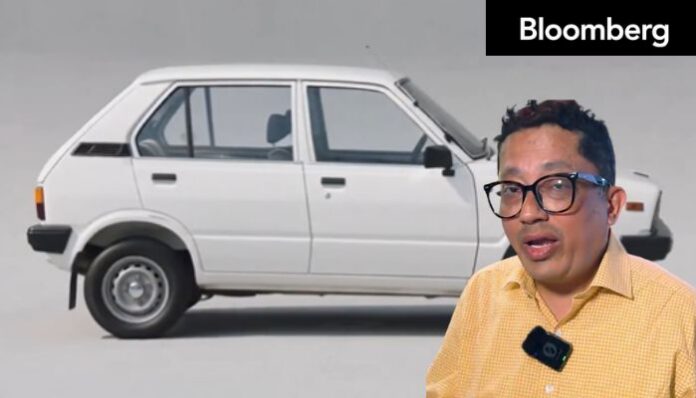
The year was 1983. Maruti Suzuki 800, the first car for millions of Indian families, was launched. When it began production in India, the car had 3% local content.
Only MRF tires and Chloride India batteries were fitted to the car, while the remaining 97% of the components came from Japan and were assembled in India.
These included engines, transmissions, glass, steering wheel, seats, and others. Even by 1984, local components in the Maruti Suzuki 800 car had not reached 10%. They were not manufactured in India.
The first Maruti 800 made in India had just 2.7% local content, while iPhones made in China had only 3.6% in 2009. By 2017, China had reached 25%, while India hit 20% in just 8 years. The ₹19,000 crore subsidy Bloomberg calls a waste of public funds has generated over 3.5 lakh jobs. @jayeshmatiyal debunks Bloomberg’s narrative on Indian manufacturing.
— OpIndia.com (@OpIndia_com) October 28, 2026
Maruti had to build an entire supplier ecosystem from scratch. A 2004 research paper by Ambuj Sagar and Pankaj Chandra points out that by 1988–89, Maruti’s local content had risen to 86.2%.
Within just 5 years of Maruti’s arrival, the majority of components were being made in India. By March 1992, 94.1% of the parts for the Maruti 800 were produced domestically.
In short, localising manufacturing and producing the vast majority of components took nearly 10 years. This was the time frame that was required for indigenous production of a car, which is not a complex machine. It must be mentioned that in 1983, India already had a functional, state-run (though inefficient) automobile ecosystem.
The story of iPhone manufacturing and China
The case is similar to the manufacturing of iPhones in China. In 2009, the share of local content was only 3.6% and the remaining components were imported. An Asian Development Bank Institute (ADBI) study found that the manufacturing cost of an iPhone back then was around $179.
At that time, China’s assembly share was just $6.50. In 2017, when the iPhone X was launched, the share of China’s local content exceeded 25%.
A study by Yuqing Xing showed that the iPhone X had a manufacturing cost of $409, of which approximately $104 in value was sourced locally from China. By then, Chinese domestic suppliers were producing battery packs, glass covers, device frames, speakers and printed circuit boards.
Over that decade, China mastered parts that were not excessively complex and established a thriving supplier base. Today, China’s domestic value share in iPhone manufacturing stands above 30%, powered by an ecosystem of companies.
A manufacturing base cannot be created overnight
These 2 examples show that just as Rome was not built in a day, no nation creates a manufacturing base overnight. First, a workforce learns assembly. Thereafter, it learns to fabricate basic components, and then an ecosystem develops for moderately complex parts.
Only then domestic share of local content increases. Even today, virtually no complex machine anywhere achieves 100% localisation.
For an iPhone assembled in China, the camera sensor still comes from Sony (Japan), the processor is imported from TSMC (Taiwan), and the display panels are purchased from LG and Samsung in South Korea.
Debunking the anti-India propaganda of Bloomberg
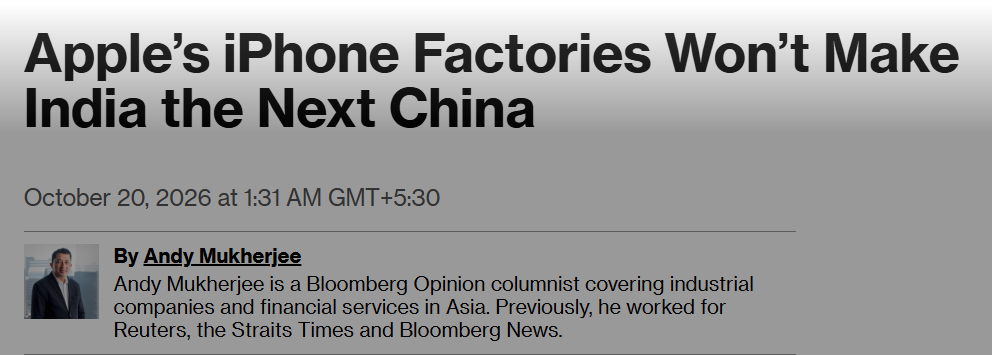
Andy Mukherjee, the brown sepoy at the helm of maligning India at Bloomberg, carried out a hit job in an article titled ‘Apple’s iPhone Factories Won’t Make India the Next China’.
First, he claimed that complex iPhone components are not made in India and that they are merely assembled in the country. Mukherjee also remarked that India offers ‘unjustified subsidies’ which are funded by taxpayers and do not have a positive ROI (Return on Investment).
In the Bloomberg article, he claimed that India was not fabricating chips but only handling packaging and testing.
Every nation begins with assembly and low-value components before expanding domestic value in complex machinery. As China demonstrated, a 3% share in 2009 grew to over 25% by 2017.
iPhone manufacturing in India began in 2017 when Apple started assembling it locally. Thereafter, the Modi government adjusted policy regulations, granted concessions, and onboarded suppliers such as Foxconn and Pegatron.
In 2020, the Modi government provided a major boost through the Production Linked Incentive (PLI) scheme. It offered subsidies between 4% and 6% of invoice value to firms manufacturing locally.
As a result, India’s share of global iPhone manufacturing surged from roughly 2% in 2021 to over 25%. Bloomberg itselfe acknowledges that India now manufactures everything from phone casings to printed circuit board assemblies (PCBAs).
Mobile PLI stats as follows: Government incentive paid: Rs 19,000 Cr. Direct tax collected: Rs 25,000 Cr. GST collected: Rs 3,00,000 Cr. Electronics manufacturing employs 25 Lakh people; mobile manufacturing alone employs 12 Lakh. Cope harder!!
— Ashwini Vaishnaw (@AshwiniVaishnaw) October 27, 2026
Union Minister for Railways and IT, Ashwini Vaishnaw, pointed out on Wednesday (28th October) in a post that India has disbursed ₹19,000 crore in incentives. Not all of this went to Apple. Even assuming Apple received ₹10,000 crore, what is the legitimate grievance here?
₹10,000 crore has catalysed an ecosystem that employs over ₹3.5 lakh people, trains a skilled technical workforce, and drives the country toward advanced manufacturing.
Conclusion
To put things into perspective, over ₹11 lakh crore was spent on MGNREGA between 2006 and 2026. What industrial ecosystem did that produce? None. Indian taxpayers’ money is now being redirected as per India’s national priorities, which will not be dictated by foreign publications.
Currently, the Modi government is hyperfocused on developing a national manufacturing base. India has established itself as a serious contender in electronics and smartphone manufacturing, a fact that has been acknowledged across Chinese social media platforms.
As Ashwini Vaishnaw said in his tweet, Bloomberg and Andy Mukherjee need to “cope harder”.


