

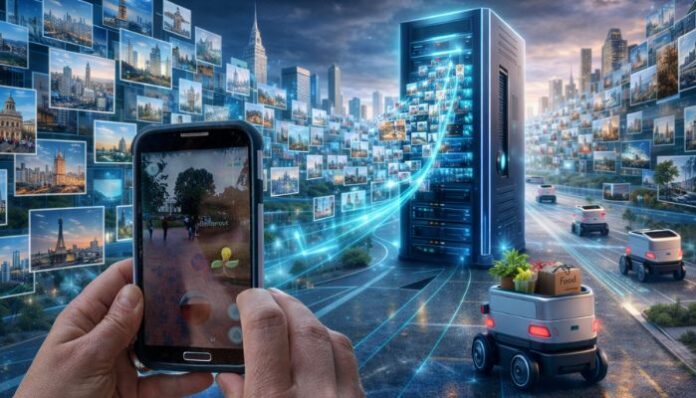
On 10th March (local time), Niantic Spatial announced a new partnership with Coco Robotics, giving an unexpected technological afterlife to the global gaming phenomenon Pokémon Go. Niantic, which created the augmented reality game in 2016, is using data generated through it to help delivery robots navigate city streets with far greater precision.
Under the agreement announced, Niantic Spatial will deploy its spatial AI tools and Visual Positioning System, known as VPS, to support Coco Robotics’ fleet of sidewalk delivery robots. Notably, Niantic has been working on creating the AI model since 2024, as announced in a press release that year. The system allows machines to determine their position based on nearby buildings and landmarks. According to Niantic, it improves navigation in dense urban environments where GPS signals often become unreliable.
From augmented reality game to robot navigation
For delivery robots, accurate localisation is critical. Coco’s robots move along sidewalks carrying groceries or restaurant orders. They must reach the exact pickup spot outside restaurants and stop at the correct door when delivering food. In city areas with high rise buildings and underpasses, GPS signals frequently drift and sometimes place devices dozens of metres away from their actual position.
According to Niantic, its visual positioning system can narrow that margin to centimetre level accuracy by analysing what a robot’s cameras can see around it. The company stated that by combining visual data with conventional navigation tools, robots can operate more reliably in complex urban environments where traditional positioning systems struggle.
How Pokémon Go data feeds the system
The data that this system is using was originally gathered through a popular mobile game Pokémon Go. The game encourages players to explore real world locations such as statues, parks, and landmarks that appeared in the game as PokéStops or gyms.
Over the years, Niantic introduced optional scanning features that rewarded players for capturing images of these locations. Niantic says such contributions helped it build a large visual dataset of millions of mapped locations worldwide. According to media reports, the system behind Niantic Spatial’s technology has been trained on over 30 billion urban images collected across many cities. It has allowed the company to build detailed models of real world environments.
Questions over data reuse
Niantic has maintained that scanning features were voluntary and focused on publicly accessible locations. However, the shift from gaming to robotics has sparked broader discussion about how user generated data can later be repurposed. Many players who scanned may not have anticipated that the same data would eventually contribute to technologies guiding autonomous delivery robots.
For Niantic Spatial, the Coco partnership can be seen as a demonstration of a larger ambition. The company says it aims to build advanced geospatial AI systems capable of helping robots, wearable devices, and other technologies better understand and navigate the physical world. Niantic, in other words, wants to become the Google Maps of the AI ecosystem.
