

This is Part 2 of a three-part series on aero engines in India. You can read Part 1 here and Part 3 here.
In Part 1 of this series on aero engines being developed in India, we discussed how state-owned entities like HAL and DRDO are building indigenous workhorses like the Dry Kaveri, HTFE-25, HTSE-1200, and other engines for fighters, helicopters, UAVs and missiles. However, the story of Indian aerospace propulsion is no longer confined to government laboratories and public-sector shop floors. Across the country, a quiet revolution is underway as private conglomerates and deep-tech start-ups bypass decades of bureaucratic inertia to design, test, and manufacture their own jet engines from scratch.
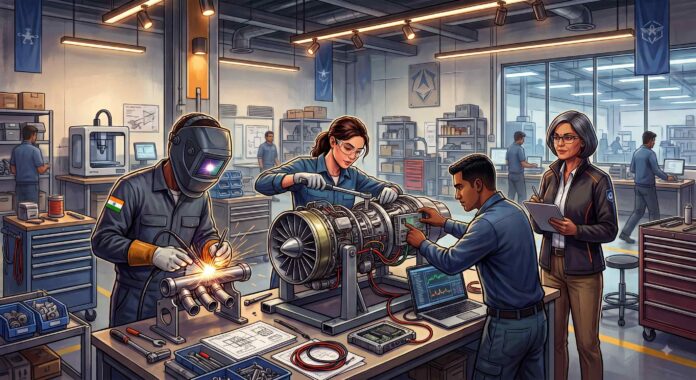
If the state-owned behemoths represent the heavy industry of this revolution, India’s private sector is its agile, disruptive vanguard. For decades, private firms were merely build-to-print vendors. Today, they are designers, innovators, and prime contractors. The private sector has moved from component supply into complete engine development, particularly in the micro and small-thrust regimes essential for the expanding unmanned and missile fleets.
Here are some major developments taking place in India’s private aero engine sector:
Yantur by Paninian
The Yantur is a family of indigenous aero-engines being developed by Hyderabad-based private defence technology firm Paninian India Private Limited, representing a significant private-sector contribution to India’s aerospace propulsion capabilities. The range includes the compact Yantur TJ1.6 turbojet, a 1.6 kilonewton-class engine designed to power the company’s Svayatt-TD1 autonomous aerial target and decoy system at speeds approaching Mach 0.9 for realistic air defence training.
More prominently, Paninian has unveiled the Yantur 4.5 kilonewton turbofan engine programme, described as India’s first privately developed turbofan in this thrust class. Intended primarily to power the Svayatt L1 long-range autonomous cruise missile platform under the Ministry of Defence’s Make-I initiative for a Long-Range Land Attack Cruise Missile, the engine has completed its conceptual and detailed design phases and is progressing towards subsystem testing, validation and full certification.

Its modular core architecture is designed for scalability, with potential growth to around 12.5 kilonewtons to support future collaborative combat aircraft or unmanned platforms such as the Svayatt CCAV. Incorporating patented innovations in engine architecture, compressor and combustor design, digital-twin health monitoring and additive manufacturing techniques, the Yantur programme aims to build sovereign private-sector expertise in compact turbofan technology, engine controls and propulsion-airframe integration, complementing public-sector efforts and advancing India’s self-reliance in critical defence propulsion systems.
GTRE designed turbojet by Azad Engineering
India achieved a landmark in indigenous aero-engine technology when Hyderabad-based Azad Engineering delivered the country’s first fully indigenous expendable turbojet engine in the 350 kg thrust class to the Defence Research and Development Organisation’s Gas Turbine Research Establishment on 22 July 2026. Designed entirely by GTRE and officially referred to as the Advanced Turbo Engine or Advanced Turbo Gas Generator (ATGG), the single-spool turbojet features a four-stage axial-flow compressor, an annular combustor, a single-stage uncooled axial-flow turbine and a fixed-exit nozzle, making it compact, cost-effective and optimised for single-mission or limited-endurance applications rather than the long service lives of manned aircraft engines.
Azad Engineering, selected as the sole industry partner in May 2024, handled complete manufacturing, assembly and integration using advanced superalloys and precision processes, converting the laboratory design into a flight-ready unit within roughly two years. The engine is intended primarily for platforms such as medium-range anti-ship missiles, jet-powered loitering munitions, unmanned aerial vehicles and anti-drone systems, where expendable propulsion is preferred. The uncooled turbine and relatively simple architecture make the design particularly suited to expendable or medium-endurance applications where cost-effectiveness, compactness and reliability are paramount.

The propulsion system is intended for a range of defence applications, including cruise missiles, unmanned aerial vehicles (UAVs), drones and other platforms that require turbojet power.
This successful collaboration between GTRE’s design expertise and private-sector manufacturing capability marks a significant step towards self-reliance in a highly specialised technology domain mastered by only a handful of nations. The achievement marks Azad’s evolution from a specialist manufacturer of high-precision turbine and aero-engine components into a systems-level supplier capable of delivering complete propulsion units.
Compact turbojets by DG Propulsion
DG Propulsion, a New Delhi-based Indian aerospace startup, has developed a family of compact turbojets covering the 20 to 100 kilogram-force range for unmanned aerial vehicles. The company specialises in the design, development and manufacture of compact indigenous turbojet engines for unmanned and specialised platforms.
Its current product range centres on the micro-turbojet family. The flagship DG J40 delivers a nominal 40 kgf of thrust in a highly compact package weighing around 3.7 kilograms, with a diameter of 148 mm and length of 370 mm. The engine has demonstrated strong performance in rigorous testing, including one-hour endurance runs and peak outputs exceeding 43 kgf under simulated military conditions. An improved V2 variant emphasises easier maintenance and serviceability.

Complementary models include the smaller DG J20 and the higher-thrust DG J60 and DG J100, the latter aimed at UAVs requiring greater payload capacity and endurance. All engines feature proprietary digital engine control units, rapid throttle response and modular architectures that support quick integration and mission-specific configuration.
DG Propulsion has progressively expanded its ambitions. After validating its smaller engines through ground and endurance testing, the company is investing in modular test infrastructure capable of handling systems up to 10 kilonewtons. The engine is intended for higher-performance UAVs, cruise missiles and advanced autonomous platforms, while also opening pathways towards future turbofan variants. Advanced manufacturing techniques, including metal 3D printing of core modules that consolidate multiple components into single parts, have helped reduce complexity, weight and production time.
Through in-house design of critical elements such as compressors, combustors, turbines and control systems, combined with partnerships under initiatives like iDEX and collaborations with defence public-sector units, DG Propulsion is contributing to India’s growing private-sector capability in aero-engine technology. Its engines, positioned in the 10–200 kgf thrust roadmap, aim to provide reliable, cost-effective and fully indigenous propulsion solutions that support the expanding ecosystem of autonomous aerial systems.
Kalyani Gas Turbine by Bharat Forge
Bharat Forge Limited, the flagship company of the Kalyani Group, has steadily expanded its capabilities from forging and automotive components into advanced aerospace and defence propulsion systems. Through its dedicated Gas Turbine and Technology Development Centre in Bengaluru, the company is actively engaged in the ab-initio design and development of indigenous gas turbine engines, particularly small jet engines suited to unmanned platforms.
A notable achievement is the Kalyani Gas Turbine 45, or KGT 45, a 45 kilogram-force thrust-class engine whose performance was successfully validated at the Bengaluru test facility in January 2023. Designed for operation up to an altitude of eight kilometres, the KGT 45 offers competitive fuel consumption and thrust-to-weight ratio along with a fully indigenous control system. It is intended for applications such as unmanned aerial vehicles, target drones, cruise missiles and range-extender roles.

Building on this foundation, Bharat Forge is developing a broader family of small jet engines in the 40 to 200 kilogram-force thrust range, aiming to meet the growing demand for reliable, compact and cost-effective propulsion in India’s expanding unmanned systems sector.
Beyond small aero-engines, the company is making significant strides in marine gas turbine technology. This year it signed a memorandum of understanding with the Government of Andhra Pradesh to establish India’s first private-sector marine gas turbine repair, overhaul and indigenous development facility near Visakhapatnam. The complex will support hot-section restoration of critical components and, in a subsequent phase, include a development and assembly hall with a hot test cell for qualifying indigenous marine gas turbines. Bharat Forge has also secured contracts to supply indigenous 1.25-megawatt gas turbine generators for the Indian Navy’s Kolkata-class destroyers, further demonstrating its expanding role in naval propulsion and power generation.
Complementing these efforts, the company manufactures high-precision components such as compressor and turbine parts, APU rotor assemblies and turbochargers for defence and locomotive engines, and has partnered with global original-equipment manufacturers for fan blades and other aero-engine hardware. Through its combination of design capability, advanced manufacturing and strategic investments, Bharat Forge is contributing meaningfully to India’s self-reliance goals in both aerial and naval gas turbine propulsion technologies.
Apart from these, several other private sector companies and start-ups are developing aero engines.
Green Aero, an IIT Delhi-incubated deep-tech startup, has developed a 400-newton thrust micro-turbine engine designed for high-speed drones, collaborative combat aircraft and standoff weapon systems. The liquid-fuelled unit features multi-fuel capability, operating on jet fuel, diesel or hydrogen, and incorporates advanced airblast atomisers along with effusion-cooled liners; the company has also demonstrated a hydrogen-capable core known as Blue Dragon and focuses on fuel-agnostic, high-efficiency propulsion.

D-Propulse, an IIT Madras-incubated firm, is advancing rotating detonation engine technology and has successfully hot-fired a 5-kilonewton air-breathing RDE integrated with an aerospike nozzle at a DRDO facility. The pressure-gain combustion system offers higher thermodynamic efficiency than conventional engines and is intended for cruise missiles, high-speed UAVs and potential hybrid turbofan-RDE configurations for future fighters, with a flight-ready version targeted for around 2027.
Nabhdrishti Aerospace, based at IISc Bengaluru, has developed the ND400, a 400-newton micro gas turbine weighing approximately 3.95 kilograms for the core (5.2 kilograms complete system). Capable of speeds up to 95,000 rpm and operation to 10,000 metres altitude, it features high fuel flexibility (jet fuel, diesel, LNG, biofuels and hydrogen blends) and is designed for dual-use in UAV propulsion and power generation with improved efficiency and lower cost.
Poeir Jets, a Bengaluru company that pioneered private-sector micro-jet development in India, produces a series of microjet engines including the MJE 20 (20 kgf thrust) and MJE 40 (40 kgf thrust) for UAVs and remote-controlled aircraft. The firm has also worked on higher-thrust variants and hybrid turbine-electric heavy-lift drones, establishing early indigenous capability in compact jet propulsion through additive manufacturing techniques.
Raghu Vamsi Machine Tools of Hyderabad has brought its INDRA series of micro turbojet engines to flight-ready status, including the RV14 (140 N), RV19 (190 N), RV25 (approximately 240–250 N) and RV40 (400 N) models. Developed with academic support and fully indigenous manufacturing, these single-spool engines are designed to be used in target drones, loitering munitions and UAVs. The company is also pursuing a larger 4.9 kN-class turbofan for cruise missiles and heavier unmanned platforms.
The Horizon of Sovereign Power
The narrative of Indian aerospace propulsion has fundamentally changed. The struggles of the past have birthed a pragmatic, diversified ecosystem. Today, DRDO and HAL are securing the workhorse platforms, from stealth UCAVs to the entire helicopter fleet. A geopolitical masterstroke with Safran is securing the fifth-generation future. And beneath it all, a hungry private sector is churning out compact engines for the next generation of cruise missiles and swarm drones.
When an air force relies on imported engines, its sovereignty is conditional. Every flight hour, every spare part, and every export opportunity is subject to the whims of a foreign legislature. But as the turbines of the HTFE-25, the HTSE-1200, and the Yantur spool up on test benches across the country, India is forging something far more valuable than thrust. It is forging true strategic autonomy. The tale of India’s aero-engine sector is no longer one of delays and dependencies; it is a tale of an aerospace superpower finally taking flight on its own terms.
India’s private sector has proven it can design, iterate, and assemble complex propulsion systems. Yet, whether an engine is conceived in a government laboratory or an agile start-up garage, every propulsion pioneer eventually collides with the exact same brutal reality: an engine design on paper is only as good as the metal that contains its fire. In the third and final instalment of this series, we step inside the combustion chamber to explore the pinnacle of engineering physics—the secret world of single-crystal turbine blades, nickel-based superalloys, and the metallurgical breakthroughs that make flight possible.



