

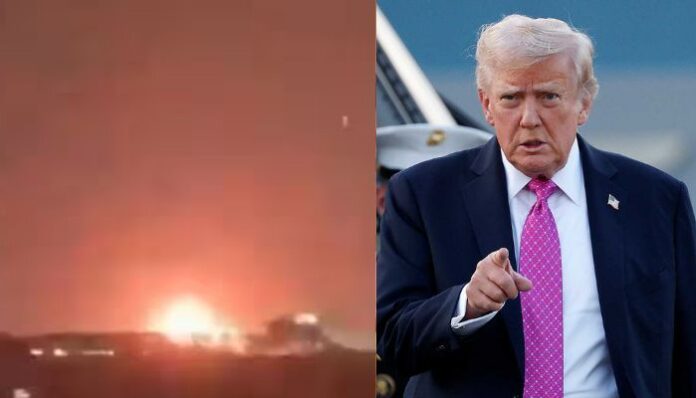
Tensions in the Middle East have sharply escalated after Iran launched a missile strike on a major energy facility in Qatar on Wednesday, 18th March. According to officials, Iranian missiles hit the Ras Laffan industrial area, which houses the world’s largest liquefied natural gas (LNG) processing facility.
QatarEnergy’s Ras Laffan Industrial City to the north of Doha, Qatar's main site for the production of liquefied natural gas and gas-to-liquid, as well as the largest export terminal for LNG in the world, has been heavily targeted tonight by ballistic missiles fired by Iran.… pic.twitter.com/Ax9WaOjDAK
— OSINTdefender (@sentdefender) March 18, 2026
State-owned Qatar Energy confirmed that the attack caused “extensive damage” to the site, although all personnel were reported safe. A fire that broke out following the strike was later brought under control. The Foreign Ministry of Qatar strongly condemned the attack, calling it “brazen” and a “direct threat to its national security and the stability of the region.”
Statement | Qatar Condemns in Strongest Terms Iranian Targeting of Energy Facilities in Saudi Arabia and UAE
— Ministry of Foreign Affairs – Qatar (@MofaQatar_EN) March 19, 2026
Doha | March 19, 2026
The State of Qatar condemns in the strongest terms the Iranian targeting of energy facilities in the Kingdom of Saudi Arabia and the United Arab… pic.twitter.com/EoBckLPGZV
In a statement, authorities said, “The Iranian side continues its escalatory policies that are pushing the region toward the abyss.” They also made it clear that Qatar “reserves its right to respond.”
The attack came shortly after strikes on Iran’s South Pars gas field, which Qatar had earlier blamed on Israel. While Israeli media suggested that Israel carried out the strike, there has been no official confirmation from the Israeli military.
Trump warns Iran of strong retaliation
Amid the growing crisis, US President Donald Trump issued a strong warning to Iran in a long post on Truth Social on Thursday, 19th March. Reacting to the situation, Trump said the US “knew nothing” about the Israeli strike on Iran’s South Pars gas field.
He also stressed that Qatar had no role in the attack. “The United States knew nothing about this particular attack, and the country of Qatar was in no way… involved with it,” he wrote.
Calling Iran’s retaliation “unjustifiably and unfairly,” Trump warned of serious consequences if Qatar is targeted again. He wrote that if Iran strikes Qatar once more, the US will “massively blow up the entirety of the South Pars Gas Field at an amount of strength and power that Iran has never seen or witnessed before.”
However, Trump added that he does not want to take such a step due to its long-term impact, saying he would avoid “this level of violence and destruction” unless necessary.
Iran expands attacks to Saudi Arabia and UAE
The conflict has not remained limited to Qatar. Iran has also launched strikes against Saudi Arabia and the UAE.
Saudi Arabia has stated that its air defence systems have intercepted drones and ballistic missiles targeting strategic areas in the country. A drone targeting the Diplomatic Quarter in Riyadh was shot down, while several ballistic missiles were intercepted in different parts of the country, including Al-Kharj and the Eastern Province. Despite this, debris from the intercepted missiles injured four people near the capital.
In the UAE, it has been stated that 13 ballistic missiles and 27 drones, all launched from Iran, were intercepted in the country. Some of this debris has fallen in Abu Dhabi, forcing operations to be halted in gas stations such as Habshan and Bab oil fields. No injuries were reported in these incidents.
Wider conflict and rising global concern
The recent events are part of a larger conflict, which started on 28th February, as the US and Israel struck Iran with massive attacks resulting in the killing of the Iranian Supreme Leader Ayatollah Ali Khamenei. Ever since, Iran has struck back against Israel and US-allied countries in the Gulf region.
Iran had earlier warned that it could strike sites in Qatar, Saudi Arabia, and the UAE. The situation has further worsened as Israel continues its conflict with Iran-backed Hezbollah in Lebanon, displacing over a million people.
Meanwhile, Iranian President Masoud Pezeshkian warned that the situation could spiral out of control, saying it could lead to “consequences beyond control, the scope of which would engulf the entire world.”
حمله به زیرساختهای انرژی ایران را قاطعانه محکوم میکنم. اینگونه اقدامات تجاوزکارانه، دستاوردی برای دشمن صهیونی آمریکایی و حامیانشان نخواهد داشت. بلکه شرایط را پیچیدهتر کرده و میتواند پیامدهایی خارج از کنترل بهدنبال داشته باشد که دامنه آن همه جهان را درگیر میکند. https://t.co/FGtTZZjA6Y
— Masoud Pezeshkian (@drpezeshkian) March 18, 2026
The South Pars gas field, which was at the centre of the initial strike, is one of the most important energy assets in the world and accounts for nearly 70% of Iran’s gas production. The attack has drawn criticism from several countries, including Qatar, the UAE, and Oman, which called it a dangerous escalation.
With multiple countries now involved and key energy infrastructure under attack, the situation in the Middle East remains tense, with fears of further escalation in the coming days.
