

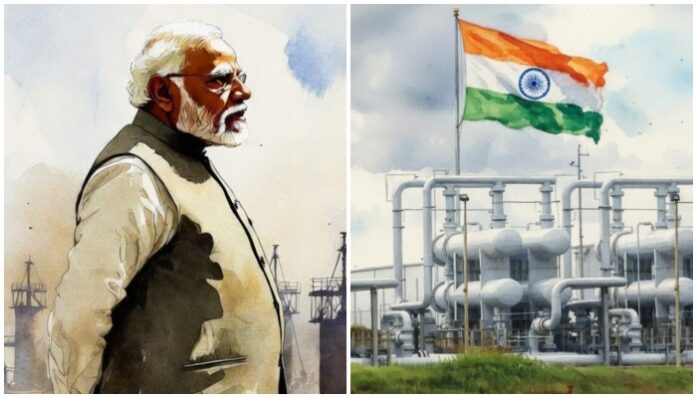
PM Modi spoke in the Lok Sabha on March 23 regarding the war in West Asia and how India is dealing with the economic and material fallouts of the conflict, especially with the closure of the Strait of Hormuz. He mentioned India’s Strategic Petroleum Reserves (SPR) to indicate the nation’s preparedness.
PM Modi informed the parliament that India holds about 53 lakh metric tons of Strategic Petroleum Reserves and has a diversified import network spanning 41 countries across the globe, making the country energy secure and ready to deal with an oil crisis.
“In the last ten years, India has prioritised the storage of crude oil to deal with a supply shock. Today, India has a strategic petroleum reserve of more than 53 lakh metric tonnes, and we are working to increase the SPR capacity to more than 65 lakh metric tonnes in the coming years,” PM told Lok Sabha.
Strategic Petroleum Reserves (SPR) are secure and specialised storage facilities developed to store crude oil for use in an emergency. They serve as a buffer, protecting the energy supply chain from temporary disruptions driven by outside variables like delays in transit, natural disasters or alterations in international markets.
The majority of SPRs are deep underground caverns, sometimes man-made for the purpose, sometimes earlier underground mines, and sometimes even natural underground cavern systems. Mostly, SPRs are of two categories: hard rock caverns, which are excavated underground chambers and are common in India, or salt caverns, which are found in the United States and are formed by dissolving salt domes.
The Indian Strategic Petroleum Reserves Limited (ISPRL), a specific institution under the Ministry of Petroleum and Natural Gas, is in charge of managing the nation’s SPR network. The country has a 5.3 million ton crude oil reserve capacity spread over three locations: Vishakhapatnam (1.33 MMT), Mangaluru (1.5 Million Metric Ton or MMT) and Padur (2.5 MMT), all of which were constructed as components of the Strategic Petroleum Reserve (SPR) program’s phase I.
To further augment the SPR capacity, the Modi Government, in July 2021, had also approved the establishment of two additional commercial-cum-strategic petroleum reserve facilities with a total storage capacity of 6.5 MMT at Chandikhol (4 MMT) in Odisha and Padur (2.5 MMT) in Karnataka, on a Public-Private Partnership mode.
On 9th February, Union Minister for Petroleum and Natural Gas Hardeep Singh Puri told the Rajya Sabha that in the event of a geopolitical shock, the nation’s strategic petroleum reserves could fulfil energy needs for 74 days. However, the number was extended to 90 days by the Indian Energy Agency.
