

Amid rising global tensions and a spike in crude oil prices, the Government of India has reduced the special additional excise duty (SAED) on petrol and diesel by ₹10, according to an official order issued on 26th March. The move comes at a time when the ongoing US-Iran conflict has disrupted oil supplies and pushed prices above $100 per barrel. The government has also increased export duty on fuel to discourage exports so that the domestic supply remains adequate.
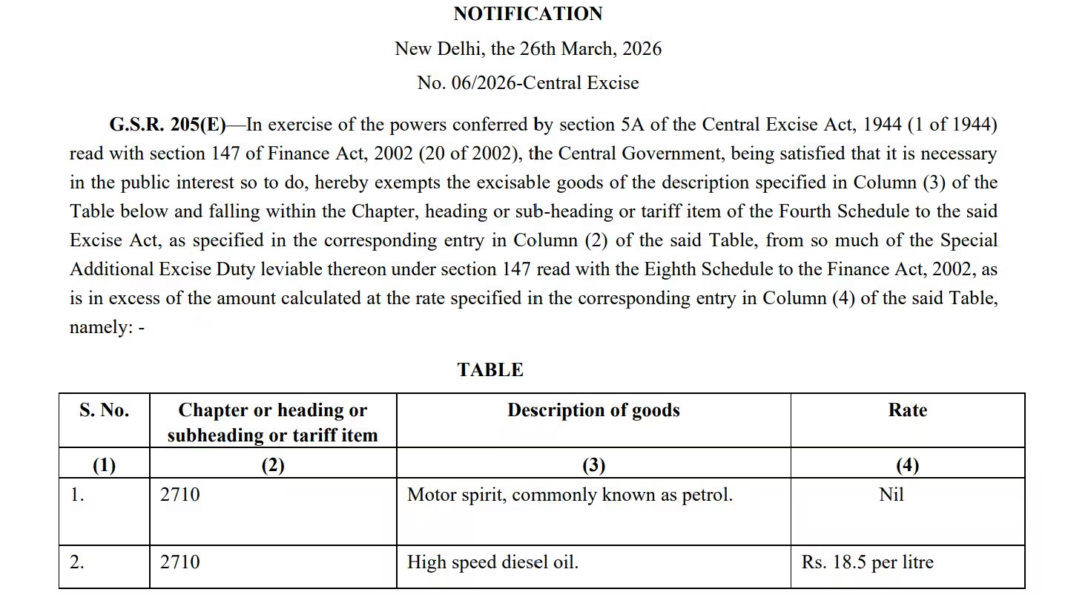
As per the notification, the SAED on petrol has been brought down to zero, while diesel (high-speed diesel) will now attract an SAED of ₹18.5 per litre in one category. The changes have been made through amendments to the central excise rules and came into effect immediately after the Gazette notification.
In view of the West Asia crisis, the central excise duty on petrol and diesel for domestic consumption has been reduced by ₹10 per litre each. This will provide protection to consumers from rise in prices. Hon. PM @narendramodi has always ensured that citizens are protected from…
— Nirmala Sitharaman (@nsitharaman) March 27, 2026
The government has also made changes in the duty structure of aviation turbine fuel. The SAED on ATF has been fixed at ₹50 per litre, but with certain exemptions, the effective rate is capped at ₹29.5 per litre in specific cases.
With global crude prices surging, many nations passed the burden to citizens. Bharat chose to protect its poor and middle income families.
— Ashwini Vaishnaw (@AshwiniVaishnaw) March 27, 2026
PM @narendramodi Ji has reduced excise duty on petrol and diesel by ₹10 per litre, while imposing export duties on diesel and ATF to secure…
“With global crude prices surging, many nations passed the burden to citizens. Bharat chose to protect its poor and middle income families. PM Modi has reduced excise duty on petrol and diesel by ₹10 per litre, while imposing export duties on diesel and ATF to secure domestic supply. Government has absorbed fiscal losses to provide relief to its people amid the global crisis”, Union Minister Ashwini Vaishnaw posted on X.
Despite these changes, there is no immediate expectation of a reduction in fuel prices at petrol pumps. The cutting of excise duty will help OMCs absorb price volatility in the international market and ease out any pressure to increase retail price for consumers.
In a post on X, oil minister Hardeep Singh Puri said, “International crude prices have gone through the roof in the last 1 month from around 70 dollars/barrel to around 122 dollars/barrel. Consequently, petrol and diesel prices for consumers have gone up all over the world.” He added that prices have increased by around 30%-50% in South East Asian countries, 30% in North American countries, 20% in Europe and 50% in African countries.
International crude prices have gone through the roof in the last 1 month from around 70 dollars/barrel to around 122 dollars/barrel. Consequently, petrol and diesel prices for consumers have gone up all over the world. Prices have increased by around 30%-50% in South East Asian…
— Hardeep Singh Puri (@HardeepSPuri) March 27, 2026
The minister said that the govt had two choices, either increase prices drastically or bear the brunt on its finances, adding that the Modi govt chose the second option to safeguard the Indian citizen. He added that oil companies are losing around ₹24 per litre of petrol and around ₹30 per litre of diesel due to hike in international oil prices.
Puri further said that all necessary steps are being taken to ensure uninterrupted availability of fuel, energy, and other critical supplies for our citizens. “We are fully prepared to handle emerging challenges,” he said.
Global oil prices have increased sharply due to the current situation in the Gulf region, where tensions have affected key oil supply routes like the Strait of Hormuz. This narrow waterway carries nearly one-fifth of the world’s oil and gas, and tensions in this region have already led to higher oil prices.
For a country like India, which is heavily dependent on imported crude oil, this is a concern. By reducing excise duties like SAED, the government aims to reduce the pressure on consumers and prevent a sharp rise in retail fuel prices, even when the global markets are unstable.
