

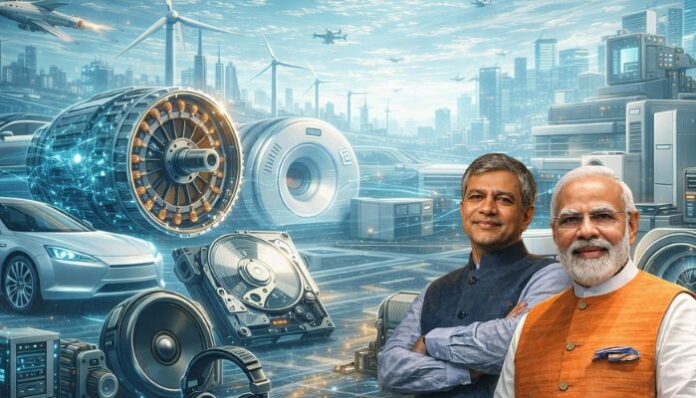
On 30th March, the Government of India approved 29 projects worth Rs 7,104 crore under the Electronic Component Manufacturing Scheme, with a strong emphasis on building domestic capabilities in critical technologies. Among the 29 projects, India’s first rare earth permanent magnet manufacturing unit has got the limelight. Notably, in November 2025, government had launched Rare Earth Magnet scheme worth Rs 7,280 crore aiming at reducing dependence on imports from China and other countries.
🚨~"India’s first rare earth magnet unit is approved today. The entire IP, Design, and R&D is done in India."
— Moneycontrol (@moneycontrolcom) March 30, 2026
~"61% of domestic demand of electronics to be met from locally made lithium ion batteries."
~"India will be able to meet 100 per cent demand in laminates segment. We… pic.twitter.com/tCVIovfEbV
Rare earth magnet unit marks strategic breakthrough
The government has approved a Rs 700 crore rare earth magnet facility. The unit will be established in Uttar Pradesh and has been awarded to Lohum Cleantech. According to Union Minister Ashwini Vaishnaw, it will use fully indigenous technology and intellectual property, making it strategically important.
The project is expected to strengthen India’s position across the refined mineral to magnet value chain. This specific segment is dominated by a few global suppliers, with China being the major one controlling approximately 90% of the market share. The government estimates that domestic production from such initiatives could meet around 25% of India’s rare earth magnet demand.
The move is not only crucial to reducing import dependence but also for sectors like electric vehicles, clean energy and defence, where rare earth magnets are indispensable.
Wider push towards component manufacturing
The approvals span 16 product segments that include lithium ion cells, flexible printed circuit boards, connectors and display modules. Eight states will get benefited from the projects, with Karnataka and Maharashtra in the lead.
The projects are expected to generate over 14,000 jobs and drive production worth Rs 84,515 crore. The broader ECMS programme has now seen total approved investments of Rs 61,671 crore, with projections of Rs 4.51 lakh crore in cumulative output.
Vaishnaw said India is transitioning from assembling finished products to manufacturing core components, calling it a shift towards building the “heart” of electronic devices.
Reducing import dependence, boosting exports
According to media reports, the government projects 50% localisation in PCBs and 61% in lithium ion batteries. Capacitor demand fulfilment is expected to rise to 61%, while relays could achieve full domestic supply with export potential.
