

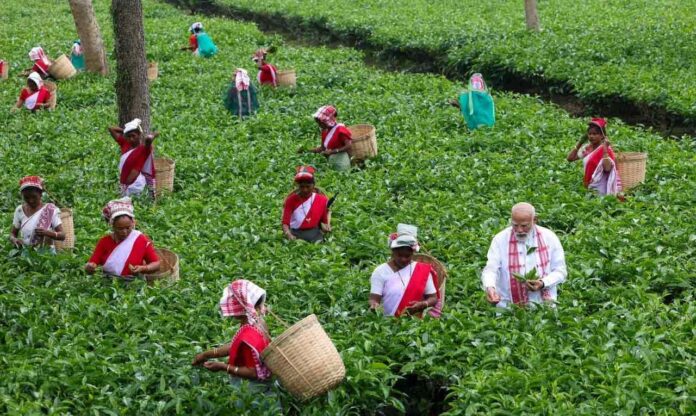
Prime Minister Narendra Modi visited the Manohari Tea Estate in Dibrugarh district this morning, where he plucked tea leaves with women workers, interacted warmly with them, and witnessed vibrant cultural performances that highlighted the deep-rooted traditions of Assam’s tea communities.
In a series of posts on X, the Prime Minister described the visit as deeply memorable. “Tea is the soul of Assam! The tea from here has made its way across the world,” he wrote. “This morning in Dibrugarh, I went to a tea garden and interacted with women working here. It was a very memorable experience.” He shared photographs capturing the lush green plantations and his engagement with the workers.
Tea is the soul of Assam! The tea from here has made its way across the world.
— Narendra Modi (@narendramodi) April 1, 2026
This morning in Dibrugarh, I went to a tea garden and interacted with women working here. It was a very memorable experience. pic.twitter.com/2VZufAAZ0h
Further posts by the PM detailed the warmth of the occasion. “We are very proud of the efforts of each and every tea garden family. Their hard work and perseverance have enhanced Assam’s pride,” he noted, posting additional glimpses from the estate.
We are very proud of the efforts of each and every tea garden family. Their hardwork and perseverance have enhanced Assam’s pride.
— Narendra Modi (@narendramodi) April 1, 2026
Here are some more glimpses from a tea garden in Dibrugarh. pic.twitter.com/L7je3s8JnO
PM Modi plucked tea leaves with the workers, which was followed by the women sharing stories of their culture and taking selfies with him. The women workers welcomed the Prime Minister with songs and traditional dances. They performed a soulful song paying homage to Jagat Janani Maa, showcasing their strong connection to their cultural roots even amid daily toil in the gardens.
“It is amazing how they remain so connected with their culture and roots,” PM Modi wrote. The lively singing and dancing created a festive atmosphere, reflecting the spirit and resilience of Assam’s tea communities.
The women at the tea garden in Dibrugarh sang a song, which pays homage to Jagat Janani Maa. It is amazing how they remain so connected with their culture and roots. pic.twitter.com/sBDEklAqxI
— Narendra Modi (@narendramodi) April 1, 2026
Assam is the heartland of Indian tea, producing more than half of the country’s total output from over 3.59 lakh hectares of plantations. The sector directly employs around seven lakh workers, a large number of them women, and supports many more in ancillary activities. Renowned worldwide for its bold, robust flavour, Assam tea remains a global favourite and a cornerstone of the state’s economy and identity.
The Assam government has taken several steps to revive and strengthen the tea industry amid challenges such as fluctuating prices, climate impacts, and the need for modernisation. Under the Assam Tea Industries Special Incentive Scheme (ATISIS), the state recently released ₹94.70 crore to support 486 tea gardens. The scheme offers interest subvention on working capital loans, a ₹10 per kg subsidy on orthodox and speciality tea production, subsidies for plant and machinery, and an agricultural income tax holiday extended up to financial year 2026-27. These measures aim to improve financial stability, encourage quality production, and promote exports.
Complementing state efforts, the central Tea Board’s Tea Development and Promotion Scheme has supported replantation across hundreds of hectares in Assam, the formation of self-help groups and farmer-producer organisations, the setting up of mini tea factories, organic conversion of plantations, and extensive capacity-building programmes for workers and small growers.
The Himanta Biswa Sarma government has also started to give land rights to tea workers. For over two centuries, tea workers lived in residential “labour lines” inside tea estates, owned by the estate. As a result, the tea workers could not avail facilities like bank loans.
Together, these initiatives seek to boost productivity, enhance quality, and ensure better livelihoods for those who sustain Assam’s iconic tea legacy.
