

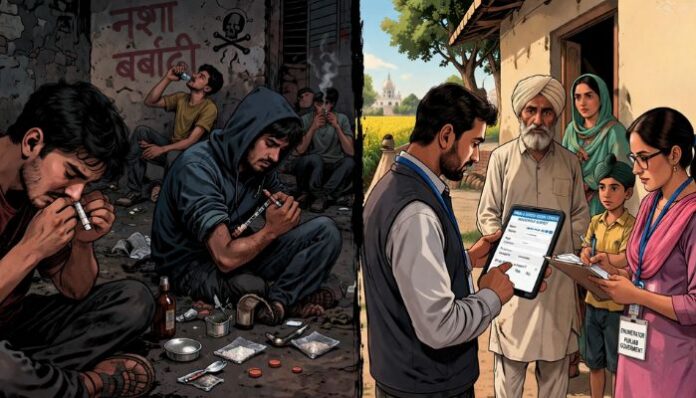
The Punjab Government has launched its first-ever Drug and Socio-Economic Census. Around 28,000 employees have been deployed to conduct a door-to-door survey across 65 lakh families. The exercise is aimed at generating granular, household-level data on drug abuse and the impact on socio-economic status.
In a statement, Chief Minister of Punjab, Bhagwant Mann, asserted that the objective of the exercise is to understand the drug problem in detail and assess the income, education and overall socio-economic status of addicts and their families. He added that the data would enable targeted policymaking focused on treatment and rehabilitation for better outcomes.
The development came at a time when Punjab is only a year away from Assembly polls scheduled in the first quarter of 2027.
Massive exercise with three-month timeline
The state government has set a deadline of three months to complete the exercise. Rs 250 crore have been earmarked in the 2026-27 financial year for the same. Each volunteer has been assigned a block and will cover around 250 households through a structured door-to-door process.
Deputy Commissioners have been made overall in-charges at the district level. Block Development Officers or BDOs in rural areas and secretary-cum-executive officers in urban wards will supervise the exercise. Furthermore, recruited volunteers, government officials and outsourced employees have been deployed as enumerators.
Smartphones diverted for census work
In an interesting move, the state has diverted 28,515 high-end 5G smartphones for the survey. These phones were procured under the Centre’s Mission Saksham Anganwadi and Poshan 2.0 scheme. Once the census is completed, these phones are expected to be handed over to Anganwadi workers.
Shift from enforcement to rehabilitation
Officials claimed that this census would help identify the extent of drug abuse in the state. Furthermore, it will reveal information about what kind of substances are used by addicts along with demographic and socio-economic indicators including age, education and income levels.
Earlier, for four years, the state government’s focus remained on enforcement. In March 2025, the state launched the “Yudh Nasheyan Virudh” campaign. The state has claimed that 56,372 drug smugglers were arrested and 39,760 FIRs were registered as part of the campaign. Furthermore, 2,458 kg of heroin, along with other narcotics including opium, charas, ganja, ICE, poppy husk and intoxicant pills, were seized. Despite the large-scale arrests and FIRs in one year of the campaign, the drug problem has remained a prominent issue in the state.
Pilot findings and public response
Reportedly, a pilot survey was conducted in 11 villages. Villagers showed willingness to share the information with officials despite concerns about social stigma. Officials claimed that families appeared eager to cooperate and viewed the exercise as an opportunity to address the drug menace more effectively.
Not to forget, while campaigning for the 2017 Assembly elections, Aam Aadmi Party leaders including Arvind Kejriwal and Bhagwant Mann promised to eradicate the drug problem from the state. The drug menace in Punjab has been a prominent political issue for a very long time, which all parties have included in their election campaigns.
