

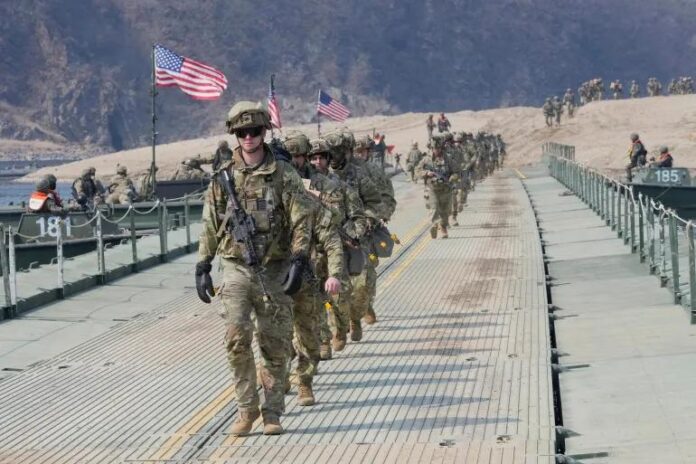
The United States military is reportedly weighing one of its most audacious contingency plans yet, physically seizing Iran’s uranium stockpile, after a directive from Donald Trump, according to a report by The Washington Post.
What’s being discussed is not a precision strike or remote sabotage, but a boots-on-the-ground operation of staggering scale. The plan envisions deploying hundreds, possibly thousands, of American troops deep inside Iranian territory to locate, secure, and extract highly sensitive nuclear material.
What the plan entails
At the heart of the proposal are heavily fortified nuclear sites such as Isfahan Nuclear Facility and Natanz Nuclear Facility. These locations are believed to house over 1,000 pounds of enriched uranium, much of it now buried under rubble following earlier airstrikes, complicating access and dramatically increasing operational risk.
This would not resemble a conventional military strike. Instead, it would be a painstaking, ground-intensive mission carried out in hostile terrain, requiring not just firepower but precision, coordination, and endurance. As one former special operations expert put it, the task would be “slow, meticulous, and potentially deadly at every step.”
Another former defence official offered a telling analogy: this isn’t like targeting a single asset; it’s akin to “taking control of the entire assembly line,” underscoring the complexity of securing and transporting nuclear material under combat conditions.
Why is it so risky
Beyond the obvious geopolitical fallout, the operational hazards are immense. Extracting radioactive material from damaged, fortified facilities in an active conflict zone presents both tactical and environmental dangers. Any misstep could escalate into a broader confrontation or trigger a radiological crisis.
Retired US General Joseph Votel acknowledged that while such a mission is technically feasible, it carries “a lot of risks.” He suggested that the International Atomic Energy Agency would be far better suited to handle uranium removal, ideally under a ceasefire framework rather than through military force.
The bigger picture
If pursued, this operation would mark a dramatic escalation, not just in US-Iran tensions, but in how nuclear threats are handled globally. Moving from deterrence and diplomacy to direct seizure of nuclear assets would set a precedent with far-reaching consequences, both strategic and legal.
