

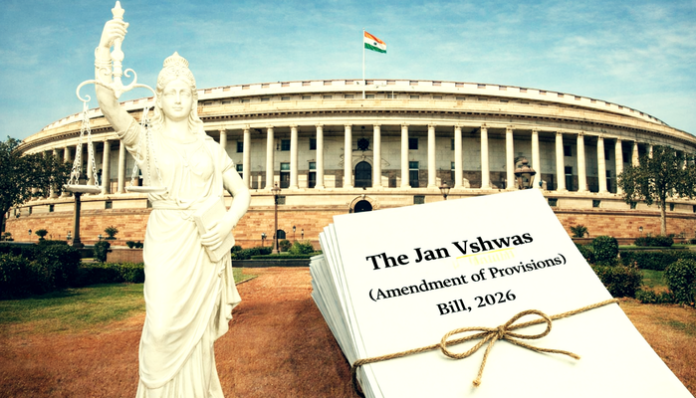
The Parliament on Thursday (2nd April) passed the Jan Vishwas (Amendment of Provisions) Bill, 2026, which decriminalises minor offences, removes redundant provisions and streamlines compliance across different sectors for improving the regulatory framework. The legislation, proposed by Minister of State for Commerce and Industry, Shri Jitin Prasada, in the Lok Sabha, marks a significant achievement in the government’s efforts to promote Ease of Doing Business and Ease of Living.
Simplifying systems, empowering people.
— Kiren Rijiju (@KirenRijiju) April 3, 2026
The #JanVishwasBill2026 is a milestone reform that reduces compliance burden & promotes a more transparent, enabling ecosystem.
A big boost for citizens, MSMEs, startups & small businesses under the leadership of Hon’ble PM Shri… pic.twitter.com/ahiTxSdBjQ
Expressing pleasure over the passing of the Bill in the Parliament, Prime Minister Modi said that the Bill “strengthens a trust-based framework that empowers our citizens”. “A big boost to ‘Ease of Living’ and ‘Ease of Doing Business’…It’s a matter of immense delight that Parliament has passed the Jan Vishwas (Amendment of Provisions) Bill 2026. This Bill strengthens a trust-based framework that empowers our citizens. It marks the end of rules and regulations that are outdated. At the same time, it ensures speedy disposal of cases and reduces litigation burden with decriminalisation. What is also noteworthy is the consultative approach with which this Bill was drafted. My compliments to all those who have given their insights towards the drafting of the Bill and supported it in Parliament,” PM Modi posted on X.
A big boost to ‘Ease of Living’ and ‘Ease of Doing Business’…
— Narendra Modi (@narendramodi) April 2, 2026
It’s a matter of immense delight that Parliament has passed the Jan Vishwas (Amendment of Provisions) Bill 2026. This Bill strengthens a trust-based framework that empowers our citizens. It marks the end of rules and…
The legislation has amended 784 provisions of 79 Central Acts administered by 23 Ministries, decriminalised 717 provisions to promote Ease of Doing Business, and 67 provisions to facilitate Ease of Living. Besides, it has rationalised over 1000 offences, including several outdated and redundant provisions, to streamline the overall regulatory framework.
Reduced penalties and criminal liability, and time-bound disposal of cases
The new law has gotten rid of criminal penalties for minor, technical, or procedural defaults and replaced them with civil and administrative enforcement mechanisms. It has replaced imprisonment with monetary penalties or warnings, introduced graded enforcement mechanisms, including warnings for first-time contraventions, and rationalised fines and penalties in proportion to the nature of the offence.
For example, under the Drugs and Cosmetics Act, 1940, violations that previously attracted up to one year imprisonment will now attract civil penalties only, and offences under the National Highways Act, 1956, which previously carried criminal punishment, will now be punishable with financial penalties.
Sections that called for imprisonment under the Indian Succession Act and the Electricity Act, 2003, have been done away with, and provisions carrying higher fines have substituted them. The offences eliminated by the law include giving a false fire alarm under the Delhi Police Act, 1978, and failing to report births or deaths under the Delhi Municipal Corporation Act, 1957. The law has made 67 amendments under the New Delhi Municipal Council Act, 1994 and the Motor Vehicles Act, 1988. It has simplified procedures and enhanced the convenience of citizens in several areas, including municipal taxation and vehicle-related compliance.
For time-bound implementation of its provisions, speedy disposal of cases and reduction of litigation burden on courts, the law provides for the appointment of Adjudicating Officers and the establishment of appellate authorities, with a 60-day disposal deadline.
How the legislation came into existence
The Bill was prepared through a comprehensive consultative process involving Inter‑Ministerial Committee meetings, High‑Level Committee meetings under NITI Aayog, interactions with industry associations, and civil society organisations. It was made with the aim of creating a trust-based legal and compliance environment, where citizens are not subjected to criminal sanctions for minor non-compliance. The law intends to enhance compliance, promote investment, and strengthen economic growth by reducing criminal liability and simplifying regulatory processes.
The Jan Vishwas (Amendment of Provisions) Bill, 2026, is built on the initiative started with the Jan Vishwas Act, 2023, which decriminalised 183 provisions in 42 Central Acts administered by 19 Ministries/ Departments. In continuation of the initiative, the Jan Vishwas (Amendment of Provisions) Bill, 2025, was introduced in the Lok Sabha on August 18, 2025. The 2025 Bill proposed amendments to 355 provisions across 16 Central Acts administered by 10 Ministries/Departments and was referred to a Select Committee.
The Select Committee, headed by the member of Parliament, Tejasvi Surya, after holding 49 sittings with committee members, participating Ministries, external stakeholders, and subject‑matter experts, submitted its report to the Lok Sabha on March 13, 2026. Following the extensive consultations and further examination of additional provisions, the committee recommended the decriminalisation of 62 additional Central Acts. Subsequently, the 2025 Bill was withdrawn, and the Jan Vishwas (Amendment of Provisions) Bill, 2026 was introduced in the Lok Sabha.
