

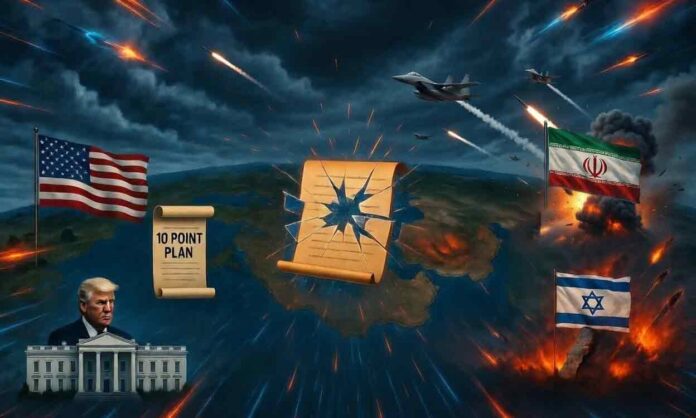
Serious differences have surfaced in the fragile two-week ceasefire between the United States and Iran, with the White House stating that the 10-point proposal publicly released by Tehran differs from the version discussed in negotiations, while President Donald Trump has explicitly said the deal does not cover Lebanon.
The ceasefire, reportedly brokered by Pakistan and announced earlier today, was intended to halt US strikes on Iran in exchange for Tehran reopening the Strait of Hormuz, with talks scheduled to begin in Islamabad on Friday. President Trump initially described Iran’s 10-point plan as a “workable basis on which to negotiate”.
After the announcement, Iran published what it presented as the full 10-point framework, which includes demands such as the lifting of all sanctions, US withdrawal from the region, compensation for war damage, and acceptance of Iran’s uranium enrichment programme. However, now the USA has rejected this plan, saying that this 10-point plan is different from what was discussed. A senior White House official told reporters that the publicly released points “do not match” what President Trump had referred to, describing the leaked version as containing “maximalist demands” that had not been agreed.
In a further sign of strain, Donald Trump stated that the ceasefire agreement does not extend to Lebanon, where Israeli forces continue operations against Hezbollah. Talking to a journalist, Trump said that the Israel-Lebanon conflict is a “separate skirmish”, and Lebanon was not included because of Hezbollah.
A few minutes after the Pentagon briefing wrapped I spoke with President Trump briefly to ask about the latest with Iran: pic.twitter.com/tW0nYD1Vcs
— Liz Landers (@ElizLanders) April 8, 2026
When asked whether he supports Israel’s continued operations against Hezbollah, Trump said, “It’s part of the deal – everyone knows that. That’s a separate skirmish.”
Israeli Prime Minister Benjamin Netanyahu’s office had already made the same position clear, stressing that the truce applies only to direct US-Iran hostilities and does not extend to Lebanon.
The comments contradict an announcement by Pakistan’s Prime Minister Shehbaz Sharif. In a post on X, Sharif declared that Iran, the US and their allies had agreed to “an immediate ceasefire everywhere including Lebanon and elsewhere, EFFECTIVE IMMEDIATELY”. He also invited delegations to Islamabad for further talks.
With the greatest humility, I am pleased to announce that the Islamic Republic of Iran and the United States of America, along with their allies, have agreed to an immediate ceasefire everywhere including Lebanon and elsewhere, EFFECTIVE IMMEDIATELY.
— Shehbaz Sharif (@CMShehbaz) April 7, 2026
I warmly welcome the…
However, now both President Trump and PM Netanyahu have rejected his claims, clarifying that ending Israeli operations against Hezbollah in Lebanon is not part of the ceasefire agreement.
Iran has reportedly told mediators with the US that it will only participate in talks in Pakistan if the current ceasefire includes Lebanon. Iranian officials said that Iran will continue to strike Gulf nations and Israel, and keep the Strait of Hormuz of Israel does not end its operations against Hezbollah in Lebanon.
The discrepancy over Lebanon has heightened concerns about the truce’s viability. Iranian officials have warned that Iran will withdraw from the ceasefire if Israel continues strikes on Hezbollah in Lebanon. Israeli operations in Beirut and southern Lebanon have intensified in the past 24 hours.
While Iran was supposed to open the Strait of Hormuz as part of the agreement, the opposite has happened, and transit of ships through the strait has stopped completely. The Fars News Agency said “oil tankers have been suspended from passing through the Strait of Hormuz” in response to the Israeli assault in Lebanon. Similarly, Iranian missile strikes on Gulf nations continued today.
